

[Mar 19, 2026] Fully Updated AZ-204 Dumps - 100% Same Q&A In Your Real Exam
Latest AZ-204 Exam Dumps - Valid and Updated Dumps
NEW QUESTION # 229
You need to ensure that validation testing is triggered per the requirements.
How should you complete the code segment? To answer, select the appropriate values in the answer area.
NOTE: Each correct selection is worth one point.
Answer:
Explanation:
Explanation
Box 1: RepositoryUpdated
When a new version of the ContentAnalysisService is available the previous seven days of content must be processed with the new version to verify that the new version does not significantly deviate from the old version.
Box 2: service
Box 3: imageCollection
Reference:
https://docs.microsoft.com/en-us/azure/devops/notifications/oob-supported-event-types
NEW QUESTION # 230
You are developing a new page for a website that uses Azure Cosmos DB for data storage. The feature uses documents that have the following format:
You must display data for the new page in a specific order. You create the following query for the page:
You need to configure a Cosmos DB policy to the support the query.
How should you configure the policy? To answer, drag the appropriate JSON segments to the correct locations. Each JSON segment may be used once, more than once, or not at all. You may need to drag the split bar between panes or scroll to view content.
NOTE: Each correct selection is worth one point.
Answer:
Explanation:
NEW QUESTION # 231
You are Implementing an Azure solution that uses Azure Cosmos DB and the latest Azure Cosmos DB SDK.
You add a change feed processor to a new container instance.
You attempt to lead a batch of 100 documents. The process falls when reading one of the documents. The solution must monitor the progress of the change feed processor instance on the new container as the change feed is read. You must prevent the change feed processor from retrying the entire batch when one document cannot be read.
You need to implement the change feed processor to read the documents.
Which features should you use? To answer, drag the appropriate features to the correct requirements. Each feature may be used once, More than once, or not at all. You may need to drag The split bat between panes or scroll to view content Each correct selection is worth one point
Answer:
Explanation:
Explanation:
NEW QUESTION # 232
You develop and deploy an Azure Logic App that calls an Azure Function app. The Azure Function App includes an OpenAPI (Swagger) definition and uses an Azure Blob storage account. All resources are secured by using Azure Active Directory (Azure AD).
The Logic App must use Azure Monitor logs to record and store information about runtime data and events.
The logs must be stored in the Azure Blob storage account.
You need to set up Azure Monitor logs and collect diagnostics data for the Azure Logic App.
Which three actions should you perform in sequence? To answer, move the appropriate actions from the list of actions to the answer area and arrange them in the correct order.
Answer:
Explanation:
Explanation:
Step 1: Create a Log Analytics workspace
Before you start, you need a Log Analytics workspace.
Step 2: Install the Logic Apps Management solution
To set up logging for your logic app, you can enable Log Analytics when you create your logic app, or you can install the Logic Apps Management solution in your Log Analytics workspace for existing logic apps.
Step 3: Add a diagnostic setting to the Azure Logic App
Set up Azure Monitor logs
* In the Azure portal, find and select your logic app.
* On your logic app menu, under Monitoring, select Diagnostic settings > Add diagnostic setting.
Reference:
https://docs.microsoft.com/en-us/azure/logic-apps/monitor-logic-apps-log-analytics
NEW QUESTION # 233
You develop a gateway solution for a public facing news API.
The news API back end is implemented as a RESTful sen/ice and hosted in an Azure App Service instance.
You need to configure back-end authentication for the API Management service instance.
Which target and gateway credential type should you use? To answer, drag the appropriate values to the correct parameters. Each value may be used once, more than once, or not at all. You may need to drag the split bar between panes or scroll to view content.
NOTE: Each correct selection is worth one point.
Answer:
Explanation:
Explanation
Box 1: Azure Resource
Box 2: Client cert
API Management allows to secure access to the back-end service of an API using client certificates.
References:
https://docs.microsoft.com/en-us/rest/api/apimanagement/apimanagementrest/azure-api-management-rest-api-ba
NEW QUESTION # 234
You are developing a back-end Azure App Service that scales based on the number of messages contained in a Service Bus queue.
A rule already exists to scale up the App Service when the average queue length of unprocessed and valid queue messages is greater than 1000.
You need to add a new rule that will continuously scale down the App Service as long as the scale up condition is not met.
How should you configure the Scale rule? To answer, select the appropriate options in the answer area.
NOTE: Each correct selection is worth one point.
Answer:
Explanation:
Explanation

Box 1: Service bus queue
You are developing a back-end Azure App Service that scales based on the number of messages contained in a Service Bus queue.
Box 2: ActiveMessage Count
ActiveMessageCount: Messages in the queue or subscription that are in the active state and ready for delivery.
Box 3: Count
Box 4: Less than or equal to
You need to add a new rule that will continuously scale down the App Service as long as the scale up condition is not met.
Box 5: Decrease count by
NEW QUESTION # 235
You develop software solutions for a mobile delivery service. You are developing a mobile app that users can use to order from a restaurant in their are a. The app uses the following workflow:
A driver selects the restaurants from which they will deliver orders.
Orders are sent to all available drivers in an area.
Only orders for the selected restaurants will appear for the driver.
The first driver to accept an order removes it from the list of available orders.
You need to implement an Azure Service Bus solution.
Which three actions should you perform in sequence? To answer, move the appropriate actions from the list of actions to the answer area and arrange them in the correct order.
Answer:
Explanation:
Reference:
https://docs.microsoft.com/en-us/azure/service-bus-messaging/service-bus-messaging-overview
NEW QUESTION # 236
A company is developing a solution that allows smart refrigerators to send temperature information to a central location. You have an existing Service Bus.
The solution must receive and store message until they can be processed. You create an Azure Service Bus Instance by providing a name, pricing tier, subscription, resource group, and location.
You need to complete the configuration.
Which Azure CLI or PowerShell command should you run?
- A. Option D
- B. Option A
- C. Option C
- D. Option B
Answer: B
Explanation:
Explanation
A service bus instance has already been created (Step 2 below). Next is step 3, Create a Service Bus queue.
Note:
Steps:
Step 1: # Create a resource group
resourceGroupName="myResourceGroup"
az group create --name $resourceGroupName --location eastus
Step 2: # Create a Service Bus messaging namespace with a unique name
namespaceName=myNameSpace$RANDOM
az servicebus namespace create --resource-group $resourceGroupName --name $namespaceName --location eastus Step 3: # Create a Service Bus queue az servicebus queue create --resource-group $resourceGroupName --namespace-name $namespaceName
--name BasicQueue
Step 4: # Get the connection string for the namespace
connectionString=$(az servicebus namespace authorization-rule keys list --resource-group
$resourceGroupName --namespace-name $namespaceName --name RootManageSharedAccessKey --query primaryConnectionString --output tsv) Reference:
https://docs.microsoft.com/en-us/azure/service-bus-messaging/service-bus-quickstart-cli
NEW QUESTION # 237
You develop an ASP.NET Core MVC application. You configure the application to track webpages and custom events.
You need to identify trends in application usage.
Which Azure Application Insights Usage Analysis features should you use? To answer, drag the appropriate features to the correct requirements. Each feature may be used once, more than once, or not at all. You may need to drag the split bar between panes or scroll to view content.
NOTE: Each correct selection is worth one point.
Answer:
Explanation:
Box1: Users
Box 2: Impact
One way to think of Impact is as the ultimate tool for settling arguments with someone on your team about how slowness in some aspect of your site is affecting whether users stick around. While users may tolerate a certain amount of slowness, Impact gives you insight into how best to balance optimization and performance to maximize user conversion.
Box 3: Retention
The retention feature in Azure Application Insights helps you analyze how many users return to your app, and how often they perform particular tasks or achieve goals. For example, if you run a game site, you could compare the numbers of users who return to the site after losing a game with the number who return after winning. This knowledge can help you improve both your user experience and your business strategy.
Box 4: User flows
The User Flows tool visualizes how users navigate between the pages and features of your site. It's great for answering questions like:
How do users navigate away from a page on your site?
What do users click on a page on your site?
Where are the places that users churn most from your site?
Are there places where users repeat the same action over and over?
References:
https://docs.microsoft.com/en-us/azure/azure-monitor/app/usage-impact
NEW QUESTION # 238
You need to configure the ContentUploadService deployment.
Which two actions should you perform? Each correct answer presents part of the solution.
NOTE: Each correct selection is worth one point.
- A. Add the following markup to line CS23:
types: Private - B. Add the following markup to line CS23:
types: Public - C. Add the following markup to line CS24:
osType: Windows - D. Add the following markup to line CS24:
osType: Linux
Answer: A,D
Explanation:
Scenario: All Internal services must only be accessible from Internal Virtual Networks (VNets) There are three Network Location types - Private, Public and Domain Reference:
https://devblogs.microsoft.com/powershell/setting-network-location-to-private/
Topic 1, Contoso, Ltd
Case study
This is a case study. Case studies are not timed separately. You can use as much exam time as you would like to complete each case. However, there may be additional case studies and sections on this exam. You must manage your time to ensure that you are able to complete all questions included on this exam in the time provided.
To answer the questions included in a case study, you will need to reference information that is provided in the case study. Case studies might contain exhibits and other resources that provide more information about the scenario that is described in the case study. Each question is independent of the other questions in this case study.
At the end of this case study, a review screen will appear. This screen allows you to review your answers and to make changes before you move to the next section of the exam. After you begin a new section, you cannot return to this section.
To start the case study
To display the first question in this case study, click the Next button. Use the buttons in the left pane to explore the content of the case study before you answer the questions. Clicking these buttons displays information such as business requirements, existing environment, and problem statements. When you are ready to answer a question, click the Question button to return to the question.
Background
Overview
You are a developer for Contoso, Ltd. The company has a social networking website that is developed as a Single Page Application (SPA). The main web application for the social networking website loads user uploaded content from blob storage.
You are developing a solution to monitor uploaded data for inappropriate content. The following process occurs when users upload content by using the SPA:
* Messages are sent to ContentUploadService.
* Content is processed by ContentAnalysisService.
* After processing is complete, the content is posted to the social network or a rejection message is posted in its place.
The ContentAnalysisService is deployed with Azure Container Instances from a private Azure Container Registry named contosoimages.
The solution will use eight CPU cores.
Azure Active Directory
Contoso, Ltd. uses Azure Active Directory (Azure AD) for both internal and guest accounts.
Requirements
ContentAnalysisService
The company's data science group built ContentAnalysisService which accepts user generated content as a string and returns a probable value for inappropriate content. Any values over a specific threshold must be reviewed by an employee of Contoso, Ltd.
You must create an Azure Function named CheckUserContent to perform the content checks.
Costs
You must minimize costs for all Azure services.
Manual review
To review content, the user must authenticate to the website portion of the ContentAnalysisService using their Azure AD credentials. The website is built using React and all pages and API endpoints require authentication. In order to review content a user must be part of a ContentReviewer role. All completed reviews must include the reviewer's email address for auditing purposes.
High availability
All services must run in multiple regions. The failure of any service in a region must not impact overall application availability.
Monitoring
An alert must be raised if the ContentUploadService uses more than 80 percent of available CPU cores.
Security
You have the following security requirements:
* Any web service accessible over the Internet must be protected from cross site scripting attacks.
* All websites and services must use SSL from a valid root certificate authority.
* Azure Storage access keys must only be stored in memory and must be available only to the service.
* All Internal services must only be accessible from internal Virtual Networks (VNets).
* All parts of the system must support inbound and outbound traffic restrictions.
* All service calls must be authenticated by using Azure AD.
User agreements
When a user submits content, they must agree to a user agreement. The agreement allows employees of Contoso, Ltd. to review content, store cookies on user devices, and track user's IP addresses.
Information regarding agreements is used by multiple divisions within Contoso, Ltd.
User responses must not be lost and must be available to all parties regardless of individual service uptime.
The volume of agreements is expected to be in the millions per hour.
Validation testing
When a new version of the ContentAnalysisService is available the previous seven days of content must be processed with the new version to verify that the new version does not significantly deviate from the old version.
Issues
Users of the ContentUploadService report that they occasionally see HTTP 502 responses on specific pages.
Code
ContentUploadService

NEW QUESTION # 239
You are maintaining an existing application that uses an Azure Blob GPv1 Premium storage account. Data older than three months is rarely used.
Data newer than three months must be available immediately. Data older than a year must be saved but does not need to be available immediately.
You need to configure the account to support a lifecycle management rule that moves blob data to archive storage for data not modified in the last year.
Which three actions should you perform in sequence? To answer, move the appropriate actions from the list of actions to the answer area and arrange them in the correct order.
Answer:
Explanation:
Explanation
Step 1: Upgrade the storage account to GPv2
Object storage data tiering between hot, cool, and archive is supported in Blob Storage and General Purpose v2 (GPv2) accounts. General Purpose v1 (GPv1) accounts don't support tiering.
You can easily convert your existing GPv1 or Blob Storage accounts to GPv2 accounts through the Azure portal.
Step 2: Copy the data to be archived to a Standard GPv2 storage account and then delete the data from the original storage account Step 3: Change the storage account access tier from hot to cool Note: Hot - Optimized for storing data that is accessed frequently.
Cool - Optimized for storing data that is infrequently accessed and stored for at least 30 days.
Archive - Optimized for storing data that is rarely accessed and stored for at least 180 days with flexible latency requirements, on the order of hours.
Only the hot and cool access tiers can be set at the account level. The archive access tier can only be set at the blob level.
Reference:
https://docs.microsoft.com/en-us/azure/storage/blobs/storage-blob-storage-tiers
NEW QUESTION # 240
Note: This question is part of a series of questions that present the same scenario. Each question in the series contains a unique solution that might meet the stated goals. Some question sets might have more than one correct solution, while others might not have a correct solution.
After you answer a question in this question, you will NOT be able to return to it. As a result, these questions will not appear in the review screen.
You are developing a website that will run as an Azure Web App. Users will authenticate by using their Azure Active Directory (Azure AD) credentials.
You plan to assign users one of the following permission levels for the website: admin, normal, and reader. A user's Azure AD group membership must be used to determine the permission level. You need to configure authorization.
Solution: Configure the Azure Web App for the website to allow only authenticated requests and require Azure AD log on.
Does the solution meet the goal?
- A. No
- B. Yes
Answer: A
Explanation:
Instead in the Azure AD application's manifest, set value of the groupMembershipClaims option to All.
https://blogs.msdn.microsoft.com/waws/2017/03/13/azure-app-service-authentication-aad-groups/
NEW QUESTION # 241
You develop an ASP.NET Core MVC application. You configure the application to track webpages and custom events.
You need to identify trends in application usage.
Which Azure Application Insights Usage Analysis features should you use? To answer, drag the appropriate features to the correct requirements. Each feature may be used once, more than once, or not at all. You may need to drag the split bar between panes or scroll to view content.
NOTE: Each correct selection is worth one point.
Answer:
Explanation:
Box1: Users
Box 2: Impact
One way to think of Impact is as the ultimate tool for settling arguments with someone on your team about how slowness in some aspect of your site is affecting whether users stick around. While users may tolerate a certain amount of slowness, Impact gives you insight into how best to balance optimization and performance to maximize user conversion.
Box 3: Retention
The retention feature in Azure Application Insights helps you analyze how many users return to your app, and how often they perform particular tasks or achieve goals. For example, if you run a game site, you could compare the numbers of users who return to the site after losing a game with the number who return after winning. This knowledge can help you improve both your user experience and your business strategy.
Box 4: User flows
The User Flows tool visualizes how users navigate between the pages and features of your site. It's great for answering questions like:
How do users navigate away from a page on your site?
What do users click on a page on your site?
Where are the places that users churn most from your site?
Are there places where users repeat the same action over and over?
References:
https://docs.microsoft.com/en-us/azure/azure-monitor/app/usage-impact
NEW QUESTION # 242
You create the following PowerShell script:
For each of the following statements, select Yes if the statement is true. Otherwise, select No, NOTE: Each correct selection is worth one point.
Answer:
Explanation:
Explanation:
Box 1: No
The AzScheduledQueryRuleSource is Heartbeat, not CPU.
Box 2: Yes
The AzScheduledQueryRuleSource is Heartbeat!
Note: New-AzScheduledQueryRuleTriggerCondition creates an object of type Trigger Condition. This object is to be passed to the command that creates Alerting Action object.
Box 3: No
The schedule is 60 minutes, not two hours.
-FrequencyInMinutes: The alert frequency.
-TimeWindowInMinutes: The alert time window
The New-AzAscheduledQueryRuleSchedule command creates an object of type Schedule. This object is to be passed to the command that creates Log Alert Rule.
Reference:
https://docs.microsoft.com/en-us/powershell/module/az.monitor/new-azscheduledqueryrule
https://docs.microsoft.com/en-us/powershell/module/az.monitor/new-azscheduledqueryruletriggercondition
NEW QUESTION # 243
Note: This question is part of a series of questions that present the same scenario. Each question in the series contains a unique solution. Determine whether the solution meets the stated goals.
You are developing and deploying several ASP.Net web applications to Azure App Service. You plan to save session state information and HTML output. You must use a storage mechanism with the following requirements:
* Share session state across all ASP.NET web applications
* Support controlled, concurrent access to the same session state data for multiple readers and a single writer
* Save full HTTP responses for concurrent requests
You need to store the information.
Proposed Solution: Add the web applications to Docker containers. Deploy the containers. Deploy the containers to Azure Kubernetes Service (AKS).
Does the solution meet the goal?
- A. No
- B. Yes
Answer: A
Explanation:
Instead use Azure Cache for Redis.
Note: Azure Cache for Redis provides a session state provider that you can use to store your session state in-memory with Azure Cache for Redis instead of a SQL Server database. To use the caching session state provider, first configure your cache, and then configure your ASP.NET application for cache using the Azure Cache for Redis Session State NuGet package.
https://docs.microsoft.com/en-us/azure/azure-cache-for-redis/cache-aspnet-session-state-provider
NEW QUESTION # 244
You have a single page application (SPA) web application that manages information based on data returned by Microsoft Graph from another company's Azure Active Directory (Azure AD) instance.
Users must be able to authenticate and access Microsoft Graph by using their own company's Azure AD instance.
You need to configure the application manifest for the app registration.
How should you complete the manifest? To answer, select the appropriate options in the answer area.
NOTE: Each correct selection is worth one point.
Answer:
Explanation:
Explanation:
Box 1: true
The oauth2AllowImplicitFlow attribute Specifies whether this web app can request OAuth2.0 implicit flow access tokens. The default is false. This flag is used for browser-based apps, like JavaScript single-page apps.
In implicit flow, the app receives tokens directly from the Azure Active Directory (Azure AD) authorize endpoint, without any server-to-server exchange. All authentication logic and session handling is done entirely in the JavaScript client with either a page redirect or a pop-up box.
Box 2: requiredResourceAccess
With dynamic consent, requiredResourceAccess drives the admin consent experience and the user consent experience for users who are using static consent. However, this parameter doesn't drive the user consent experience for the general case.
resourceAppId is the unique identifier for the resource that the app requires access to. This value should be equal to the appId declared on the target resource app.
resourceAccess is an array that lists the OAuth2.0 permission scopes and app roles that the app requires from the specified resource. Contains the id and type values of the specified resources.
Example:
"requiredResourceAccess": [
{
"resourceAppId": "00000002-0000-0000-c000-000000000000",
"resourceAccess": [
{
"id": "311a71cc-e848-46a1-bdf8-97ff7156d8e6",
"type": "Scope"
}
]
}
],
Box 3: AzureADMyOrg
The signInAudience attribute specifies what Microsoft accounts are supported for the current application.
Supported values are:
AzureADMyOrg - Users with a Microsoft work or school account in my organization's Azure AD tenant (for example, single tenant) AzureADMultipleOrgs - Users with a Microsoft work or school account in any organization's Azure AD tenant (for example, multi-tenant) AzureADandPersonalMicrosoftAccount - Users with a personal Microsoft account, or a work or school account in any organization's Azure AD tenant Reference:
https://docs.microsoft.com/en-us/azure/active-directory/develop/reference-app-manifest
https://docs.microsoft.com/en-us/azure/active-directory/develop/v2-oauth2-implicit-grant-flow
NEW QUESTION # 245
You develop a web app that uses tier D1 app service plan by using the Web Apps feature of Microsoft Azure App Service.
Spikes in traffic have caused increases in page load times.
You need to ensure that the web app automatically scales when CPU load is about 85 percent and minimize costs.
Which four actions should you perform in sequence? To answer, move the appropriate actions from the list of actions to the answer area and arrange them in the correct order.
NOTE: More than one order of answer choices is correct. You will receive credit for any of the correct orders you select.
Answer:
Explanation:
1 - Configure the web app to the Standard App Service Tier
2 - Enable autoscaling on the web app
3 - Add a scale rule
4 - Add a Scale condition
Reference:
https://docs.microsoft.com/en-us/azure/monitoring-and-diagnostics/monitoring-autoscale-get-started
NEW QUESTION # 246
You are developing an application that runs in several customer Azure Kubernetes Service clusters, within each cluster, a pod runs that collects performance data to be analyzed later, a large amount of data is collected so saving latency must be minimized The performance data must be stored so that pod restarts do not impact the stored data. Write latency should be minimized.
You need to configure blob storage.
How should you complete the YAML configuration? To answer, select the appropriate options in the answer area.
Answer:
Explanation:
Explanation:
NEW QUESTION # 247
You are developing a solution for a hospital to support the following use cases:
*The most recent patient status details must be retrieved even if multiple users in different locations have updated the patient record.
*Patient health monitoring data retrieved must be the current version or the prior version.
*After a patient is discharged and all charges have been assessed, the patient billing record contains the final charges.
You provision a Cosmos DB NoSQL database and set the default consistency level for the database account to Strong. You set the value for Indexing Mode to Consistent.
You need to minimize latency and any impact to the availability of the solution. You must override the default consistency level at the query level to meet the required consistency guarantees for the scenarios.
Which consistency levels should you implement? To answer, drag the appropriate consistency levels to the correct requirements. Each consistency level may be used once, more than once, or not at all. You may need to drag the split bar between panes or scroll to view content.
NOTE: Each correct selection is worth one point.
Answer:
Explanation:
Explanation: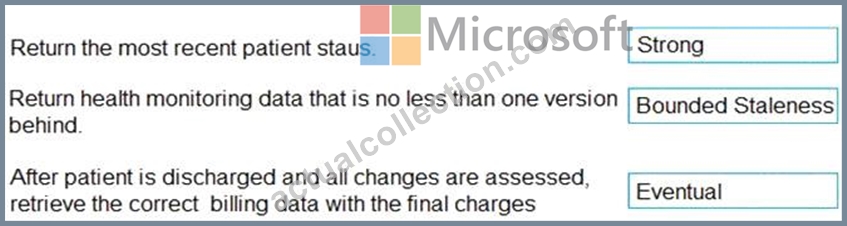
Box 1: Strong
Strong: Strong consistency offers a linearizability guarantee. The reads are guaranteed to return the most recent committed version of an item. A client never sees an uncommitted or partial write. Users are always guaranteed to read the latest committed write.
Box 2: Bounded staleness
Bounded staleness: The reads are guaranteed to honor the consistent-prefix guarantee. The reads might lag behind writes by at most "K" versions (that is "updates") of an item or by "t" time interval. When you choose bounded staleness, the "staleness" can be configured in two ways:
The number of versions (K) of the item
The time interval (t) by which the reads might lag behind the writes
Box 3: Eventual
Eventual: There's no ordering guarantee for reads. In the absence of any further writes, the replicas eventually converge.
NEW QUESTION # 248
You need to add code at line AM10 of the application manifest to ensure that the requirement for manually reviewing content can be met.
How should you complete the code? To answer, select the appropriate options in the answer area.
NOTE: Each correct selection is worth one point.
Answer:
Explanation:
Explanation
Box 1: sid
Sid: Session ID, used for per-session user sign-out. Personal and Azure AD accounts.
Scenario: Manual review
To review content, the user must authenticate to the website portion of the ContentAnalysisService using their Azure AD credentials. The website is built using React and all pages and API endpoints require authentication.
In order to review content a user must be part of a ContentReviewer role.
Box 2: email
Scenario: All completed reviews must include the reviewer's email address for auditing purposes.
NEW QUESTION # 249
You have an application that provides weather forecasting data to external partners. You use Azure API Management to publish APIs.
You must change the behavior of the API to meet the following requirements:
* Support alternative input parameters.
* Remove formatting text from responses.
* Provide additional context to back-end services.
Which types of policies should you implement? To answer, drag the policy types to the correct scenarios. Each policy type may be used once, more than once, or not at all. You may need to drag the split bar between panes or scroll to view content NOTE: Each correct selection is worth one point.
Answer:
Explanation:
NEW QUESTION # 250
You develop and deploy a Java RESTful API to Azure App Service.
You open a browser and navigate to the URL for the API. You receive the following error message:
You need to resolve the error.
What should you do?
- A. Bind an SSL certificate
- B. Map a custom domain
- C. Enable authentication
- D. Enable CORS
- E. Add a CDN
Answer: D
Explanation:
Explanation
We need to enable Cross-Origin Resource Sharing (CORS).
References:
https://medium.com/@xinganwang/a-practical-guide-to-cors-51e8fd329a1f
NEW QUESTION # 251
......
Free Sales Ending Soon - 100% Valid AZ-204 Exam: https://examcollection.actualcollection.com/AZ-204-exam-questions.html