

Juniper JN0-105 Dumps Questions [2026] Pass for JN0-105 Exam
Updated Juniper Study Guide JN0-105 Dumps Questions
Juniper JN0-105 Exam Syllabus Topics:
| Topic | Details |
|---|---|
| Topic 1 |
|
| Topic 2 |
|
| Topic 3 |
|
| Topic 4 |
|
NEW QUESTION # 11
Exhibit
[edit]
user@routerl set interfaces ge-0/1/2 unit 0 family inet address 172.16.101.1/24 [edit] user@router# commit check configuration check succeeds
[edit]
user@router#
You need to configure interface ge-0/1/2 with an IP address of 172.16.100.1/24. You have accidentally entered 172.16.101.1/24 as shown in the exhibit.
Which command should you issue to solve the problem?
- A. [edit] user@router# rollback 2
- B. [edit] user@routeri rollback rescue
- C. [edit] userOrouter# rollback 0
- D. (edit] user@router# rollback 1
Answer: D
Explanation:
If you've committed a configuration and then need to revert to the previous configuration, the rollback command is used. Since the incorrect IP address has not been committed, as indicated by the commit check command being successful, issuing rollback 1 will undo the changes made in the current session, which includes the accidental entry of the IP address.
NEW QUESTION # 12
Which prompt indicates that you are using configuration mode?
- A. #
- B. %
- C. $
- D. >
Answer: A
Explanation:
In Junos OS, the # prompt indicates that you are in configuration mode. This mode is used for making changes to the configuration of the device.
NEW QUESTION # 13
Click the Exhibit button.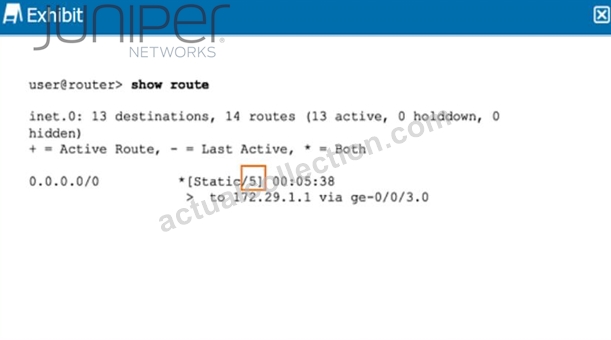
Referring the exhibit, what does the highlighted number indicate?
- A. cost is 5
- B. route preference is 5
- C. hop count is 5
- D. metric is 5
Answer: B
Explanation:
In the exhibit shown, the highlighted number next to the route type (Static) within the square brackets indicates the route preference, also known as the administrative distance. In Junos, the route preference is a value that determines the priority of the route source. Lower numbers indicate a higher priority when the routing table is being calculated. The route preference is used to select the best route when multiple paths to the same destination exist from different routing sources. The number 5 is unusually low for a static route by default, suggesting it has been manually configured to override other route types.
NEW QUESTION # 14
Which statement is correct about the candidate configuration in the Junos OS?
- A. It is only used to restore the configuration to factory default settings
- B. It contains the most recent rescue configuration
- C. It is created when you execute a commit from the CLI
- D. It contains changes that have not been committed
Answer: D
Explanation:
In Junos OS, there are two main configuration databases:
* Candidate configuration: a working copy of the configuration that holds any uncommitted changes.
All configuration edits are made here.
* Active configuration: the running configuration that the system currently uses.
When you issue a commit command, the candidate configuration is promoted to active, replacing the previous configuration. Until that happens, all changes remain in the candidate configuration and do not affect device operation.
From Junos Fundamentals Guide:
"The candidate configuration is a separate copy of the configuration database. All changes are made to the candidate configuration and do not take effect until they are committed." References:
Juniper TechLibrary - Junos Configuration Fundamentals
JNCIA-Junos Exam Objective: Configuration Basics
NEW QUESTION # 15
Which process in the Junos OS is responsible for maintaining routing protocols and tables?
- A. mgd
- B. chassisd
- C. rpd
- D. dcd
Answer: C
Explanation:
The Routing Protocol Daemon (rpd) in Junos OS is responsible for maintaining routing protocols and tables.
It handles all routing information, including the calculation of routes and the population of the routing table, making it crucial for dynamic routing operations.
NEW QUESTION # 16
In the Junos OS, which keyboard shortcut allows you to move to the start of the line?
- A. Ctrl+k
- B. Ctrl+w
- C. Ctrl+a
- D. Ctrl+e
Answer: C
Explanation:
In the Junos OS command-line interface (CLI), the keyboard shortcut Ctrl+a is used to move the cursor to the start of the line. This is a common convention in many command-line environments and text editors, providing a quick way to navigate to the beginning of the current command or line of text without having to use the arrow keys. This can be particularly useful for making quick edits to commands or for navigating long lines of text more efficiently.
NEW QUESTION # 17
Which two statements are correct about the empioyee@Ri> prompt? (Choose two.)
- A. R1 is the hostname of your device.
- B. You are in configuration mode.
- C. You are at a shell prompt.
- D. You are in operational mode.
Answer: A,D
Explanation:
In Junos OS, the prompt employee@R1> indicates the current context of the user interface. The 'R1' part of the prompt signifies the hostname of the device, which in this case is 'R1'. The absence of a '#' symbol at the end of the prompt suggests that the user is in operational mode, as opposed to configuration mode which is indicated by a prompt ending in '#'. Operational mode allows users to view the status of the device and execute operational commands, but does not allow for configuration changes.
NEW QUESTION # 18
Which two external authentication methods does Junos support for administrative access? (Choose two.)
- A. ACE
- B. RADIUS
- C. TACACS+
- D. NIS
Answer: C
Explanation:
Junos OS supports several external authentication methods for administrative access, with TACACS+ (Terminal Access Controller Access-Control System Plus) and RADIUS (Remote Authentication Dial-In User Service) being among the most commonly used. Both TACACS+ and RADIUS are protocols that allow network devices to communicate with a central authentication server, enabling centralized control over user authentication and authorization. This centralization simplifies the management of user credentials and access policies, especially in larger networks with multiple devices.
NEW QUESTION # 19
Which two statements are correct about Junos traceoptions? (Choose two.)
- A. Traceoptions are enabled through configuration.
- B. Traceoption output, by default, is stored in /var/iog/<fiie-name>.
- C. Traceoptions cannot be enabled in a production environment.
- D. Traceoptions are enabled by default.
Answer: A,B
Explanation:
Traceoptions in Junos OS are used for detailed debugging and troubleshooting of protocols and processes within the system. They are not enabled by default due to the potential performance impact and volume of data generated. Instead, traceoptions are enabled through specific configuration settings under the relevant protocol or process hierarchy. This allows administrators to target their troubleshooting efforts and control the scope of logging. By default, the output generated by traceoptions is stored in files located in the /var/log directory, with the file name typically specified in the traceoptions configuration. This structured approach to logging and debugging helps in diagnosing complex issues without overwhelming the system or the administrator with irrelevant data.
NEW QUESTION # 20
You have logged on to a Junos device and are at the operational mode prompt.
Which two commands are used at this prompt? (Choose two.)
- A. request system shutdown
- B. show interface ge-0/0/0
- C. set interface ge-0/0/0 unit 0 family inet
- D. run show interface terse
Answer: B
Explanation:
At the operational mode prompt on a Junos device, you can use various commands to view the device's status and request system operations. Theshow interface ge-0/0/0command is used to display information about a specific interface, while therequest system shutdowncommand is used to properly shut down the device. The setcommand is used in configuration mode, not operational mode, and theruncommand is used to execute operational mode commands from configuration mode.
NEW QUESTION # 21
Exhibit
Exhibit
[edit]
root# set system host-name TEST_DEVICE [edit]
root# commit
[edit]
'system'
Missing mandatory statement: 'root-authentication' error: commit failed: (missing mandatory statements) [edit] root# You are configuring a new device.
Which action solves the error shown in the exhibit?
- A. loading the factory-default configuration
- B. configuring a non-root username and password
- C. reinstalling Junos
- D. configuring a password for the root account
Answer: D
Explanation:
The error message in the exhibit indicates that the root-authentication statement is missing, which is mandatory for committing the configuration. In Junos OS, it is required to set a password for the root account to commit any configuration changes. This is a security measure to ensure that unauthorized users cannot access the device's configuration mode. To solve the error shown in the exhibit, configuring a password for the root account is necessary. This can be done by using the set system root-authentication plain-text-password command, after which the user will be prompted to enter a new password for the root account.
NEW QUESTION # 22
Which three benefits occur when operating an interior gateway protocol (IGP) in an autonomous system (AS)? (Choose three.)
- A. IGPs react very fast to network change.
- B. IGPs learn everything about the subnets and best paths within your network.
- C. IGPs determine the optimal paths for data transmission.
- D. IGPs automatically distribute static routing information.
- E. IGPs learn prefixes in the global Internet's routing table.
Answer: A,B,C
Explanation:
Operating an Interior Gateway Protocol (IGP) within an Autonomous System (AS) provides several benefits, including determining the optimal paths for data transmission (B), reacting quickly to network changes (D), and learning all about the subnets and best paths within the network (E). IGPs are designed to manage routing within a single AS efficiently, adapting to changes and ensuring data is routed through the best available paths.
NEW QUESTION # 23
You want to redeploy a Junos device by clearing the existing configuration and resetting it to factory defaults.
In this scenario, which command would help to accomplish this task?
- A. request system storage cleanup
- B. request system zeroize media
- C. show system storage
- D. request system storage cleanup dry-run
Answer: B
Explanation:
The request system zeroize media command on a Junos device securely erases all data, including configuration and log files, and resets the device to its factory default settings. This command is used when redeploying a device to ensure no residual data remains from its previous deployment. It's a comprehensive and secure way to clear all configurations and data, making the device as if it were new. The other commands listed do not perform a full reset to factory defaults; for example, show system storage displays storage information, and request system storage cleanup offers to delete unnecessary files without resetting the device to factory settings.
NEW QUESTION # 24
You are logged in to a Junos OS device with SSH and issued the show protocols | compare command in the configuration, but no output is shown.
Which statement is correct in this scenario?
- A. You must commit the configuration before any output will be shown.
- B. There are no changes to the candidate configuration.
- C. The command only works for interface configuration differences.
- D. Someone accidentally deleted the active configuration.
Answer: B
Explanation:
The show | compare command in Junos OS is used to display the differences between the candidate configuration and the active configuration. If no output is shown when you issue this command, it means that there are no changes between the candidate configuration and the active configuration. This indicates that the candidate configuration is identical to the active configuration, and thus no differences are displayed.
Reference: Juniper Networks Documentation on Configuration Management
"The show | compare command displays the differences between the candidate configuration and the active configuration. If there are no changes, no output is displayed."
NEW QUESTION # 25
Which two statements describe the result when you enter? at the command-line prompt? (Choose two.)
- A. It displays summary information about the commands and options.
- B. It displays help about a text string contained in a statement.
- C. It lists tips for the help menu.
- D. It lists the available commands and options.
Answer: A,D
Explanation:
When you enter ? at the command-line prompt in Junos OS, the system provides assistance in two significant ways. Firstly, it lists the available commands and options that can be used at the current point in the command hierarchy, aiding users in understanding what commands they can execute next. Secondly, it displays summary information about those commands and options, providing brief descriptions or additional context that can help users understand the function of each command or option. This feature is particularly useful for learning the command structure or for quick reference when specific command syntax is forgotten.
NEW QUESTION # 26
When considering routing tables and forwarding tables, which two statements are correct? (Choose two.)
- A. The routing table stores all routes and prefixes from all protocols.
- B. The routing table is used by the RE to select the best route.
- C. The forwarding table stores all routes and prefixes from all protocols.
- D. The forwarding table is used by the RE to select the best route.
Answer: A,B
Explanation:
The routing table and forwarding table play distinct roles in a Junos OS device. The correct answers are A and
D: The routing table (A) is used by the Routing Engine (RE) to select the best route among all the learned routes, while the routing table (D) stores all routes and prefixes learned from all routing protocols. The forwarding table, in contrast, contains only the active routes chosen by the RE and is used by the Packet Forwarding Engine for actual packet forwarding.
NEW QUESTION # 27
Exhibit
term limit-icmp { from {
source-address {
172.25.11.0/24;
}
protocol icmp;
}
then {
count count-icmp; discard;
}
}
Referring to the exhibit, which two actions will occur when a packet matches the firewall filter? (Choose two.)
- A. An ICMP destination unreachable message will be returned.
- B. The packet will be discarded.
- C. The packet will be forwarded.
- D. A counter will be incremented.
Answer: B
Explanation:
Referring to the firewall filter configuration in the exhibit, when a packet matches the specified term limit-icmp, two actions are defined in thethenstatement:count count-icmpanddiscard. Thecount count-icmp action means that each time a packet matches this term, a counter namedcount-icmpwill be incremented, providing a tally of how many packets have matched the term. Thediscardaction means that the packet will be dropped and not forwarded through the device. This effectively prevents the packet from reaching its intended destination. There is no action specified that would cause an ICMP destination unreachable message to be returned, nor is there any action that would allow the packet to be forwarded.
NEW QUESTION # 28
Which component is considered part of the data plane?
- A. the Packet Forwarding Engine
- B. the Routing Engine
- C. the fan tray
- D. the power supply
Answer: A
Explanation:
The Packet Forwarding Engine (PFE) is an integral component of Juniper Networks devices, responsible for the data plane operations. The data plane, also known as the forwarding plane, is where the actual processing and forwarding of packets occur based on the routing and forwarding tables. The PFE executes the forwarding decisions made by the Routing Engine (RE), handling all packet transmissions, including routing, filtering, and switching packets towards their destination. This contrasts with the control plane operations handled by the RE, which involve routing table maintenance, system management, and control protocol processing.
NEW QUESTION # 29
When considering routing tables and forwarding tables, which two statements are correct? (Choose two.)
- A. The routing table stores all routes and prefixes from all protocols.
- B. The routing table is used by the RE to select the best route.
- C. The forwarding table stores all routes and prefixes from all protocols.
- D. The forwarding table is used by the RE to select the best route.
Answer: A,B
Explanation:
The routing table and forwarding table play distinct roles in a Junos OS device. The correct answers are A and D. The routing table (A) is used by the Routing Engine (RE) to select the best route among all the learned routes, while the routing table (D) stores all routes and prefixes learned from all routing protocols. The forwarding table, in contrast, contains only the active routes chosen by the RE and is used by the Packet Forwarding Engine for actual packet forwarding.
NEW QUESTION # 30
What will the request system configuration rescue save command do?
- A. It saves a configuration version prior to the configuration most recently committed as the rescue configuration.
- B. It saves the candidate configuration as the rescue configuration.
- C. It activates the rescue configuration.
- D. It saves the most recently committed configuration as the rescue configuration.
Answer: D
Explanation:
The "request system configuration rescue save" command in Junos OS saves the most recently committed configuration as the rescue configuration, making A the correct answer. This feature allows administrators to set a known good configuration that can be quickly reverted to in case of configuration errors or issues.
NEW QUESTION # 31
......
Achieve Success in Actual JN0-105 Exam JN0-105 Exam Dumps: https://examcollection.actualcollection.com/JN0-105-exam-questions.html