

Get New 2026 Valid Practice To your C-THR81-2505 Exam (Updated 86 Questions)
SAP Certified Associate C-THR81-2505 Exam Practice Test Questions Dumps Bundle!
SAP C-THR81-2505 Exam Syllabus Topics:
| Topic | Details |
|---|---|
| Topic 1 |
|
| Topic 2 |
|
| Topic 3 |
|
| Topic 4 |
|
NEW QUESTION # 13
Which mathematical formula must be set in the THEN condition to meet the Jobinfo_FTE_Comp rule requirement?
- A. (Base Salary/Previous FTE Value) X Current FTE Value
- B. (Current FTE Value-Previous FTE Value)/Base Salary
- C. (Previous FTE Value - Current FTE Value) X Base Salary
- D. (Base Salary/Current FTE Value) X Previous FTE Value
Answer: A
Explanation:
The formula (Base Salary / Previous FTE Value) X Current FTE Value ensures that the base salary is adjusted correctly when there is a change in the Full-Time Equivalent (FTE) value. This formula maintains salary proportionality by recalculating the base salary based on the ratio of the new FTE value to the previous FTE value. It is critical in cases where FTE adjustments impact an employee's compensation.
Scenario 1: HR Transaction Rules
NEW QUESTION # 14
A business rule triggers a transfer event reason when an employee's location is changed. Which base object would you use for this business rule?
- A. Job Information
- B. Employee Information
- C. Job Information Model
- D. Employee Information Model
Answer: C
Explanation:
When creating a business rule to trigger a transfer event reason upon a location change, the Job Information Model is the correct base object. This is because location is a field within the Job Information entity, and changes to fields within this entity are best handled using the Job Information Model base object for related rules.
C: Job Information Model
NEW QUESTION # 15
To which Job information field will you assign the Default_JobClass rule?
- A. Employee Class
- B. Job Code
- C. Job Title
- D. Pay Grade
Answer: B
Explanation:
The Default_JobClass rule should be assigned to the Job Code field in Job Information. This field serves as the key reference for deriving other job-related attributes, such as Job Title, Pay Grade, and Employee Class, ensuring that defaults are set when required.
Scenario 2: Approvals for Self-Service
NEW QUESTION # 16
A customer has scheduled an HRIS sync job, which includes mapping of job titles, to run every Friday. On Tuesday, an employee's job title is changed via Manager Self-Service (MSS) to become effective on Thursday.
When will the synchronization happen?
- A. Thursday, when the change becomes effective
- B. Friday, when the sync job completes
- C. Tuesday, the day the transaction is entered
- D. Saturday, the day after the sync job completes
Answer: B
Explanation:
In SAP SuccessFactors Employee Central, the HRIS synchronization (sync) job is responsible for aligning data between different modules and ensuring consistency across the system. When an employee's job title is changed via Manager Self-Service (MSS) with an effective date set to Thursday, and the HRIS sync job is scheduled to run every Friday, the synchronization will occur on Friday, when the sync job completes.
This means that any changes made effective on Thursday will be synchronized during the next scheduled HRIS sync job on Friday. Therefore, the correct answer is C. Friday, when the sync job completes.
NEW QUESTION # 17
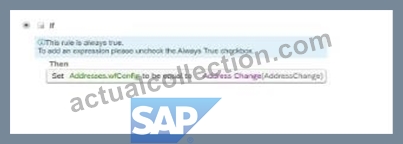
Which clause meets the WFD_Address rule requirement?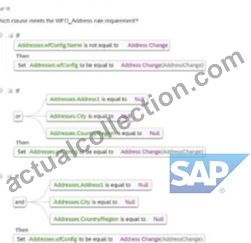
- A. Option D
- B. Option C
- C. Option B
- D. Option A
Answer: A
Explanation:
The clause in Option D meets the WFD_Address rule requirement because it checks the following conditions comprehensively:
Address is not equal to Null.
City and CountryRegion are equal to Null.
When these conditions are met, it sets the configuration for Address Change accordingly, ensuring data completeness and accuracy for address-related transactions.
Scenario 1: HR Transaction Rules
NEW QUESTION # 18
How does the system connect the country-relevant Legal Entity fields to a country? Note: There are 2 correct answers to this question.
- A. By association, using the 3-letter ISO code of the country in the Condition Values
- B. By association, using the 3-letter ISO code of the country in the Destination Filter Criteria
- C. By association, using the countryOfRegistration.code in the Condition
- D. By association, using the countryOfRegistration.code in the Source Filter Criteria
Answer: B,C
Explanation:
The system connects country-relevant Legal Entity fields to a specific country through associations that utilize the countryOfRegistration.code. This is achieved by setting the countryOfRegistration.code in the Condition and using the 3-letter ISO code of the country in the Destination Filter Criteria. By configuring these associations, the system can dynamically display or hide fields based on the country's ISO code, ensuring that only relevant fields are presented for each Legal Entity.
NEW QUESTION # 19
In which cases should the value for CREATE Respects Target Criteria be set to Yes in the Position object definition? Note: There are 2 correct answers to this question.
- A. To restrict access to create lower-level positions from the Position Org Chart
- B. To restrict access to create positions from Manage Positions
- C. To restrict access to create positions based on the granted user's target population
- D. To restrict access at the field level when creating positions
Answer: A,C
Explanation:
The CREATE Respects Target Criteria setting in the Position object definition ensures that the system applies access control criteria when creating positions. This is critical for maintaining organizational and data security. It should be set to Yes in the following cases:
A . To restrict access to create positions based on the granted user's target population:
This ensures that users can only create positions for entities (e.g., departments, locations) within their authorized target population.
C . To restrict access to create lower-level positions from the Position Org Chart:
This limits the ability to create subordinate positions in the hierarchy to authorized users, maintaining the integrity of position relationships.
NEW QUESTION # 20
The HR admin has to change the salary of an employee, which will trigger a workflow for the employee's manager. The employee's manager should be able to edit the transaction if the proposed amount is NOT correct.
Where in the workflow do you need to define this?
Refer to the screenshot to answer the question
- A. Context
- B. Edit Transaction
- C. Respect Permission
- D. No Approver Behavior
Answer: B
Explanation:
To allow the employee's manager to edit a transaction in a workflow if the proposed salary change is incorrect, you must configure the "Edit Transaction" setting in the workflow.
The "Edit Transaction" option is part of the workflow configuration in Step 1 (as shown in the screenshot).
When enabled, it allows the approver (in this case, the manager) to make adjustments to the transaction before approving it.
Scenario 2: Approvals for Self-Service
NEW QUESTION # 21
Which condition must be used for the jobinfo_FTE_Comp rule?
- A. Option D
- B. Option C
- C. Option B
- D. Option A
Answer: A
Explanation:
For the Jobinfo_FTE_Comp rule, the correct condition to use is Option D. This ensures that the system evaluates changes in FTE values and event reasons to calculate and adjust compensation data accordingly. The precise conditions are necessary to maintain consistency in how the rule is applied across various HR scenarios.
Scenario 1: HR Transaction Rules
NEW QUESTION # 22
Which object supports &&NO_OVERWRITE&& in imports? Note: There are 2 correct answers to this question.
- A. Addresses
- B. Employment Details
- C. Job Relationships
- D. Job History
Answer: B,D
Explanation:
The &&NO_OVERWRITE&& operator is supported in imports for:
A . Job History
This ensures that existing job history records are not overwritten during imports.
D . Employment Details
Employment details such as hire dates or termination records can also be preserved using this operator.
Job Relationships and Addresses do not support the &&NO_OVERWRITE&& operator.
NEW QUESTION # 23
Which of the following API types does SAP recommend to use to achieve clean core integrations? Note: There are 2 correct answers to this question.
- A. Data
- B. SOAP
- C. IDoc
- D. RFC
Answer: A,B
Explanation:
SAP recommends using SOAP APIs and Data APIs for clean core integrations.
SOAP APIs: Provide a structured, standardized method of communication for integrations, especially suitable for real-time and synchronous processes.
Data APIs: Enable smooth data exchange and are preferred for achieving non-intrusive clean core integrations.
Other methods like IDoc and RFC are older technologies that might compromise the clean core principles by requiring deeper system customizations.
NEW QUESTION # 24
You need to create a one-to-many association from Location to Legal Entity. You also need to configure filtering of the Location field based on the Company field in the Job Information block.
What do you need to add to the data models? Note: There are 2 correct answers to this question.
- A. <field-criteria> as part of <hris-field="location">
- B. <field-criteria> as part of <hris-field="company">
- C. <association> as part of <hris-element id="location">
- D. <association> as part of <hris-element id="jobInfo">
Answer: A,C
Explanation:
To establish a one-to-many association from Location to Legal Entity and enable filtering of the Location field based on the Company field in the Job Information block, the following configurations are necessary:
* Define the Association in the Location Object:
* In the location object definition, add an <association> element to link it to the legalEntity object.
This association should be defined within the <hris-element id="location"> section.
* Configure Field Criteria for the Location Field:
* Within the Job Information (jobInfo) element, add a <field-criteria> element as part of the <hris- field id="location">. This configuration ensures that the Location field is filtered based on the selected Company (Legal Entity) in the Job Information block.
Therefore, the correct answers are:
* B: <field-criteria> as part of <hris-field id="location">
* D: <association> as part of <hris-element id="location">
These configurations align with the standard practices for setting up associations and field criteria in SAP SuccessFactors Employee Central.
NEW QUESTION # 25
In which of the following HRIS elements do you assign workflow derivation rules for new hires?
- A. Job Information
- B. Compensation Information
- C. Personal Information
- D. Biographical Information
Answer: A
Explanation:
Workflow derivation rules for new hires are assigned in the Job Information HRIS element.
The Job Information section contains employment-specific details and is the primary place where workflows for hiring processes are configured.
This ensures that workflows for approvals or other processes are correctly derived and triggered during the hire action.
NEW QUESTION # 26
Which rule can effectively catch all unspecified events in a transaction?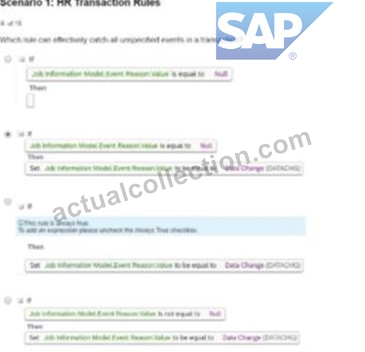
- A. Option D
- B. Option C
- C. Option B
- D. Option A
Answer: C
Explanation:
The rule in Option B effectively captures all unspecified events in a transaction because:
It sets the Event Reason Value to "Data Change" whenever the Event Reason Value is null.
This ensures that all unplanned or unspecified events are assigned a default action, which is crucial for maintaining data consistency and avoiding errors during transactions.
Scenario 1: HR Transaction Rules
NEW QUESTION # 27
Manager A initiated a job code change for Employee X with an effectivity date of January 15. Another manager initiated the same request, but for January 30. What happens to the workflows triggered by both transactions?
- A. The system will cancel the first workflow.
- B. The system will reject both workflows.
- C. The system will cancel the second workflow.
- D. The system will allow both workflows to continue.
Answer: D
Explanation:
When two workflows are initiated for the same employee with different effective dates, both workflows are allowed to proceed independently. The system processes them sequentially based on their respective effective dates. This ensures that updates are recorded in the order they occur without rejecting either workflow.
Other options, such as canceling or rejecting workflows, do not align with standard system behavior for managing multiple transactions.
NEW QUESTION # 28
......
Fully Updated Dumps PDF - Latest C-THR81-2505 Exam Questions and Answers: https://examcollection.actualcollection.com/C-THR81-2505-exam-questions.html