

Free Jun-2026 800-150 Certification Sample Questions certification Exam
Certification Topics of 800-150 Exam PDF Recently Updated Questions
Cisco 800-150 Exam Syllabus Topics:
| Topic | Details |
|---|---|
| Topic 1 |
|
| Topic 2 |
|
| Topic 3 |
|
| Topic 4 |
|
| Topic 5 |
|
NEW QUESTION # 45
Refer to the exhibit.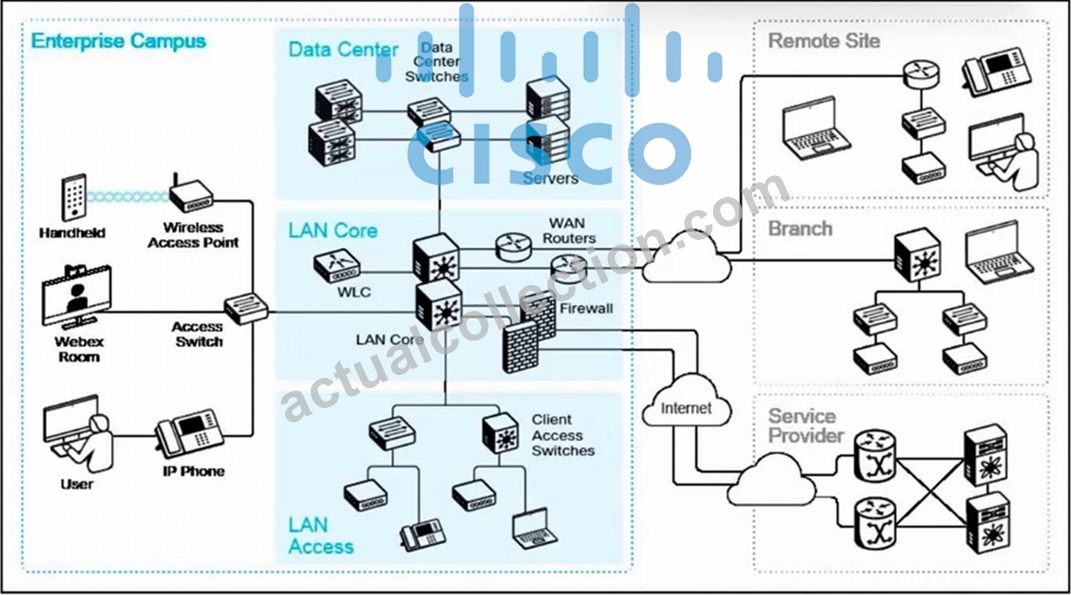
Refer to the exhibit. What are two ways remote sites or branches connect to the enterprise campus network? (Choose two.)
- A. IPsec VPN tunnels
- B. Access layer switches
- C. WAN links
- D. LAN core switches
- E. Ad hoc Wi-Fi network
Answer: A,C
Explanation:
In enterprise networking, remote sites or branch offices connect to the central campus network using:
WAN Links: These are dedicated communication paths that connect geographically dispersed networks. WAN links can be leased lines, MPLS circuits, or other forms of long-distance connectivity that facilitate reliable data transmission between remote sites and the main campus.
IPsec VPN Tunnels: Internet Protocol Security (IPsec) VPNs provide secure, encrypted tunnels over the public internet, allowing remote sites to connect to the enterprise network securely. This method is cost-effective and widely used for connecting branch offices to the central network infrastructure.
Access layer switches (Option A) and LAN core switches (Option E) are components within a local network and do not facilitate remote connectivity. Ad hoc Wi-Fi networks (Option D) are temporary and lack the security and reliability required for enterprise-level remote connections.
NEW QUESTION # 46
Which command is used to specify the source for the Cisco IOS software image to load during the boot process?
- A. boot system
- B. boot image
- C. boot ios
- D. boot source
Answer: A
Explanation:
The boot system command is used in global configuration mode to specify the source and filename of the Cisco IOS software image that should be loaded during the device's boot process. This command ensures that the device loads a specific IOS image, whether it's stored locally in flash or fetched from a TFTP server.
Syntax example:
boot system flash:c1900-universalk9-mz.SPA.157-3.M3.bin
boot image, boot ios, and boot source are invalid or non-existent in standard Cisco IOS.
NEW QUESTION # 47
Drag and drop the actions that must be taken after installing an E-Series server from the left into order on the right.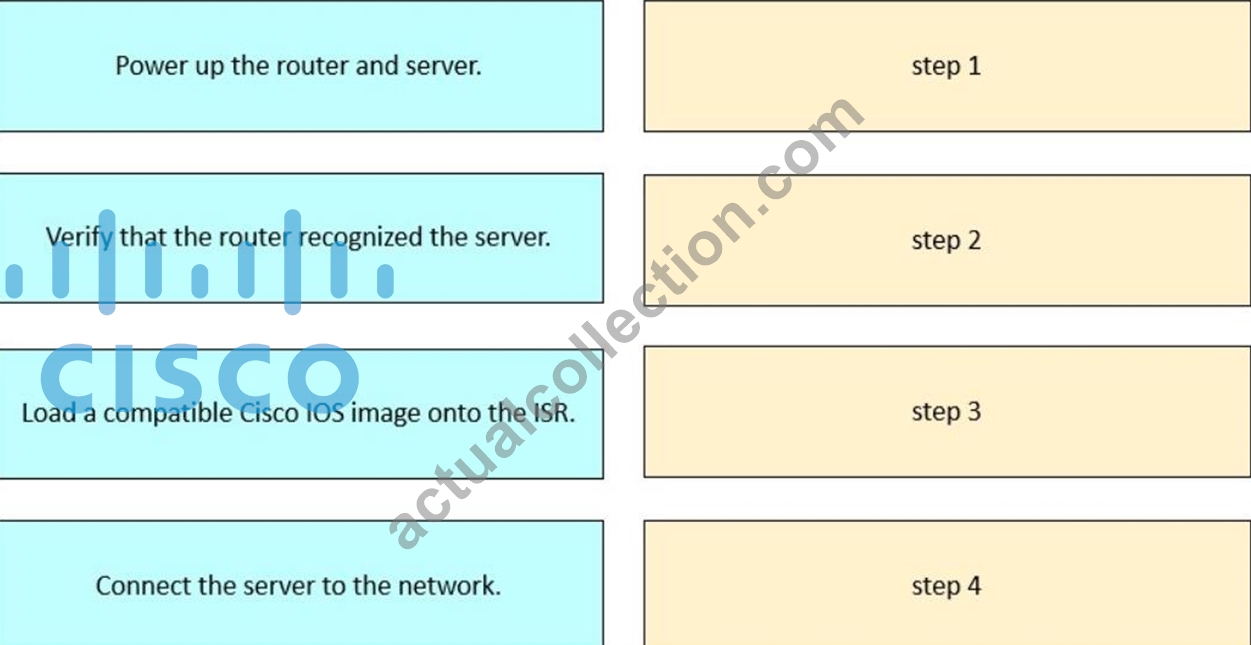
Answer:
Explanation: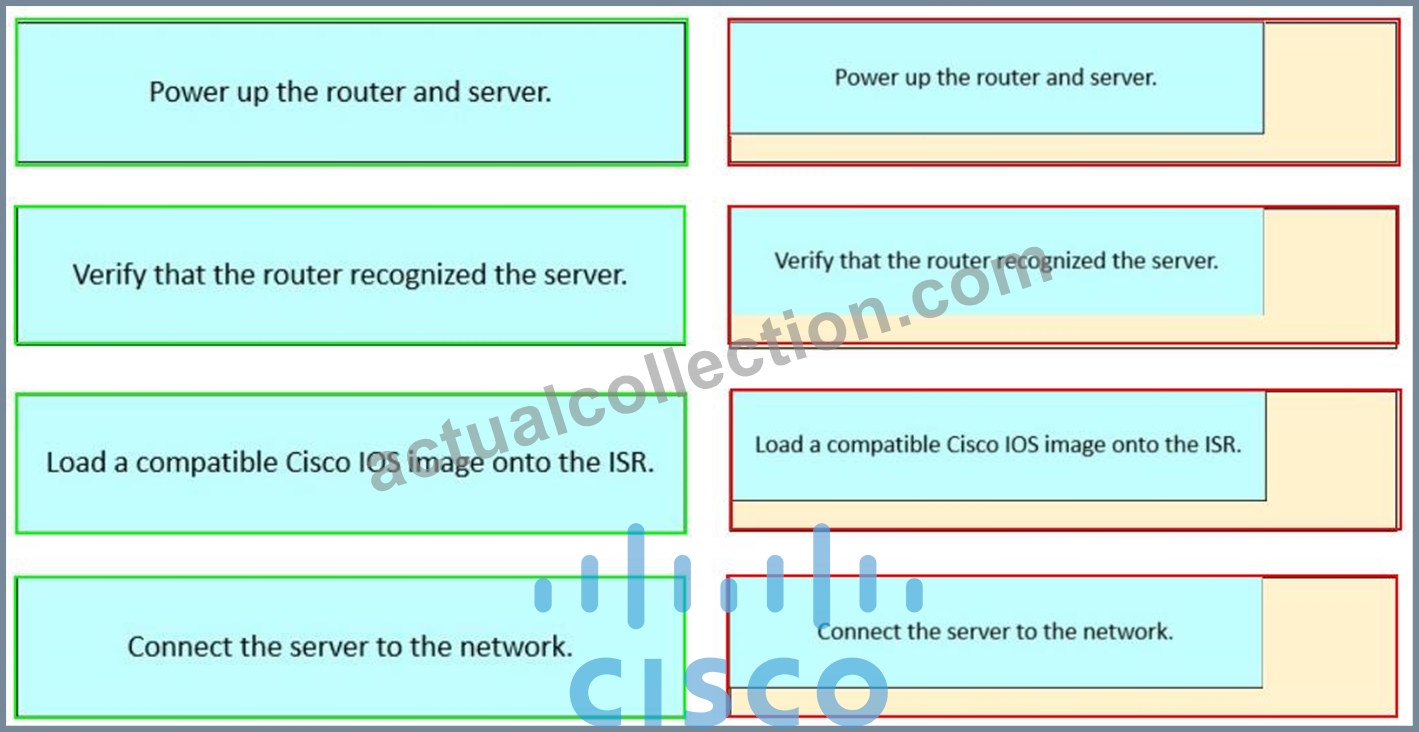
NEW QUESTION # 48
What are the steps to mount a Cisco device in a rack?
- A. Mount in rack.
Install mounting brackets.
Ground the device. - B. Install mounting brackets.
Ground the device.
Mount in rack. - C. Install mounting brackets.
Mount in rack.
Ground the device. - D. Ground the device.
Install mounting brackets.
Mount in rack.
Answer: C
Explanation:
The correct sequence for mounting a Cisco device in a rack is:
* Install mounting brackets: Attach the appropriate rack-mount brackets to the sides of the device using the screws provided. This step prepares the device for secure installation in the rack.
* Mount in rack: Carefully place the device into the rack, aligning the brackets with the rack posts, and secure it using the appropriate rack-mount screws.
* Ground the device: After the device is securely mounted, connect the grounding wire to the chassis grounding point and then to the facility ground. This step ensures safety and compliance with electrical standards.
This sequence is recommended to ensure both the physical security of the device and the safety of personnel during installation.
Reference:Supporting Cisco Devices for Field Technicians (FLDTEC) - Cisco Equipment and Related Hardware
NEW QUESTION # 49
Which layer of the OSI model provides error detection and defines how access to the media is controlled?
- A. Physical layer
- B. Data link layer
- C. Presentation layer
- D. Network layer
Answer: B
Explanation:
The Data Link Layer (Layer 2) of the OSI model is responsible for node-to-node data transfer and plays a crucial role in error detection and media access control. It ensures that data frames are transmitted to the correct device on a local network segment.
This layer is divided into two sublayers:
* Logical Link Control (LLC):Manages frame synchronization, flow control, and error checking.
* Media Access Control (MAC):Controls how devices on the network gain access to the medium and permission to transmit data.
Together, these sublayers ensure reliable data transmission by detecting and possibly correcting errors that may occur in the Physical Layer. They also manage how devices share the transmission medium, preventing collisions and ensuring orderly communication.
Reference:Supporting Cisco Devices for Field Technicians (FLDTEC) - Cisco IOS Software Basics
NEW QUESTION # 50
Which two cloud computing services are vendor-managed in an Infrastructure as a Service (IaaS) delivery model? (Choose two.)
- A. Storage
- B. Data
- C. Networking
- D. Operating System
- E. Applications
Answer: A,C
Explanation:
In the Infrastructure as a Service (IaaS) model, the cloud provider is responsible for managing and maintaining the underlying infrastructure components, including:
Networking: The cloud provider handles all aspects of network configuration, hardware, and virtual networking.
Storage: The cloud provider supplies and manages the physical and virtual storage infrastructure required to support the consumer's data needs.
The customer is responsible for managing:
Operating Systems
Applications
Data
This model offers flexibility while shifting infrastructure maintenance responsibilities to the service provider.
NEW QUESTION # 51
Which command is used to specify the source for the Cisco IOS software image to load during the boot process?
- A. boot system
- B. boot image
- C. boot ios
- D. boot source
Answer: A
Explanation:
Theboot systemcommand is used in globalconfiguration mode to specify the source and filename of the Cisco IOS software image that should be loaded during the device's boot process. This command ensures that the device loads a specific IOS image, whether it's stored locally in flash or fetched from a TFTP server.
Syntax example:
boot system flash:c1900-universalk9-mz.SPA.157-3.M3.bin
* boot image,boot ios, andboot sourceare invalid or non-existent in standard Cisco IOS.
Reference:Supporting Cisco Devices for Field Technicians (FLDTEC) -Cisco IOS Software Basics
NEW QUESTION # 52
Which command is used to download a copied configuration file from a TFTP server to merge it with the running configuration of a replacement Cisco device?
- A. merge tftp: running-config
- B. copy tftp: startup-config
- C. load tftp: running-config
- D. copy tftp: running-config
Answer: D
Explanation:
The commandcopy tftp: running-configis used to retrieve a configuration file from a TFTP server and merge it with the current running configuration of a Cisco device. Thisoperation is additive, meaning it integrates the new configuration commands into the existing running configuration without removing any pre-existing commands unless explicitly overridden.
This method is particularly useful when restoring configurations to a replacement device, as it allows for the seamless integration of necessary settings without disrupting the current operational state.
In contrast, usingcopy tftp: startup-configwould overwrite the startup configuration file, which could lead to unintended consequences upon the next device reload. The optionsload tftp: running-configandmerge tftp:
running-configare not valid Cisco IOS commands.
Reference:Supporting Cisco Devices for Field Technicians (FLDTEC) - Maintenance and RMA ProceduresCisco
NEW QUESTION # 53 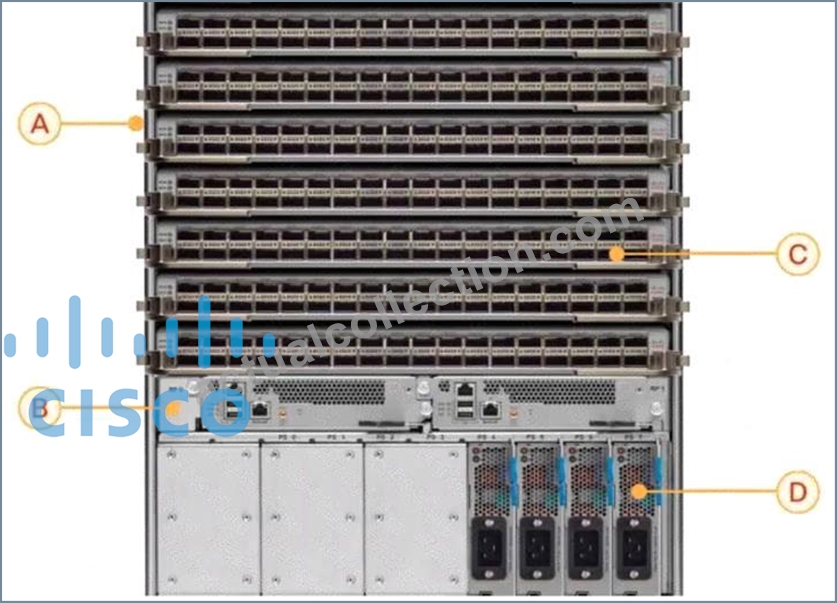
Refer to the exhibit. Drag and drop the names of the field-replaceable units from the left onto the corresponding letters on the image of the Cisco NCS 5500 Series modular router.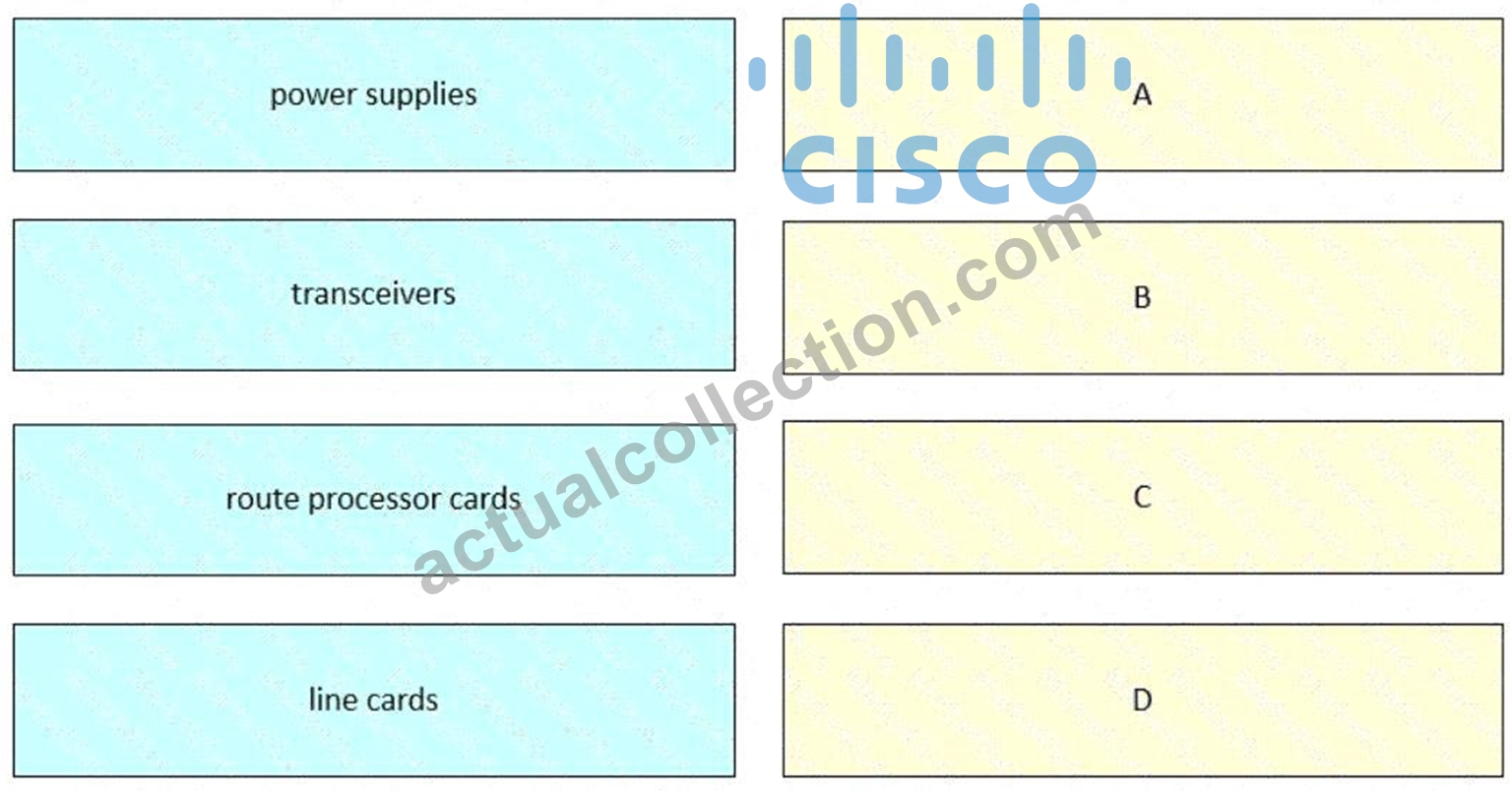
Answer:
Explanation: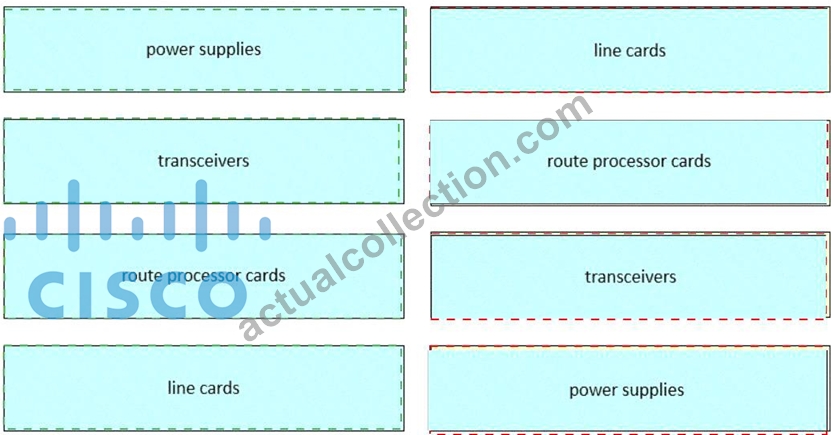
Explanation: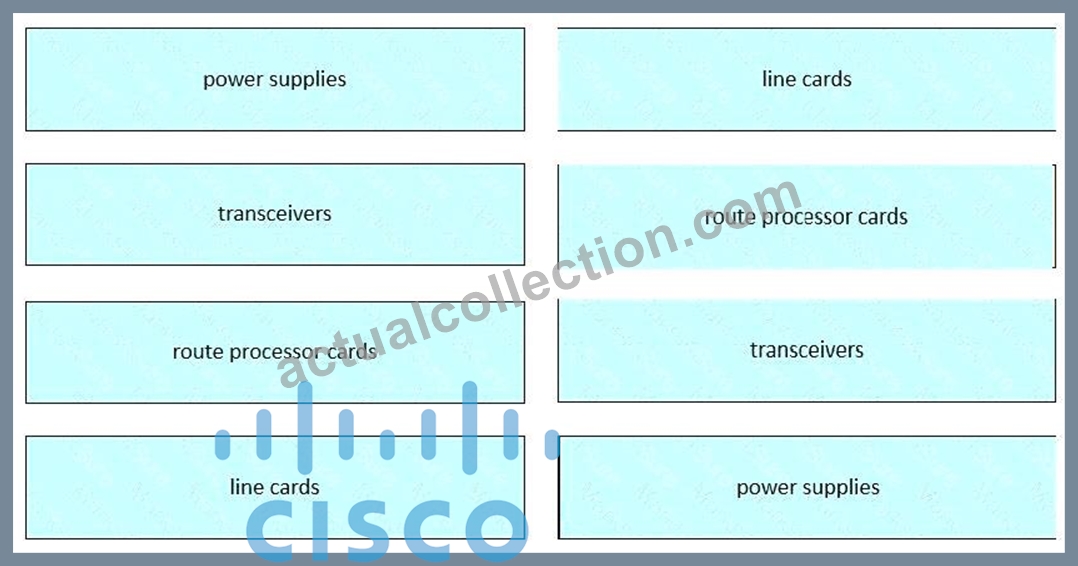
A # Line cards
Provide the physicalinterfaces for network connectivity.
B # Route processor cards
Manage routing functions and system control.
C # Transceivers
Installed in the ports of line cards for optical/electrical signal transmission.
D # Power supplies
Provide power to themodular system and are hot-swappable.
Cisco'sNCS 5500 Seriesis designed for service provider and data center deployments. The FLDTEC course outlines the layout of FRUs in modular platforms like this one:
A - Line Cards: Located in the upper slots, these modules handle the bulk of switching and forwarding functions.
B - Route Processor Cards (RP Cards): Positioned centrally, these provide management and control plane services for the router.
C - Transceivers: Installed into the line cards, transceivers provide physical connectivity through optical or copper interfaces.
D - Power Supplies: Located in the bottom rear section, these modules provide redundant and hot-swappable power to the chassis.
Recognizing each FRU visually and functionally is critical when performingRMA procedures,component diagnostics, orhardware upgradesin the field.
NEW QUESTION # 54
Refer to the exhibit.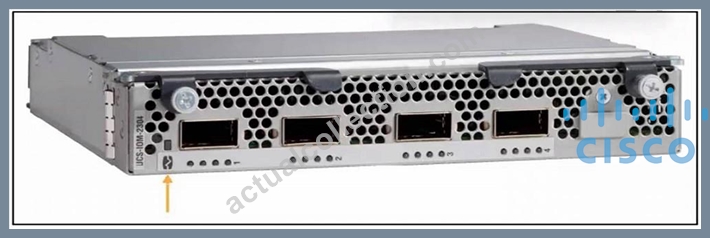
Refer to the exhibit. Which component is highlighted on the Cisco I/O module image?
- A. captive screw
- B. fan module LED
- C. chassis connections LED
- D. fixed port
Answer: C
Explanation:
The highlighted component on the Cisco I/O module is the chassis connections LED, which indicates the status of connectivity between the I/O module and the chassis.
In the exhibit, the orange arrow points to a small rectangular LED indicator located to the left side of the I/O module (Cisco UCS-IOM-2304). This specific LED is not aligned with the ports, fans, or screws, which helps identify it correctly.
Chassis connections LED (B) is responsible for indicating the status of uplink/downlink communication between the I/O module and the chassis.
Green usually indicates a healthy link.
Amber or off may indicate a problem or no connection.
Why the other answers are incorrect:
A . Captive screw → These are at the far corners, not where the arrow points.
C . Fan module LED → This IOM doesn't have user-visible fan LEDs at the front face.
D . Fixed port → These are the large rectangular SFP ports clearly visible in the middle, not near the arrow.
This identification is important when troubleshooting chassis-to-IOM connectivity or verifying module status LEDs during field maintenance.
NEW QUESTION # 55
What does OIR stand for in the context of Cisco ASR component replacement?
- A. Offline Installation and Reboot
- B. Online Insertion and Removal
- C. Operational Interface Redundancy
- D. Optical Interface Routing
Answer: B
Explanation:
Online Insertion and Removal (OIR) is a feature supported by Cisco ASR routers that allows for the insertion and removal of hardware components, such as line cards and modules, while the router is operating. This capability enables maintenance and upgrades without the need to power down the system, thus minimizing network downtime.
Key aspects of OIR include:
Seamless Operation: OIR allows for hardware changes without interrupting the router's operation.
Preservation of Routing Information: The router maintains all routing information and active sessions during the insertion or removal process.
Administrative Shutdown: While not mandatory, it is recommended to administratively shut down the interfaces associated with the component being removed to ensure a graceful transition.
This feature is particularly beneficial in high-availability environments where maintaining continuous network service is critical.
NEW QUESTION # 56 
Refer to the exhibit. Which CLI show command identifies the serial number on a router?
- A. show version
- B. show platform
- C. show idprom
- D. show inventory
Answer: D
Explanation:
Theshow inventorycommand is used on Cisco devices to display detailed information about thehardware components installed, including:
* Product Identifier (PID)
* Version Identifier (VID)
* Serial Number (SN)
* Description of the component
In the exhibit, the output clearly shows:
NAME: "Chassis", DESCR: "Cisco ISR4451-X/K9"
PID:ISR4451-X/K9, VID: V01, SN: FCW2134L0SH
This confirms thatshow inventoryis the correct command to retrieve theserial numberand hardware inventory details.
* show versionprovides some system information and sometimes includes serial numbers, but it's not as reliable or detailed for component-level hardware info.
* show idpromis not commonly used and not supported on all platforms.
* show platformprovides platform-specific info but not typically the serial number.
Reference:Supporting Cisco Devices for Field Technicians (FLDTEC) - Device Configuration and Verification
NEW QUESTION # 57
Drag and drop the characteristics from the left onto the corresponding categories of MDS switch on the right.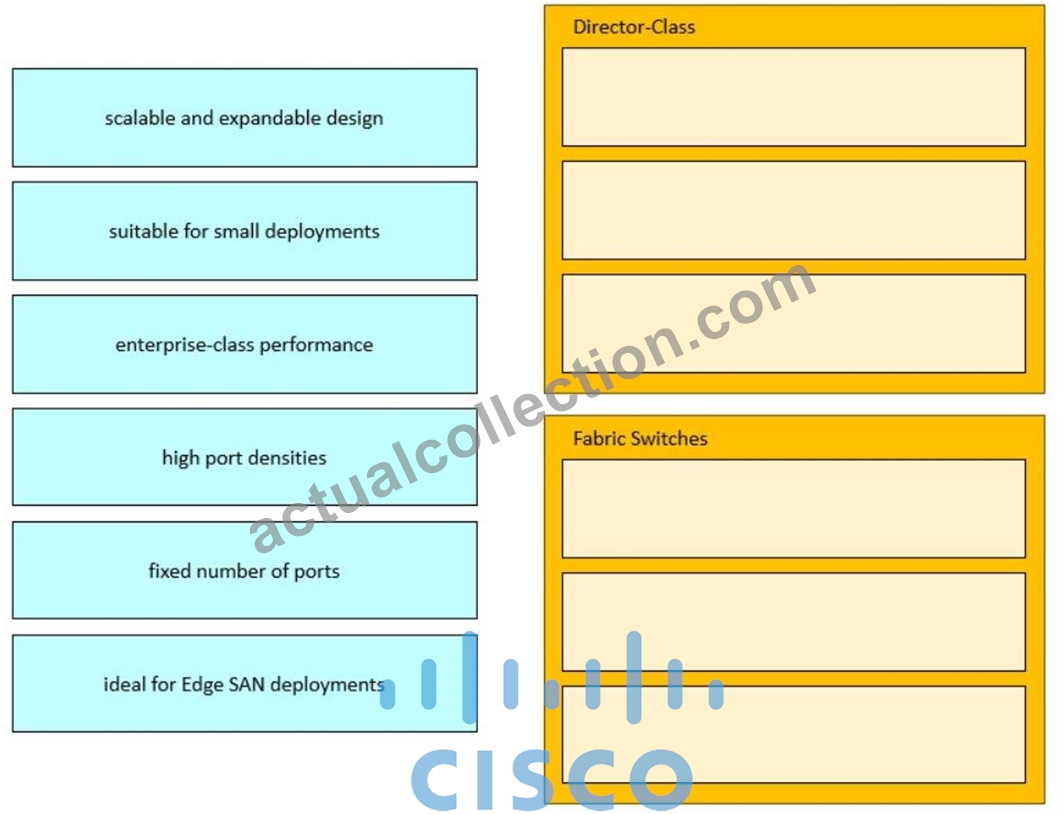
Answer:
Explanation: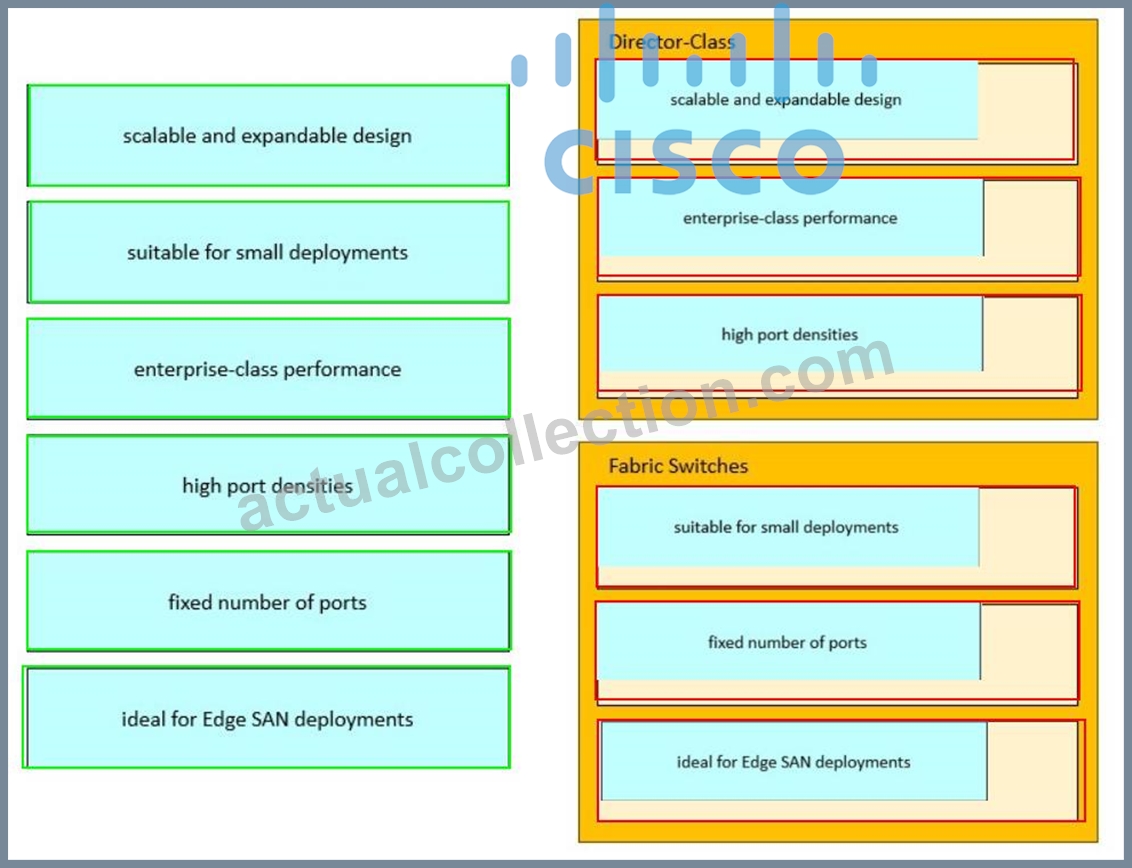
NEW QUESTION # 58
Which two components are accessed by removing the chassis cover on Cisco Catalyst 8000 Series Edge platforms? (Choose two.)
- A. Fan trays
- B. Network Interface Modules
- C. Transceivers
- D. SSDs
- E. DIMMs
Answer: D,E
Explanation:
On Cisco Catalyst 8000 Series Edge platforms, removing the chassis cover provides access to internal components such asDIMMs (Dual In-line Memory Modules)andSSDs (Solid-State Drives). These components are located internally and require the removal of the chassis cover for maintenance or replacement.
* DIMMsare used for system memory and are essential for the router's operation.
* SSDsprovide storage for system software and configurations.
Other components likeNetwork Interface Modules (NIMs)andtransceiversare typically accessible externally and do not require chassis cover removal.
Reference:Supporting Cisco Devices for Field Technicians (FLDTEC) - Cisco Equipment and Related Hardware
NEW QUESTION # 59
What is the recommended resistance value range to ensure proper grounding when using an antistatic strap to perform work on electrical components?
- A. Between 100 and 1000 megaohms
- B. Between 10 and 100 megaohms
- C. Between 1 and 10 megaohms
- D. Between 0.1 and 1 megaohms
Answer: C
Explanation:
Theideal resistance rangefor ESD wrist straps isbetween 1 and 10 megaohms. This range is sufficient to safely discharge static electricity from the technician to ground, while not allowing an abrupt discharge that could damage sensitive electronic components.
* Values below 1 megaohm may result in a rapid discharge, risking damage.
* Valuesabove 10 megaohms may not discharge static efficiently enough.
Reference:Supporting Cisco Devices for Field Technicians (FLDTEC) - Safety and ESD Precautions
NEW QUESTION # 60
......
2026 New Preparation Guide of Cisco 800-150 Exam: https://examcollection.actualcollection.com/800-150-exam-questions.html