

[Feb 09, 2026] Get New GAFRB Practice Test Questions Answers
GAFRB Dumps and Exam Test Engine
AGA GAFRB Exam Syllabus Topics:
| Topic | Details |
|---|---|
| Topic 1 |
|
| Topic 2 |
|
| Topic 3 |
|
NEW QUESTION # 70
The purpose for establishing a custodial fund is to
- A. account for assets held in a trustee capacity.
- B. track financial resources to be used for acquisition of capital facilities.
- C. provide services to the public on a fee basis.
- D. accumulate resources for payment of debt.
Answer: A
Explanation:
A custodial fund is a type of fiduciary fund used by state and local governments to report assets held temporarily in a purely custodial capacity-for example, taxes collected by one government on behalf of another. These funds do not involve administrative or financial control over the assets; the government is merely acting as an intermediary.
As per GASB Statement No. 84, custodial funds replace agency funds and are used to report fiduciary activities that are not held in a trust agreement and where the government does not have discretion over how the resources are spent.
Relevant Standards and References:
GASB Statement No. 84, Fiduciary Activities
GASB Codification Section 1300: Fiduciary Funds
GFOA Best Practices - Accounting and Financial Reporting for Fiduciary Activities Therefore, Option A is correct.
NEW QUESTION # 71
Which of the following revenue sources is an exchange-like transaction?
- A. grants
- B. income taxes
- C. fines
- D. operating permits
Answer: D
Explanation:
Exchange and exchange-like transactions occur when each party receives and gives up essentially equal value.
In the case of operating permits (e.g., business licenses or environmental permits), the payer receives a direct and proportional benefit in exchange for the fee paid, making this an exchange-like transaction.
In contrast:
Income taxes and fines are non-exchange revenues.
Grants may or may not be exchange-like, depending on stipulations, but generally are non-exchange.
Relevant Standards and References:
GASB Statement No. 33, Accounting and Financial Reporting for Nonexchange Transactions GASB Codification Section N50, Nonexchange Transactions GFOA Best Practices - Revenue Recognition Therefore, Option B is correct.
NEW QUESTION # 72
A basic financial statement that includes a budgetary comparison serves to
- A. demonstrate the ability of the entity to meet its commitments.
- B. demonstrate compliance with the legally adopted budget.
- C. measure the service potential of physical and other resources.
- D. disclose and document the restrictions on resources.
Answer: B
Explanation:
A basic financial statement that includes a budgetary comparison (typically the Statement of Revenues, Expenditures, and Changes in Fund Balances - Budget and Actual) is used to demonstrate whether the government complied with its legally adopted budget.
This is a core element of accountability in governmental financial reporting and is required under GASB Statement No. 34.
Relevant References:
GASB Statement No. 34 - Budgetary Comparison Statements
GASB Codification Section 2400 - Budgetary Accounting and Reporting
GFOA Best Practices - Budget Monitoring and Reporting
B). demonstrate compliance with the legally adopted budget
NEW QUESTION # 73
A city issues S100,000 of 10-year general obligation bonds on April 1, 2024. Debt service of $10,000 must be paid each year on March 31, with 5% interest paid on the unpaid balance. Based upon this information, the interest expense reported on the government-wide statement for fiscal year ending March 31, 2025, is
- A. $ 4,500.
- B. $15.000.
- C. $5,000.
- D. $ 3,750.
Answer: C
Explanation:
The city issues $100,000 in general obligation bonds on April 1, 2024, and the first principal payment of
$10,000 is due on March 31, 2025. The interest rate is 5% annually on the unpaid principal balance.
As of April 1, 2024, the full $100,000 is outstanding. For the full fiscal year (April 1, 2024 to March 31,
2025), interest accrues on the full amount until payment is made. The interest on $100,000 for one year at 5%
=
Interest Expense = $100,000 × 5% = $5,000
Note: Interest is typically calculated on the beginning-of-period balance, and since the payment is made at the end of the year (March 31, 2025), the full $5,000 interest is recognized for that year.
Relevant Standards and References:
GASB Statement No. 34, Basic Financial Statements for State and Local Governments GASB Codification Section 2200 (Government-Wide Financial Statements) GFOA Guidance on Long-Term Debt Accounting
NEW QUESTION # 74
Which of the following events requires both a proprietary and a budgetary accounting entry?
- A. A contracting officer's representative receives delivery of previously ordered printers.
- B. A contracting officer signs a contract to buy printers.
- C. A budget officer allots resources to a program office to buy printers.
- D. A funds certifying official commits resources to order printers.
Answer: A
Explanation:
This is the point when a proprietary entry and a budgetary entry must both be recorded:
Proprietary entry: To record the asset (e.g., equipment) and recognize the payable Budgetary entry: To move from unpaid obligation (Undelivered Orders) to paid obligation (Delivered Orders) Receiving goods/services triggers both the accrual of the expense and the update of the obligation's status in the budgetary accounts.
Relevant References:
FASAB SFFAS No. 1 - Accounting for Selected Assets and Liabilities
Treasury Financial Manual, Part 2, Ch. 4700 - Proprietary vs. Budgetary Accounting GAO Red Book - Appropriations Law B). A contracting officer's representative receives delivery of previously ordered printers.
NEW QUESTION # 75
The major difference in applying the accrual concept in governmental fund accounting, as opposed to private- sector accounting, is that revenues are
- A. recognized when they become measurable and available.
- B. recognized when an encumbrance order is prepared.
- C. recorded when collectability occurs or can be reasonably estimated.
- D. recognized in the accounting period in which they are received.
Answer: A
Explanation:
Governmental fund accounting uses the modified accrual basis of accounting. Under this basis, revenues are recognized when:
They are measurable (amount can be reasonably determined)
They are available (collectible within the current period or soon enough thereafter to pay current liabilities - typically within 60 days) This is the key difference from full accrual accounting, which recognizes revenue when it is earned, regardless of when received.
Relevant References:
GASB Statement No. 33 - Accounting and Financial Reporting for Nonexchange Transactions GASB Statement No. 34 - Fund Accounting and Modified Accrual Basis GASB Codification Section 1600 - Fund Financial Reporting C). recognized when they become measurable and available
NEW QUESTION # 76
A state grant will reimburse a city for 40% of the architectural, construction and project management costs to build an annex to a city building. A city employee, who is paid salary and benefits of 510,000 a month, works half-time on the project for six months.
The city reports the following project budgeted and actual costs:
Purpose Budget Actual
Architectural fees $ 100.000 $ 90,000
Construction costs $10,500,000 $10,000,000
Based upon the above information, what is the amount of allowable costs that the state will reimburse the city on the grant?
- A. $4.264.000
- B. $4.048.000
- C. $4,252,000
- D. $4.060.000
Answer: B
Explanation:
First, we calculate total eligible project costs:
Eligible categories (architectural, construction, project management):
Architectural (actual): $90,000
Construction (actual): $10,000,000
Project management (city employee at 50% time for 6 months):
$10,000/month × 6 months × 50% = $30,000
Total eligible cost = $90,000 + $10,000,000 + $30,000 = $10,120,000
State reimburses 40% of eligible cost:
0.40 × $10,120,000 = $4,048,000
Relevant References:
OMB Uniform Guidance (2 CFR § 200) - Cost Principles
GFOA Best Practices - Grant Compliance
State grant agreements outlining cost-sharing requirements
A). $4,048,000
NEW QUESTION # 77
The quarterly inventory record below has been provided for use in preparing the organization's financial statements. Based upon the information provided, what method of inventory valuation is used by the organization?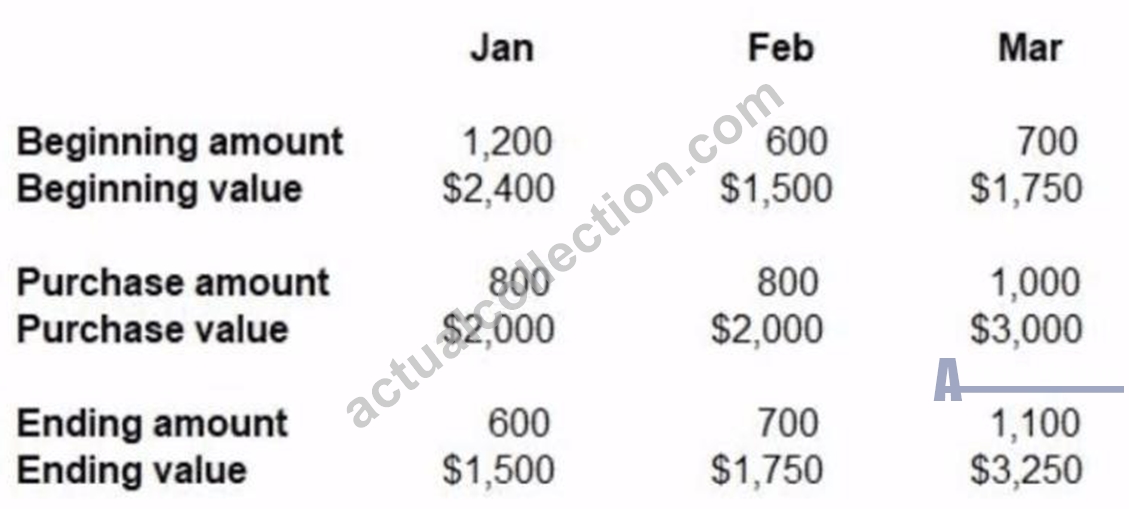
- A. average cost
- B. FIFO
- C. LIFO
- D. net weight scale
Answer: A
Explanation:
The organization's inventory records show that the beginning and ending amounts and values change each month, and the relationship between units and dollar values suggests that the cost per unit is averaged, not fixed (as with FIFO or LIFO). Let's evaluate January:
Beginning: 1,200 units / $2,400 # $2.00 per unit
Purchased: 800 units / $2,000 # $2.50 per unit
Ending: 600 units / $1,500 # $2.50 per unit
The ending value of $1,500 for 600 units gives a per-unit cost of $2.50, matching the purchase cost in January. This suggests the system uses a weighted average cost method rather than tracking the specific cost layers (as FIFO or LIFO would).
Relevant References:
FASAB SFFAS No. 3 - Accounting for Inventory and Related Property
GAAP and GASB guidelines on inventory valuation
GFOA Best Practices - Inventory and Supply Chain Management
B). average cost
NEW QUESTION # 78
If an internal service fund needs to develop an hourly billing rate, the calculation should include
- A. the replacement cost of equipment purchased during the year.
- B. all materials purchased during the year, even if the materials were not consumed.
- C. the acquisition cost of equipment purchased during the year.
- D. all materials consumed during the year.
Answer: D
Explanation:
An internal service fund is used to account for goods or services provided by one department or agency to other departments or agencies of the governmental unit, typically on a cost-reimbursement basis.
To establish accurate billing rates (e.g., hourly rates), the fund must use actual costs of providing services.
This includes materials consumed, labor, depreciation, and overhead. Materials purchased but not used should not be included in the rate calculation for the current period.
Relevant Standards and References:
FASAB SFFAS No. 4, Managerial Cost Accounting
GASB Codification Section 1800, Internal Service Funds
GFOA Best Practices - Internal Service Fund Rate Setting
Therefore, Option A is correct.
NEW QUESTION # 79
In state and local financial audits, material weaknesses must be reported to the
- A. legislature.
- B. taxpayers.
- C. governing body.
- D. local media.
Answer: C
Explanation:
What Are Material Weaknesses?
* Amaterial weaknessin internal control is a deficiency or combination of deficiencies that creates a reasonable possibility of a material misstatement in the financial statements that would not be prevented or detected in a timely manner.
* In the context of state and local financial audits, material weaknesses must be reported to those charged with governance, as they are responsible for oversight and corrective actions.
Why Is the Governing Body the Correct Answer?
* Thegoverning body(e.g., city council, county board, or state commission) is directly responsible for overseeing the entity's financial operations and ensuring accountability. Reporting material weaknesses to them ensures that corrective actions can be implemented to strengthen internal controls.
* Auditors communicate such findings through anaudit reportor amanagement letteraddressed to the governing body.
Why Other Options Are Incorrect:
* A. Legislature:The legislature may have oversight of state budgets and appropriations but is not the direct governing body for financial audits.
* C. Taxpayers:While transparency is important, material weaknesses are not directly reported to taxpayers. They may be disclosed in public audit reports, but taxpayers are not the primary audience.
* D. Local media:Material weaknesses are not formally reported to the media; their disclosure depends on the entity's public reporting processes.
References and Documents:
* GAO Yellow Book (GAGAS):Requires auditors to report material weaknesses to those charged with governance.
* GASB (Governmental Accounting Standards Board):Emphasizes the importance of communicating significant audit findings to governing bodies.
* AICPA Audit Standards (AU-C 265):Requires auditors to communicate material weaknesses to management and those charged with governance.
NEW QUESTION # 80
An agency offers service for a fee; bad debts have historically averaged 5% of each year's fee revenue. During the past fiscal year, $1.1 million in fee revenue was recorded and $1 million in fees was collected. What is the bad debt expense recorded for the past fiscal year?
- A. $100,000
- B. $ 50.000
- C. $ 55.000
- D. $ 5.000
Answer: C
Explanation:
The agency uses accrual accounting, meaning bad debt expense should be recognized based on the revenue earned, not the cash collected. The historical bad debt rate is 5%.
Fee revenue recorded = $1.1 million
Bad debt expense = 5% × $1,100,000 = $55,000
This matches the standard accounting treatment under FASAB SFFAS No. 1, where the expense is estimated and recognized in the same period as the related revenue.
Relevant References:
FASAB SFFAS No. 1 - Accounting for Selected Assets and Liabilities
GAAP treatment for allowance for doubtful accounts
Treasury Financial Manual - Accounts Receivable Accounting
C). $55,000
NEW QUESTION # 81
Wasteful year-end spending may be discouraged by including which of the following in the appropriation law?
- A. impoundment controls
- B. multi-year appropriation authority
- C. annual appropriations
- D. delimiting contracting procedures
Answer: B
Explanation:
Comprehensive Detailed Explanation:
Year-end wasteful spending (also known as "use-it-or-lose-it" spending) often occurs because agencies rush to obligate funds before they expire at fiscal year-end. Providing multi-year appropriations reduces this pressure by allowing agencies to obligate funds over a longer period, thus promoting better planning and reducing unnecessary or rushed spending.
Relevant References:
GAO Red Book - Appropriations Law
OMB Circular A-11 - Budget Execution
Congressional Budget Office (CBO) Reports on Year-End Spending
D). multi-year appropriation authority
NEW QUESTION # 82
All the following are required financial statement reporting on governmental funds EXCEPT
- A. expenditures and changes in fund balance.
- B. statement of cash flows.
- C. the operating statement.
- D. the balance sheet.
Answer: B
Explanation:
The governmental funds (e.g., general fund, special revenue fund, capital projects fund) are reported using the modified accrual basis and current financial resources measurement focus. Required financial statements for governmental funds include:
Balance Sheet
Statement of Revenues, Expenditures, and Changes in Fund Balances
There is no requirement for a statement of cash flows for governmental funds. The statement of cash flows is only required for proprietary funds (e.g., enterprise and internal service funds) and is prepared using the direct method.
Relevant References:
GASB Statement No. 34 - Basic Financial Statements
GASB Codification Section 2200
GFOA Governmental Fund Reporting Guidelines
D). statement of cash flows
NEW QUESTION # 83
The primary purpose of accumulating and reporting cost information is to O
- A. include specific details in external financial statements.
- B. inform stockholders of detailed operational data.
- C. meet a SEC reporting requirement.
- D. provide a means for management to assess decision performance.
Answer: D
Explanation:
The primary purpose of accumulating and reporting cost information-especially in government and nonprofit environments-is to support internal decision-making. Cost data help managers assess program efficiency, evaluate resource use, and make policy or operational decisions.
While external financial statements may incorporate summarized cost information, and stockholders and regulatory agencies may have interests in private-sector settings, the most direct and core purpose is to support management.
Relevant References:
FASAB SFFAS No. 4 - Managerial Cost Accounting Concepts and Standards
GFOA - Cost Accounting for Decision-Making
OMB Circular A-136 and A-11 (federal reporting objectives)
B). provide a means for management to assess decision performance
NEW QUESTION # 84
A state had problems with its cash reconciliation resulting in a difference between the total cash per books versus cash balance with banks. The possible loss could only be estimated within a range of $100 million to
$300 million with no amount within the range considered a better estimate than any other. The state should recognize a minimum liability of
- A. $100 million and disclose in the notes the exposure to an additional $200 million loss.
- B. an amount to be determined by external auditors.
- C. $300 million with no additional disclosure required.
- D. $200 million and disclose in the notes the exposure to an additional $100 million loss.
Answer: A
Explanation:
GASB Statement No. 62 (based on FASB ASC 450-20) provides guidance on recognizing loss contingencies.
If a loss is probable and the amount can only be estimated as a range, and no single amount within the range is better, the minimum amount in the range should be accrued.
The remainder of the range should be disclosed in the notes to the financial statements.
Thus:
Accrue: $100 million
Disclose: Additional exposure up to $200 million
Relevant References:
GASB Statement No. 62 - Paragraph 96
GAAP Implementation Guide - Loss Contingencies
AICPA Audit Guide - Government Auditing Standards
A). $100 million and disclose in the notes the exposure to an additional $200 million loss
NEW QUESTION # 85
A specific operation of the government is funded by 60% from the general fund, 40% from specific revenues.
This should be reported in which fund?
- A. internal service fund
- B. special revenue fund
- C. capital projects fund
- D. general fund
Answer: B
Explanation:
A special revenue fund is used to account for the proceeds of specific revenue sources that are restricted or committed to expenditure for specified purposes (other than debt service or capital projects). In this case, 40% of the operation is funded by specific revenues, which triggers the use of a special revenue fund, provided those revenues are legally restricted or committed to the operation.
Even though 60% of the funding comes from the general fund, the existence of a dedicated revenue stream (40%) for a specific purpose qualifies it for reporting in a special revenue fund.
Relevant References:
GASB Statement No. 54 - Fund Balance Reporting and Governmental Fund Type Definitions GASB Codification Section 1300 - Fund Types GFOA - Fund Structure Guidance B). special revenue fund
########################
NEW QUESTION # 86
According to GASB, when should landfill closure and post-closure costs be recognized?
- A. when payments for costs are made
- B. when the landfill is closed
- C. every five years until the landfill is closed
- D. each year the landfill is operating
Answer: D
Explanation:
Comprehensive Detailed Explanation:
According to GASB Statement No. 18 (Accounting for Municipal Solid Waste Landfill Closure and Postclosure Care Costs), governments must recognize a portion of closure and post-closure costs each year as the landfill's capacity is used.
This is done using the "units-of-consumption" method, meaning costs are accrued in proportion to how much of the landfill's total capacity has been filled. The total estimated cost is spread over the useful life of the landfill.
Relevant References:
GASB Statement No. 18 - Landfill Closure and Postclosure Costs
GASB Codification Section L10.103
GFOA Environmental Liabilities Guidance
D). each year the landfill is operating
NEW QUESTION # 87
Interest accrued on the public debt is reported as
- A. a receipt.
- B. an outlay.
- C. a cost of goods sold.
- D. a tax expenditure.
Answer: B
Explanation:
Interest accrued on the public debt (e.g., Treasury securities) is considered a government expenditure. In federal financial reporting and budgeting, this is classified as an outlay, representing a payment made to meet an obligation.
It is not a receipt (revenues collected), a cost of goods sold (used in commercial accounting), or a tax expenditure (which refers to revenue foregone due to deductions, credits, etc.).
Relevant References:
OMB Circular A-11 - Budgetary Definitions
Treasury Financial Manual (TFM) - Federal Outlay Reporting
GAO Glossary - Public Debt Interest Treatment
B). an outlay
NEW QUESTION # 88
......
2026 New ActualCollection GAFRB PDF Recently Updated Questions: https://examcollection.actualcollection.com/GAFRB-exam-questions.html