

Download Microsoft DP-420 Exam Dumps to Pass Exam Easily in 2026
Get 100% Real Free Azure Cosmos DB Developer Specialty DP-420 Sample Questions
NEW QUESTION # 136
You have an Azure Cosmos DB account named account1 that has a default consistency level of session.
You have an app named App1.
You need to ensure that the read operations of App1 can request either bounded staleness or consistent prefix consistency.
What should you modify for each consistency level? To answer, select the appropriate options in the answer area.
NOTE: Each correct selection is worth one point.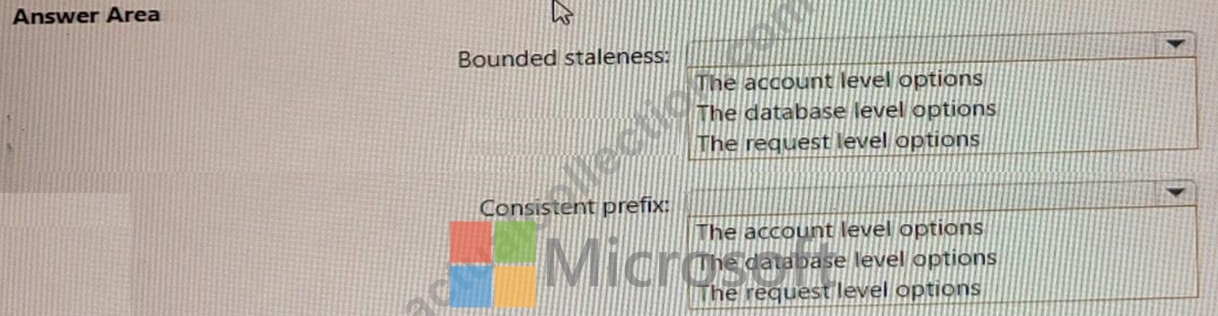
Answer:
Explanation: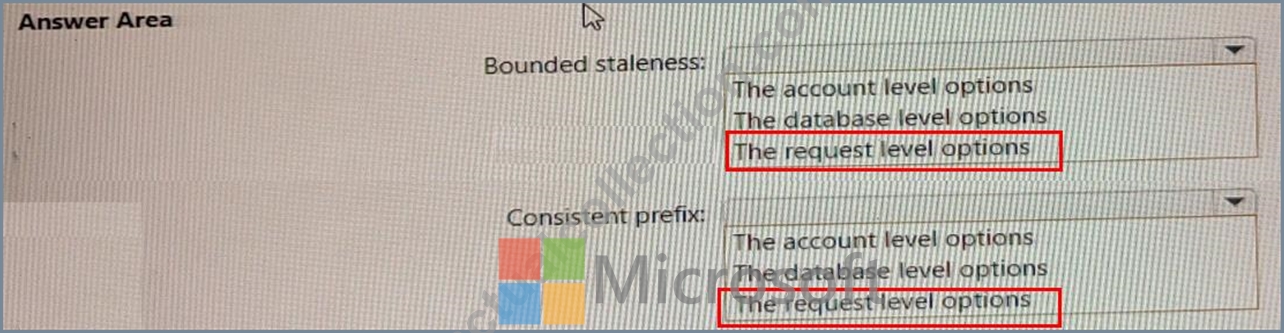
NEW QUESTION # 137
You have an Azure Cosmos DB for NoSQL account that has multiple write regions.
You need to receive an alert when requests that target the database exceed the available request units per second (RU/s).
Which Azure Monitor signal should you use?
- A. Metadata Requests
- B. Region Removed
- C. Document Quota
- D. Data Usage
Answer: C
Explanation:
Azure Monitor is a service that provides comprehensive monitoring for Azure resources, including Azure Cosmos DB. You can use Azure Monitor to collect, analyze, and alert on metrics and logs from your Azure Cosmos DB account. You can create alerts for Azure Cosmos DB using Azure Monitor based on the metrics, activity log events, or Log Analytics logs on your account1.
For your scenario, if you want to receive an alert when requests that target the database exceed the available request units per second (RU/s), you should use the Document Quota metric. This metric measures the percentage of RU/s consumed by your account or container. You can create an alert rule on this metric from the Azure portal by following these steps2:
In the Azure portal, select the Azure Cosmos DB account you want to monitor.
Under the Monitoring section of the sidebar, select Alerts, and then select New alert rule.
In the Create alert rule pane, fill out the Scope section by selecting your subscription name and resource type (Azure Cosmos DB accounts).
In the Condition section, select Add condition and choose Document Quota from the list of signals.
In the Configure signal logic pane, specify the threshold value and operator for your alert condition. For example, you can choose Greater than or equal to 90 as the threshold value and operator to receive an alert when your RU/s consumption reaches 90% or more of your provisioned throughput.
In the Alert rule details section, specify a name and description for your alert rule.
In the Actions section, select Add action group and choose how you want to receive notifications for your alert. For example, you can choose Email/SMS/Push/Voice as an action type and enter your email address or phone number as a receiver.
Review your alert rule settings and select Create alert rule to save it.
NEW QUESTION # 138
You have an Azure Cosmos DB for NoSQL account named accounts1.
You plan to implement the integrated cache for account1.
You need to configure the connectivity mode and the consistency level for requests that target account1. The solution must maximize consistency while using the integrated cache.
What should you configure? To answer, select the appropriate options in the answer area.
NOTE: Each correct selection is worth one point.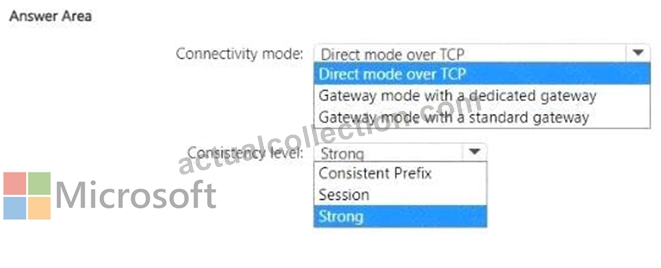
Answer:
Explanation: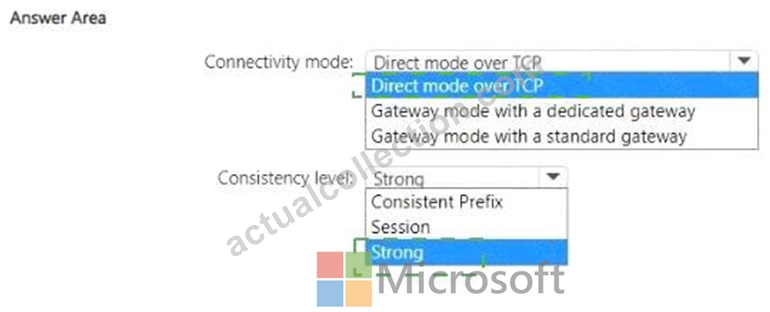
Explanation: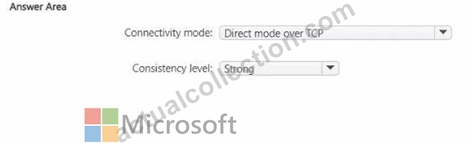
NEW QUESTION # 139
You have a container named container1 in an Azure Cosmos DB Core (SQL) API account.
The following is a sample of a document in container1.
{
"studentId": "631282",
"firstName": "James",
"lastName": "Smith",
"enrollmentYear": 1990,
"isActivelyEnrolled": true,
"address": {
"street": "",
"city": "",
"stateProvince": "",
"postal": "",
}
}
The container1 container has the following indexing policy.
{
"indexingMode": "consistent",
"includePaths": [
{
"path": "/*"
},
{
"path": "/address/city/?"
}
],
"excludePaths": [
{
"path": "/address/*"
},
{
"path": "/firstName/?"
}
]
}
For each of the following statements, select Yes if the statement is true. Otherwise, select No.
NOTE: Each correct selection is worth one point.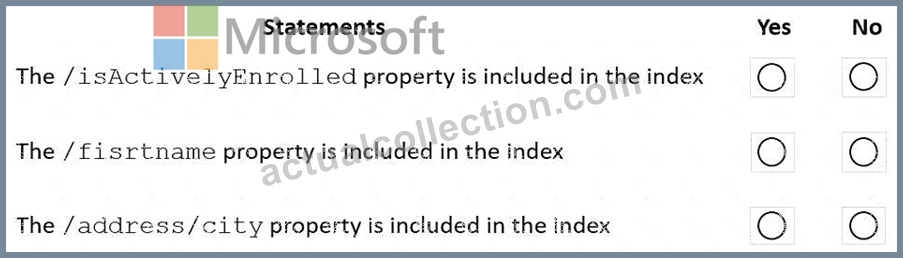
Answer:
Explanation: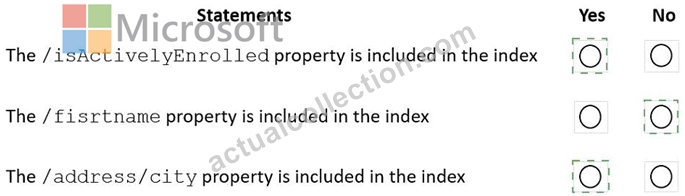
Explanation: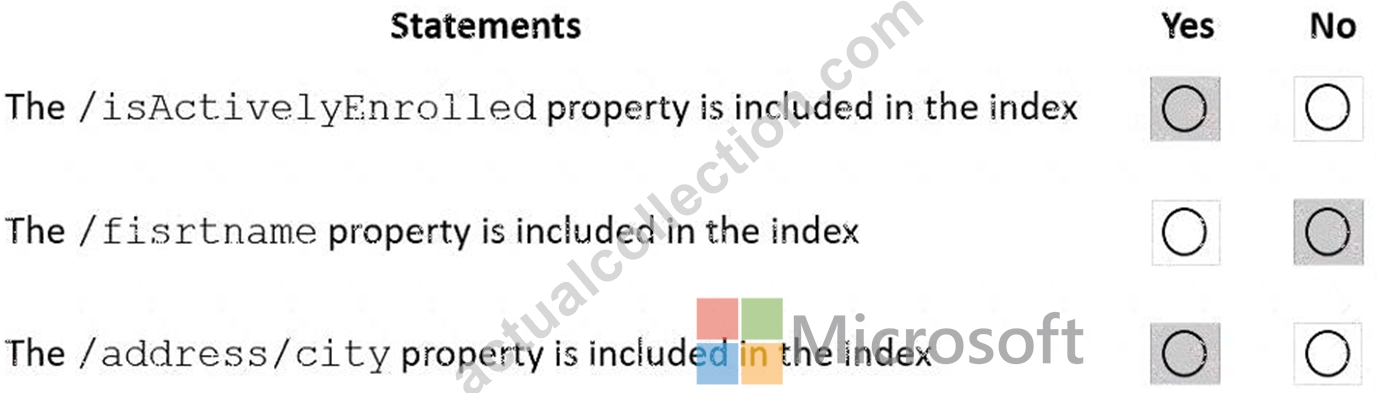
Box 1: Yes
"path": "/*" is in includePaths.
Include the root path to selectively exclude paths that don't need to be indexed. This is the recommended approach as it lets Azure Cosmos DB proactively index any new property that may be added to your model.
Box 2: No
"path": "/firstName/?" is in excludePaths.
Box 3: Yes
"path": "/address/city/?" is in includePaths
Reference: https://docs.microsoft.com/en-us/azure/cosmos-db/index-policy
NEW QUESTION # 140
You have an Azure Cosmos DB Core (SQL) API account named account1 that has the disableKeyBasedMetadataWriteAccess property enabled.
You are developing an app named App1 that will be used by a user named DevUser1 to create containers in account1. DevUser1 has a non-privileged user account in the Azure Active Directory (Azure AD) tenant.
You need to ensure that DevUser1 can use App1 to create containers in account1.
What should you do? To answer, select the appropriate options in the answer area.
NOTE: Each correct selection is worth one point.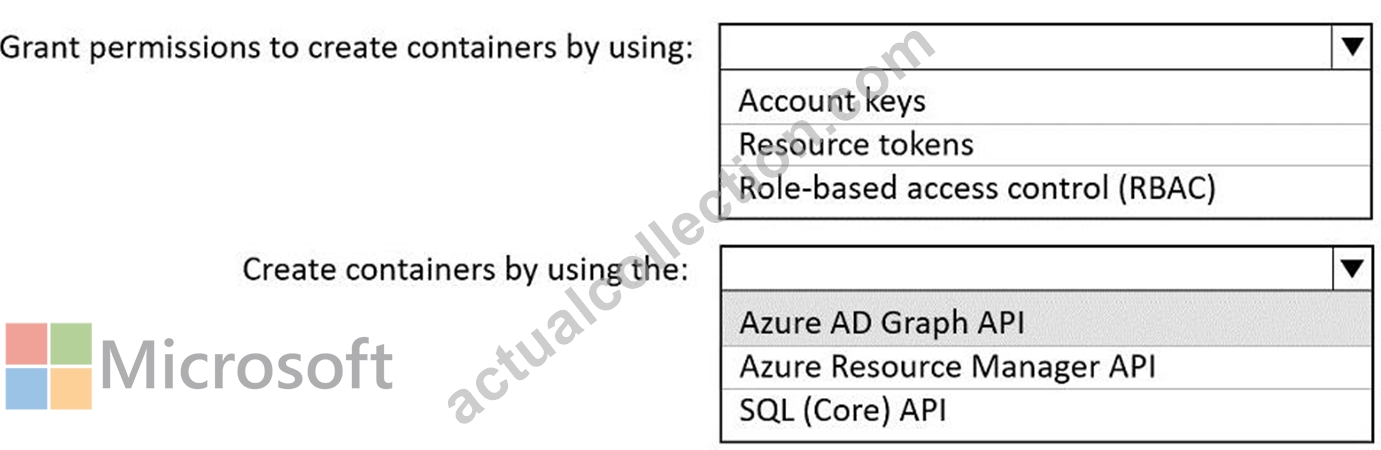
Answer:
Explanation: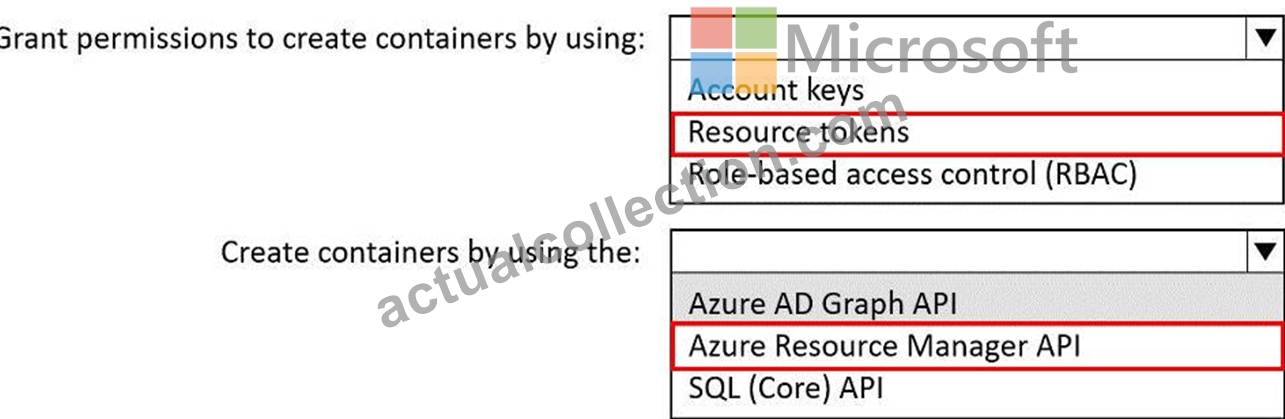
Reference:
https://docs.microsoft.com/en-us/azure/cosmos-db/secure-access-to-data
https://docs.microsoft.com/en-us/rest/api/resources/
NEW QUESTION # 141
Hotspot Question
You have three containers in an Azure Cosmos DB Core (SQL) API account as shown in the following table.
You have the following Azure functions:
- A function named Fn1 that reads the change feed of cn1
- A function named Fn2 that reads the change feed of cn2
- A function named Fn3 that reads the change feed of cn3
You perform the following actions:
- Delete an item named item1 from cn1.
- Update an item named item2 in cn2.
For an item named item3 in cn3, update the item time to live to 3,600 seconds. For each of the following statements, select Yes if the statement is true. Otherwise, select No.
NOTE: Each correct selection is worth one point.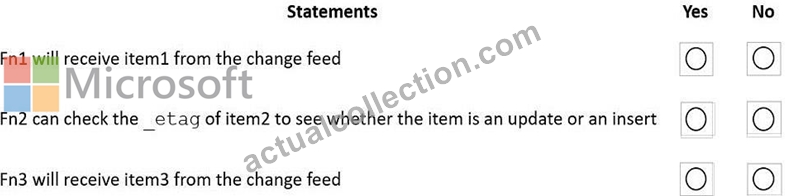
Answer:
Explanation: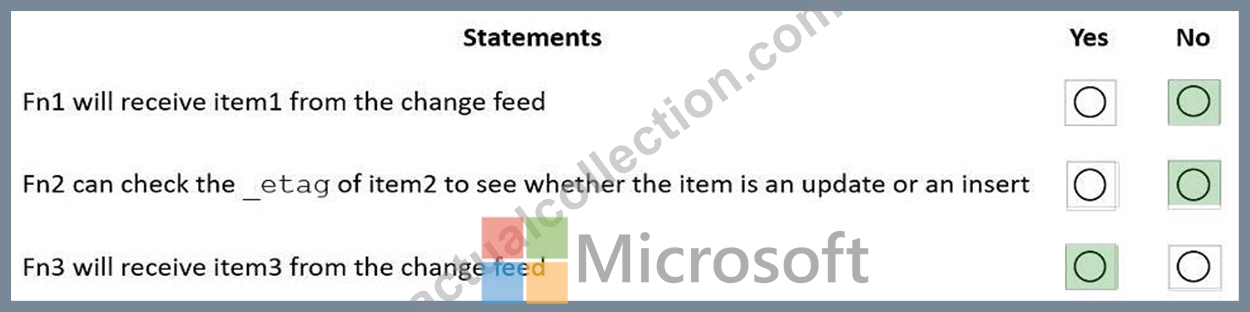
Explanation:
Box 1: No
Azure Cosmos DB's change feed is a great choice as a central data store in event sourcing architectures where all data ingestion is modeled as writes (no updates or deletes). Note: The change feed does not capture deletes. If you delete an item from your container, it is also removed from the change feed. The most common method of handling this is adding a soft marker on the items that are being deleted. You can add a property called "deleted" and set it to
"true" at the time of deletion. This document update will show up in the change feed. You can set a TTL on this item so that it can be automatically deleted later.
Box 2: No
The _etag format is internal and you should not take dependency on it, because it can change anytime.
Box 3: Yes
Change feed support in Azure Cosmos DB works by listening to an Azure Cosmos container for any changes.
Reference:
https://docs.microsoft.com/en-us/azure/cosmos-db/sql/change-feed-design-patterns
https://docs.microsoft.com/en-us/azure/cosmos-db/change-feed
NEW QUESTION # 142
Hotspot Question
You configure Azure Cognitive Search to index a container in an Azure Cosmos DB for NoSQL account as shown in the following exhibit.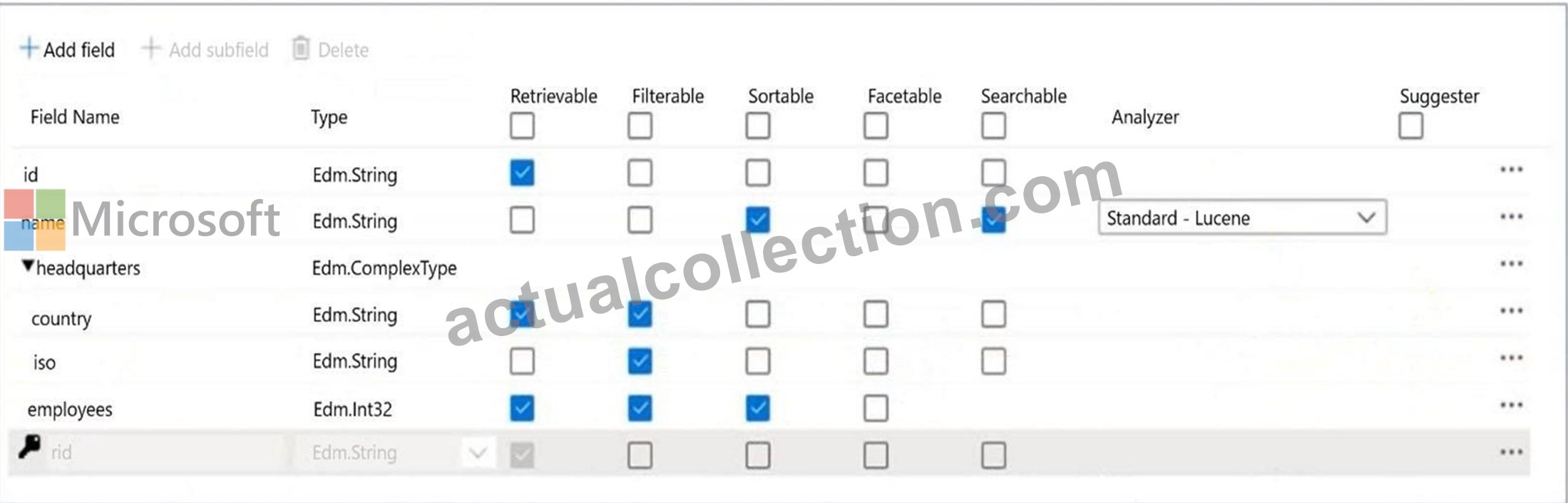
Use the drop-down menus to select the answer choice that completes each statement based on the information presented in the graphic.
NOTE: Each correct selection is worth one point.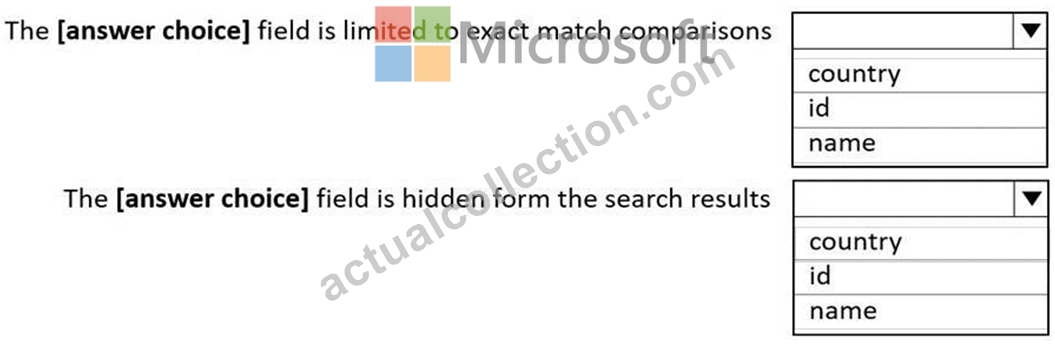
Answer:
Explanation: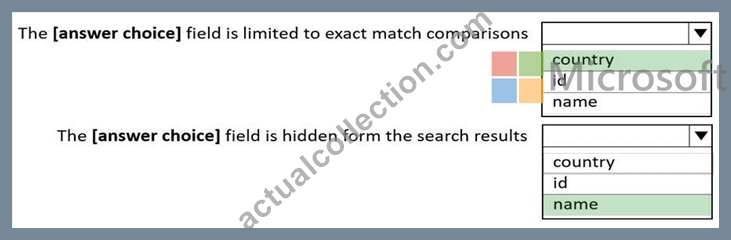
Explanation:
Box 1: country
The country field is filterable.
Note: filterable: Indicates whether to enable the field to be referenced in $filter queries. Filterable differs from searchable in how strings are handled. Fields of type Edm.String or Collection(Edm.String) that are filterable do not undergo lexical analysis, so comparisons are for exact matches only.
Box 2: name
The name field is not Retrievable.
Retrievable: Indicates whether the field can be returned in a search result. Set this attribute to false if you want to use a field (for example, margin) as a filter, sorting, or scoring mechanism but do not want the field to be visible to the end user.
Note: searchable: Indicates whether the field is full-text searchable and can be referenced in search queries.
Reference: https://docs.microsoft.com/en-us/rest/api/searchservice/create-index
NEW QUESTION # 143
Note: This question is part of a series of questions that present the same scenario. Each question in the series contains a unique solution that might meet the stated goals. Some question sets might have more than one correct solution, while others might not have a correct solution.
After you answer a question in this section, you will NOT be able to return to it. As a result, these questions will not appear in the review screen.
You have a container named container1 in an Azure Cosmos DB Core (SQL) API account.
You need to make the contents of container1 available as reference data for an Azure Stream Analytics job.
Solution: You create an Azure Data Factory pipeline that uses Azure Cosmos DB Core (SQL) API as the input and Azure Blob Storage as the output.
Does this meet the goal?
- A. Yes
- B. No
Answer: B
Explanation:
Explanation
Instead create an Azure function that uses Azure Cosmos DB Core (SQL) API change feed as a trigger and Azure event hub as the output.
The Azure Cosmos DB change feed is a mechanism to get a continuous and incremental feed of records from an Azure Cosmos container as those records are being created or modified. Change feed support works by listening to container for any changes. It then outputs the sorted list of documents that were changed in the order in which they were modified.
The following diagram represents the data flow and components involved in the solution:
Reference: https://docs.microsoft.com/en-us/azure/cosmos-db/sql/changefeed-ecommerce-solution
NEW QUESTION # 144
Gateway mode using the dedicated gateway is one of the ways to connect to an Azure Cosmos DB account. Which of the following statement(s) is/are true about a dedicated gateway?
- A. A dedicated gateway can be provisioned in Azure Cosmos DB accounts with IP firewalls or Private Link configured
- B. You can use RBAC (role-based access control) to authenticate data plane requests routed through the dedicated gateway
- C. A dedicated gateway can be provisioned in an Azure Cosmos DB account in a Virtual Network (Vnet)
- D. Dedicated gateways are supported only on SQL API accounts
Answer: D
Explanation:
https://docs.microsoft.com/en-us/azure/cosmos-db/dedicated-gateway#connect-to-azure-cosmos-db-using-direct-mode
NEW QUESTION # 145
Note: This question is part of a series of questions that present the same scenario. Each question in the series contains a unique solution that might meet the stated goals. Some question sets might have more than one correct solution, while others might not have a correct solution.
After you answer a question in this section, you will NOT be able to return to it. As a result, these questions will not appear in the review screen.
You have a container named container1 in an Azure Cosmos DB Core (SQL) API account.
You need to make the contents of container1 available as reference data for an Azure Stream Analytics job.
Solution: You create an Azure Data Factory pipeline that uses Azure Cosmos DB Core (SQL) API as the input and Azure Blob Storage as the output.
Does this meet the goal?
- A. Yes
- B. No
Answer: B
Explanation:
Explanation
Instead create an Azure function that uses Azure Cosmos DB Core (SQL) API change feed as a trigger and Azure event hub as the output.
The Azure Cosmos DB change feed is a mechanism to get a continuous and incremental feed of records from an Azure Cosmos container as those records are being created or modified. Change feed support works by listening to container for any changes. It then outputs the sorted list of documents that were changed in the order in which they were modified.
The following diagram represents the data flow and components involved in the solution:
Reference: https://docs.microsoft.com/en-us/azure/cosmos-db/sql/changefeed-ecommerce-solution
NEW QUESTION # 146
You have a database in an Azure Cosmos DB Core (SQL) API account.
You plan to create a container that will store employee data for 5,000 small businesses. Each business will have up to 25 employees. Each employee item will have an emailAddress value.
You need to ensure that the emailAddress value for each employee within the same company is unique.
To what should you set the partition key and the unique key? To answer, select the appropriate options in the answer area.
NOTE: Each correct selection is worth one point.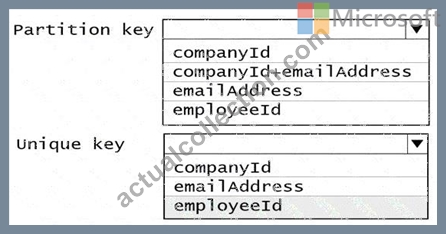
Answer:
Explanation: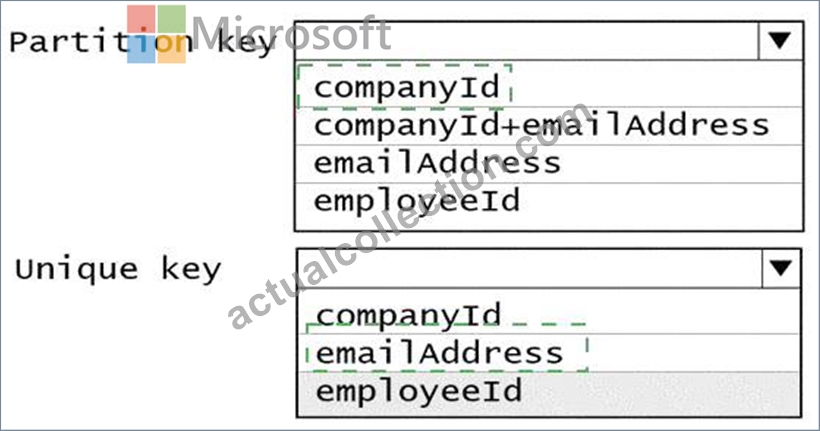
Explanation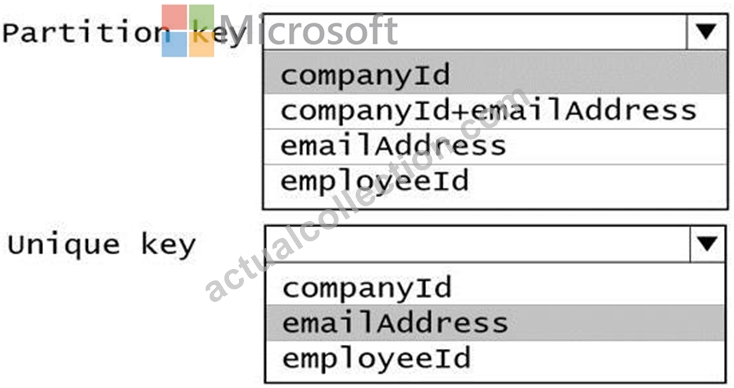
Box 1: CompanyID
After you create a container with a unique key policy, the creation of a new or an update of an existing item resulting in a duplicate within a logical partition is prevented, as specified by the unique key constraint. The partition key combined with the unique key guarantees the uniqueness of an item within the scope of the container.
For example, consider an Azure Cosmos container with Email address as the unique key constraint and CompanyID as the partition key. When you configure the user's email address with a unique key, each item has a unique email address within a given CompanyID. Two items can't be created with duplicate email addresses and with the same partition key value.
Box 2: emailAddress
Reference: https://docs.microsoft.com/en-us/azure/cosmos-db/unique-keys
NEW QUESTION # 147
The following is a sample of a document in orders.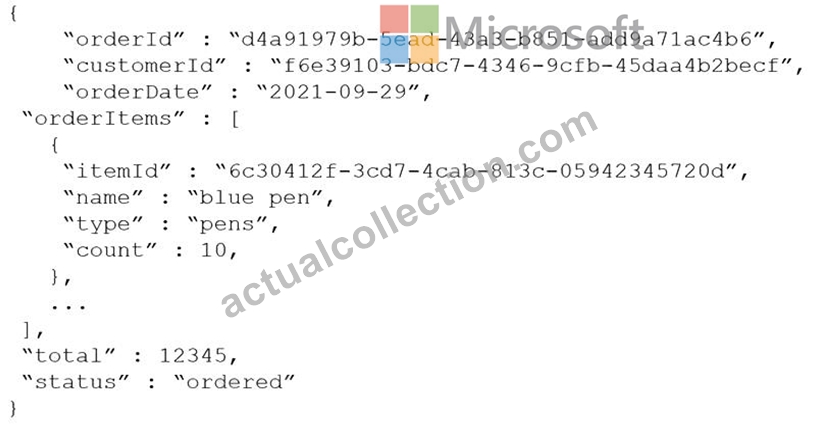
The orders container uses customer as the partition key.
You need to provide a report of the total items ordered per month by item type. The solution must meet the following requirements:
Ensure that the report can run as quickly as possible.
Minimize the consumption of request units (RUs).
What should you do?
- A. Configure the report to query a new aggregate container. Populate the aggregates by using the change feed.
- B. Configure the report to query a new aggregate container. Populate the aggregates by using SQL queries that run daily.
- C. Configure the report to query orders by using a SQL query.
- D. Configure the report to query orders by using a SQL query through a dedicated gateway.
Answer: A
Explanation:
You can facilitate aggregate data by using Change Feed and Azure Functions, and then use it for reporting.
Reference: https://docs.microsoft.com/en-us/azure/cosmos-db/change-feed
NEW QUESTION # 148
You plan to use a multi-region Azure Cosmos DB for NoSQL account to store data for a new application suite.
The suite contains the applications shown in the following table.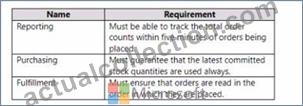
Each application should use the weakest consistency level possible.
Which consistency level should you configure for each application? To answer, select the appropriate options in the answer area. NOTE: Each correct selection is worth one point.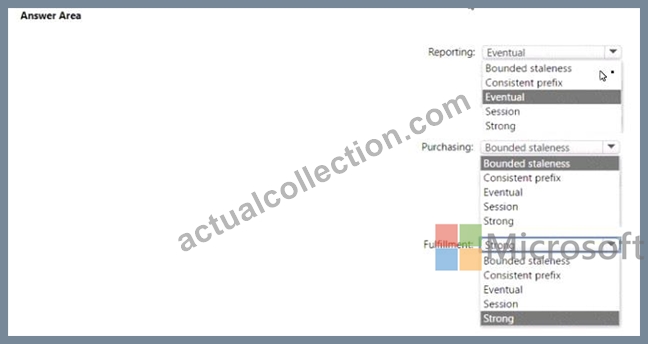
Answer:
Explanation: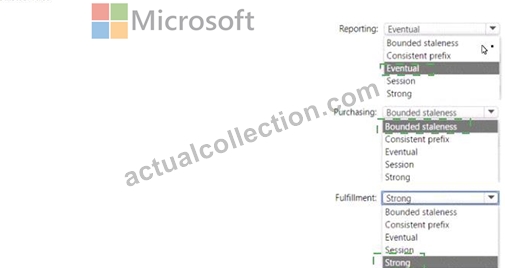
Explanation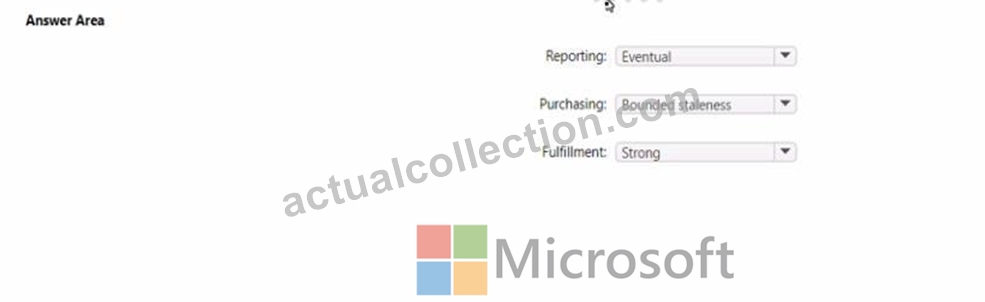
NEW QUESTION # 149
You have an Azure Cosmos DB for NoSQL database that hosts the containers shown in the following table.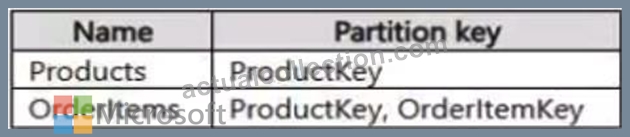
You need to ensure that when a product name changes in the Products container, the product name changes in all orders that have NOT been shipped.
What should you implement?
- A. a change feed
- B. a pre-trigger
- C. a stored procedure
- D. a post-trigger
Answer: A
Explanation:
To ensure the product name stays synchronized between your Products and OrderItems containers in Azure Cosmos DB, you should implement a Change Feed-driven microservice.
Because Cosmos DB is a non-relational database, it does not support traditional SQL "joins" or automatic cascading updates across containers. You must handle this "denormalization" logic yourself.
The Core Constraint
OrderItems has a composite or different partition key logic (ProductKey, OrderItemKey).
Even if they share ProductKey, a single update in Products cannot automatically lock or update rows in OrderItems across different logical partitions.
Required Components
1. Enable Change Feed on the "Products" Container
This acts as a persistent log of all changes (inserts and updates).
It triggers your logic whenever a ProductName is modified.
2. Azure Functions (with Cosmos DB Trigger)
The easiest way to process the Change Feed.
Trigger: Monitors the Products container.
Reference:
https://devblogs.microsoft.com/cosmosdb/data-modeling-and-partitioning-for-relational-workloads
NEW QUESTION # 150
You have an Azure subscription.
You plan to implement an Azure Cosmos DB for NoSQL single-region write account named account1 that will replicate across two Azure regions.
You need to set the default consistency level for account1. The solution must meet the following requirements:
- Writes must be performed to a local majority in a single region.
- Reads must be performed from a local minority in a single region.
Which consistency level should you select?
- A. Consistent Prefix
- B. Session
- C. Bounded Staleness
- D. Strong
Answer: C
Explanation:
Based on the Azure Cosmos DB architecture for a NoSQL single-region write account with two regions, the appropriate consistency level is Bounded Staleness.
Here is how this level maps to your specific requirements:
Writes to a Local Majority: For all consistency levels except Strong, Azure Cosmos DB performs writes to a local majority (three out of four replicas) within the primary write region before acknowledging the operation.
Reads from a Local Minority: In the Bounded Staleness and Strong consistency levels, reads are performed against a local minority (two replicas in a four-replica set) to compare log sequence numbers (LSN) and ensure consistency.
Single-Region Write vs. Strong Consistency: While Strong consistency also uses local minority reads, it requires a global majority for writes (acknowledgment from all regions), which contradicts your requirement for a "local majority" write.
Regional Behavior: Bounded Staleness is specifically recommended for single-region write accounts with multiple regions where "near strong" consistency is desired; it provides strong consistency guarantees for clients reading within the same region as the write.
Incorrect:
Other levels like Session, Consistent Prefix, and Eventual perform reads from only a single replica, which does not meet your "local minority" read requirement.
Reference:
https://learn.microsoft.com/en-us/azure/cosmos-db/consistency-levels
NEW QUESTION # 151
You have an Azure Cosmos DB for NoSQL database named DB1 that hosts a container named Contained.
The partition key for Container! is /city.
You are developing a cloud-native app named App1 that will store customer information in DB1. App1 will perform transactional batch operations to update the items in Contained.
You need to configure App1 to meet the following requirements:
* Ensure that batch operations are rolled back if an item ' s ETag value has changed since the value was last read.
* Ensure that all operations in the batch apply to a single partition key value.
How should you complete the C# code? To answer, select the appropriate options in the answer area.
NOTE: Each correct selection is worth one point.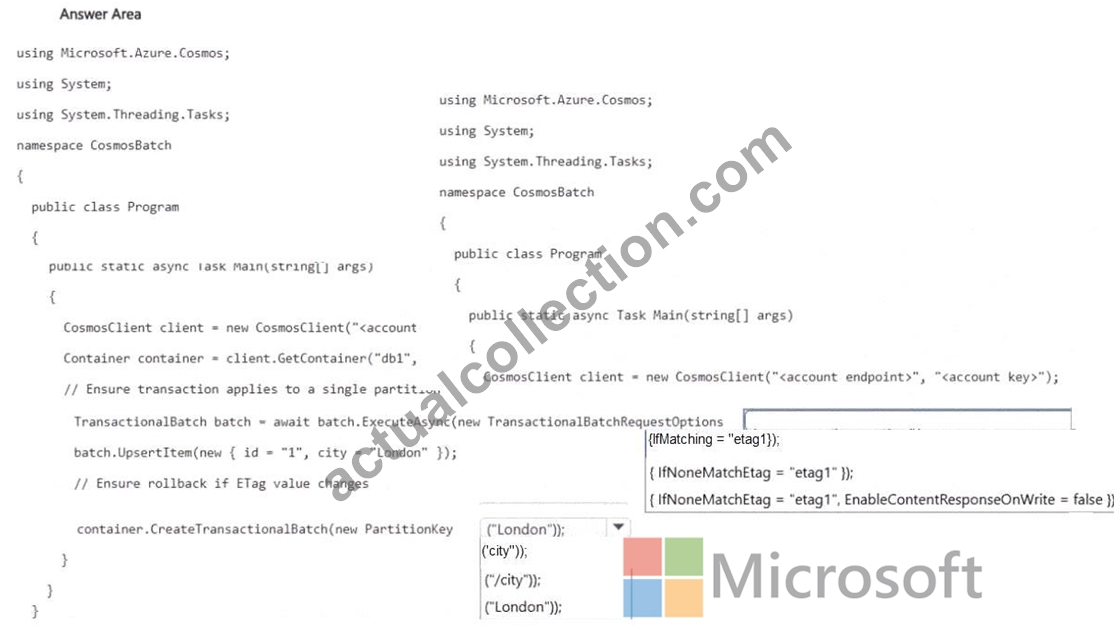
Answer:
Explanation: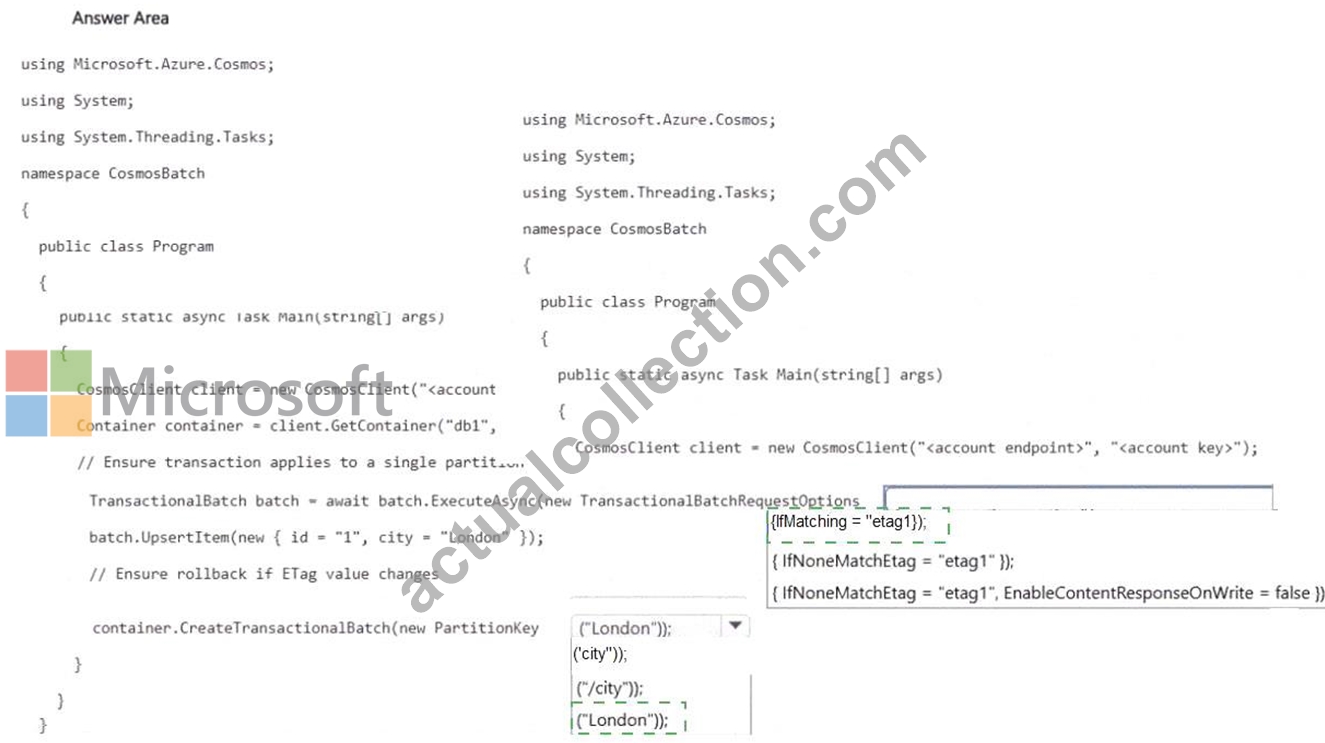
Explanation: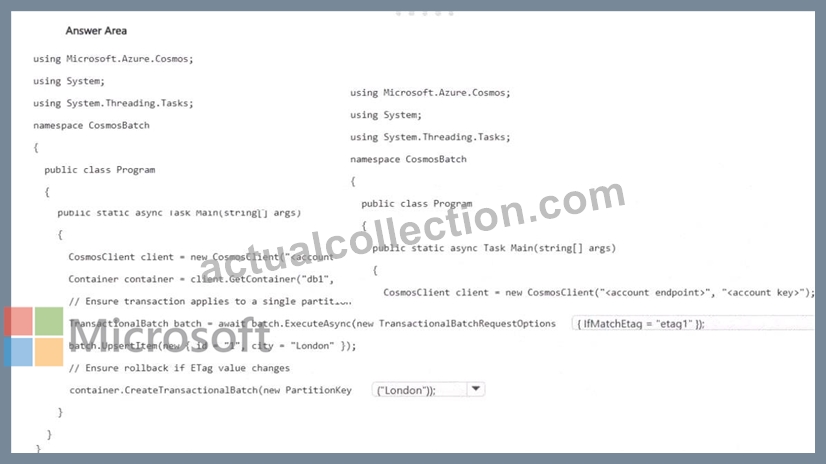
NEW QUESTION # 152
You have a database in an Azure Cosmos DB Core (SQL) API account.
You plan to create a container that will store employee data for 5,000 small businesses. Each business will have up to 25 employees. Each employee item will have an emailAddress value.
You need to ensure that the emailAddress value for each employee within the same company is unique.
To what should you set the partition key and the unique key? To answer, select the appropriate options in the answer area.
NOTE: Each correct selection is worth one point.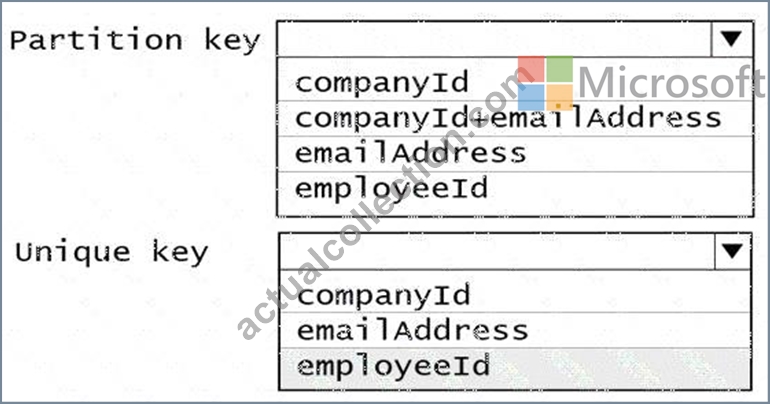
Answer:
Explanation: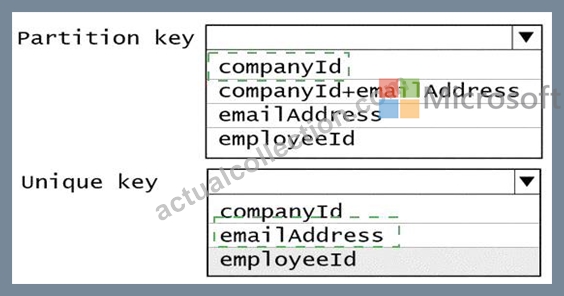
Explanation
Box 1: CompanyID
After you create a container with a unique key policy, the creation of a new or an update of an existing item resulting in a duplicate within a logical partition is prevented, as specified by the unique key constraint. The partition key combined with the unique key guarantees the uniqueness of an item within the scope of the container.
For example, consider an Azure Cosmos container with Email address as the unique key constraint and CompanyID as the partition key. When you configure the user's email address with a unique key, each item has a unique email address within a given CompanyID. Two items can't be created with duplicate email addresses and with the same partition key value.
Box 2: emailAddress
Reference: https://docs.microsoft.com/en-us/azure/cosmos-db/unique-keys
NEW QUESTION # 153
Hotspot Question
You have an Azure Cosmos DB for NoSQL database that hosts a container named Container1.
Container1 stores order details, including the following properties:
- OrderNumber (a number)
- OrderDate (a date)
You need to write a query that returns the following for each order:
- OrderNumber
- PeriodDate (as the first day of the calendar year based on orderDate) How should you complete the query? To answer, select the appropriate options in the answer area.
NOTE: Each correct selection is worth one point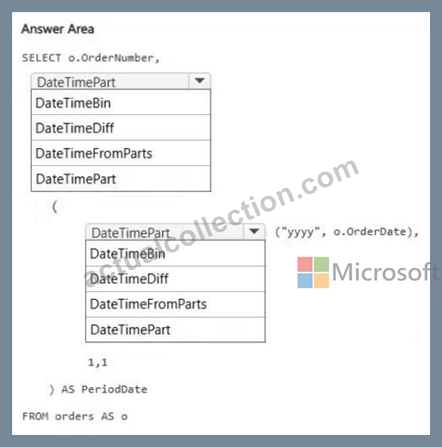
Answer:
Explanation: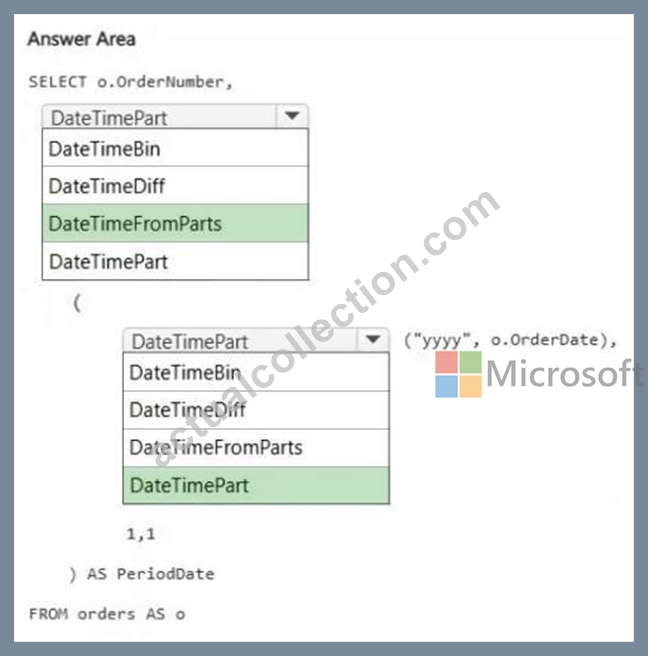
NEW QUESTION # 154
You plan to create an Azure Cosmos DB database named db1 that will contain two containers. One of the containers will contain blog posts, and the other will contain users. Each item in the blog post container will include:
* A single blog post
* All the comments associated to the blog post
* The names of the users who created the blog post and added the comments.
You need to design a solution to update usernames m the user container without causing data integrity issues.
The solution must minimize administrative and development effort. What should you include in the solution?
To answer, select the appropriate options in the answer area.
NOTE: Each correct selection is worth one point.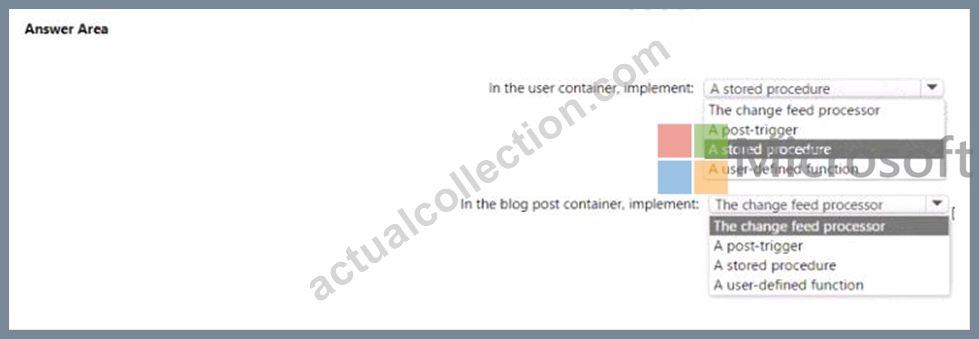
Answer:
Explanation: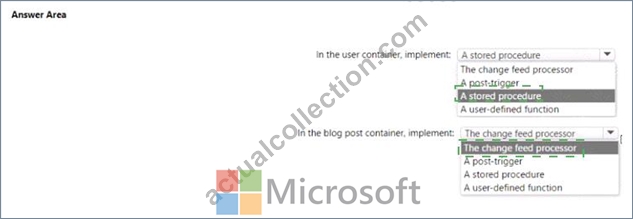
Explanation: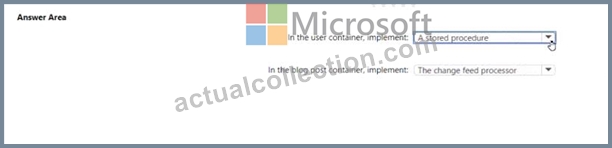
NEW QUESTION # 155
You have a container named container1 in an Azure Cosmos DB Core (SQL) API account. Upserts of items in container1 occur every three seconds.
You have an Azure Functions app named function1 that is supposed to run whenever items are inserted or replaced in container1.
You discover that function1 runs, but not on every upsert.
You need to ensure that function1 processes each upsert within one second of the upsert.
Which property should you change in the Function.json file of function1?
- A. leaseCollectionsThroughput
- B. maxItemsPerInvocation
- C. checkpointInterval
- D. feedPollDelay
Answer: D
NEW QUESTION # 156
You are troubleshooting the current issues caused by the application updates.
Which action can address the application updates issue without affecting the functionality of the application?
- A. Add a custom indexing policy to the con-product container.
- B. Set the default consistency level of account1 to bounded staleness.
- C. Set the default consistency level of account1 to strong.
- D. Enable time to live for the con-product container.
Answer: B
Explanation:
Bounded staleness is frequently chosen by globally distributed applications that expect low write latencies but require total global order guarantee. Bounded staleness is great for applications featuring group collaboration and sharing, stock ticker, publish-subscribe/queueing etc.
Scenario: Application updates in con-product frequently cause HTTP status code 429 "Too many requests". You discover that the 429 status code relates to excessive request unit (RU) consumption during the updates.
Reference:
https://docs.microsoft.com/en-us/azure/cosmos-db/consistency-levels
Topic 1, Litware, inc
Overview
This is a case study. Case studies are not timed separately. You can use as much exam time as you would like to complete each case. However, there may be additional case studies and sections on this exam. You must manage your time to ensure that you are able to complete all questions included on this exam in the time provided.
To answer the questions included in a case study, you will need to reference information that is provided in the case study. Case studies might contain exhibits and other resources that provide more information about the scenario that is described in the case study. Each question is independent of the other questions in this case study.
At the end of this case study, a review screen will appear. This screen allows you to review your answers and to make changes before you move to the next section of the exam. After you begin a new section, you cannot return to this section.
To start the case study
To display the first question in this case study, click the Next button. Use the buttons in the left pane to explore the content of the case study before you answer the questions. Clicking these buttons displays information such as business requirements, existing environment, and problem statements. If the case study has an All Information tab, note that the information displayed is identical to the information displayed on the subsequent tabs. When you are ready to answer a question, click the Question button to return to the question.
Overview
Litware, Inc. is a United States-based grocery retailer. Litware has a main office and a primary datacenter in Seattle. The company has 50 retail stores across the United States and an emerging online presence. Each store connects directly to the internet.
Existing environment. Cloud and Data Service Environments.
Litware has an Azure subscription that contains the resources shown in the following table.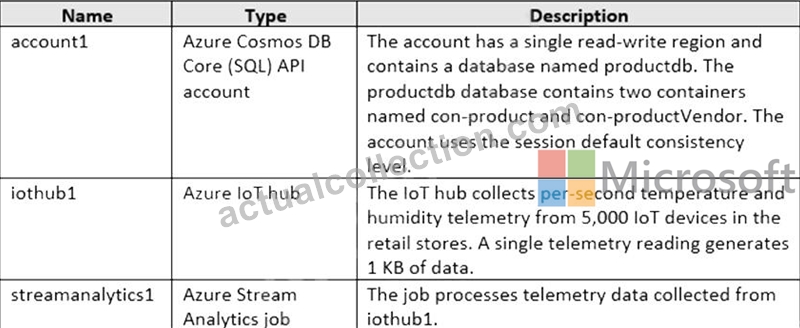
Each container in productdb is configured for manual throughput.
The con-product container stores the company's product catalog data. Each document in con-product includes a con-productvendor value. Most queries targeting the data in con-product are in the following format.
SELECT * FROM con-product p WHERE p.con-productVendor - 'name'
Most queries targeting the data in the con-productVendor container are in the following format SELECT * FROM con-productVendor pv ORDER BY pv.creditRating, pv.yearFounded Existing environment. Current Problems.
Litware identifies the following issues:
Updates to product categories in the con-productVendor container do not propagate automatically to documents in the con-product container.
Application updates in con-product frequently cause HTTP status code 429 "Too many requests". You discover that the 429 status code relates to excessive request unit (RU) consumption during the updates.
Requirements. Planned Changes
Litware plans to implement a new Azure Cosmos DB Core (SQL) API account named account2 that will contain a database named iotdb. The iotdb database will contain two containers named con-iot1 and con-iot2.
Litware plans to make the following changes:
Store the telemetry data in account2.
Configure account1 to support multiple read-write regions.
Implement referential integrity for the con-product container.
Use Azure Functions to send notifications about product updates to different recipients.
Develop an app named App1 that will run from all locations and query the data in account1.
Develop an app named App2 that will run from the retail stores and query the data in account2. App2 must be limited to a single DNS endpoint when accessing account2.
Requirements. Business Requirements
Litware identifies the following business requirements:
Whenever there are multiple solutions for a requirement, select the solution that provides the best performance, as long as there are no additional costs associated.
Ensure that Azure Cosmos DB costs for IoT-related processing are predictable.
Minimize the number of firewall changes in the retail stores.
Requirements. Product Catalog Requirements
Litware identifies the following requirements for the product catalog:
Implement a custom conflict resolution policy for the product catalog data.
Minimize the frequency of errors during updates of the con-product container.
Once multi-region writes are configured, maximize the performance of App1 queries against the data in account1.
Trigger the execution of two Azure functions following every update to any document in the con-product container.
NEW QUESTION # 157
You plan to store order data in an Azure Cosmos DB for NoSQL account. The data contains information about orders and their associated items.
You need to develop a model that supports read operations for orders. The solution must minimize the number of requests.
What should you do?
- A. Create a single database that contains one container. Store orders and order items in separate documents in the container.
- B. Create a single database that contains one container. Create a separate document for each order and embed the order items into the order documents.
- C. Create a database for orders and a database for order items.
- D. Create a single database that contains a container for orders and a container for order items.
Answer: B
Explanation:
By denormalizing data, your application may need to issue fewer queries and updates to complete common operations.
Typically denormalized data models provide better read performance.
Note: In general, use embedded data models when:
There are contained relationships between entities.
There are one-to-few relationships between entities.
There's embedded data that changes infrequently.
There's embedded data that will not grow without bound.
There's embedded data that is queried frequently together.
Reference:
https://docs.microsoft.com/en-us/azure/cosmos-db/sql/modeling-data
NEW QUESTION # 158
You need to configure an Apache Kafka instance to ingest data from an Azure Cosmos DB Core (SQL) API account. The data from a container named telemetry must be added to a Kafka topic named iot. The solution must store the data in a compact binary format.
Which three configuration items should you include in the solution? Each correct answer presents part of the solution.
NOTE: Each correct selection is worth one point.
- A. "connector.class": "com.azure.cosmos.kafka.connect.source.CosmosDBSourceConnector"
- B. "key.converter": "org.apache.kafka.connect.json.JsonConverter"
- C. "key.converter": "io.confluent.connect.avro.AvroConverter"
- D. "connector.class": "com.azure.cosmos.kafka.connect.source.CosmosDBSinkConnector"
- E. "connect.cosmos.containers.topicmap": "iot#telemetry"
- F. "connect.cosmos.containers.topicmap": "iot"
Answer: C,D,E
Explanation:
C: Avro is binary format, while JSON is text.
F: Kafka Connect for Azure Cosmos DB is a connector to read from and write data to Azure Cosmos DB. The Azure Cosmos DB sink connector allows you to export data from Apache Kafka topics to an Azure Cosmos DB database. The connector polls data from Kafka to write to containers in the database based on the topics subscription.
D: Create the Azure Cosmos DB sink connector in Kafka Connect. The following JSON body defines config for the sink connector.
Extract:
"connector.class": "com.azure.cosmos.kafka.connect.sink.CosmosDBSinkConnector",
"key.converter": "org.apache.kafka.connect.json.AvroConverter"
"connect.cosmos.containers.topicmap": "hotels#kafka"
Reference:
https://docs.microsoft.com/en-us/azure/cosmos-db/sql/kafka-connector-sink
https://www.confluent.io/blog/kafka-connect-deep-dive-converters-serialization-explained/
NEW QUESTION # 159
You have a container named container1 in an Azure Cosmos DB Core (SQL) API account. The container1 container has 120 GB of data.
The following is a sample of a document in container1.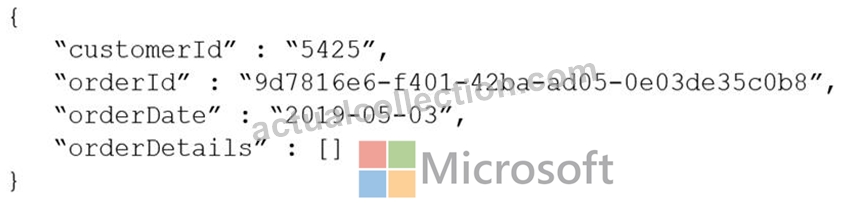
The orderId property is used as the partition key.
For each of the following statements, select Yes if the statement is true. Otherwise, select No.
NOTE: Each correct selection is worth one point.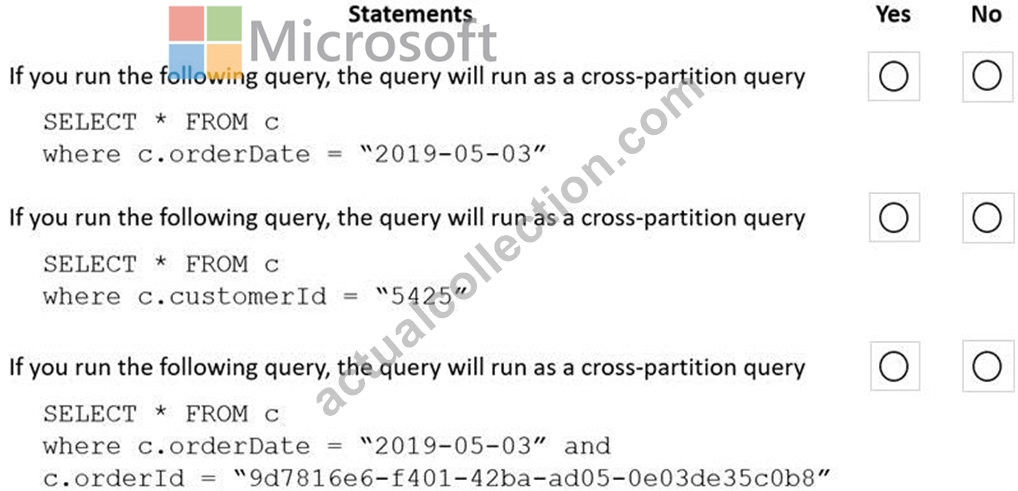
Answer:
Explanation: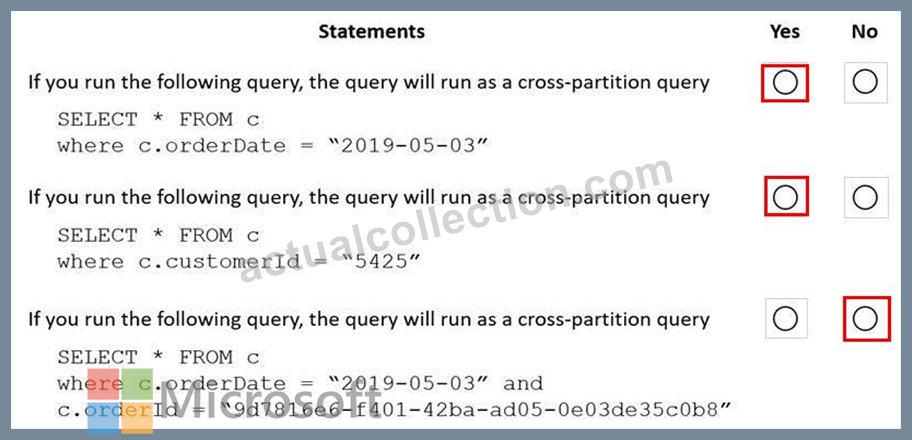
NEW QUESTION # 160
You have a database in an Azure Cosmos DB for NoSQL account that is configured for multi-region writes.
You need to use the Azure Cosmos DB SDK to implement the conflict resolution policy for a container. The solution must ensure that any conflict sent to the conflict feed.
Solution: You set ConfilictResolutionMode to Custom. You Set ResolutionProcedures to a custom stored procedure. You configure the custom stored procedure to use the isTomstone parameter to resolve conflict.
Does this meet the goal?
- A. Yes
- B. No
Answer: A
Explanation:
The solution is incorrect because there is no "isTom" parameter in the Azure Cosmos DB SDK. The correct parameter is "isTombstone".
NEW QUESTION # 161
......
DP-420 Study Guide Realistic Verified Dumps: https://examcollection.actualcollection.com/DP-420-exam-questions.html