

[Dec 01, 2025] Fully Updated PCNSE Dumps - 100% Same Q&A In Your Real Exam
Latest PCNSE Exam Dumps - Valid and Updated Dumps
Palo Alto Networks PCNSE exam is a valuable certification for security engineers who want to demonstrate their expertise in managing and securing networks using the Palo Alto Networks platform. With the increasing importance of network security in today's digital landscape, the PCNSE certification is becoming more and more valuable for professionals looking to advance their careers in the field of cybersecurity.
Palo Alto Networks Certified Security Engineer (PCNSE) certification is a valuable certification for professionals who work with Palo Alto Networks' Next-Generation Firewalls (NGFWs). Palo Alto Networks Certified Network Security Engineer Exam certification exam is a comprehensive test of an individual's knowledge and skills in Palo Alto Networks' PAN-OS 10.0 operating system. Palo Alto Networks Certified Network Security Engineer Exam certification is recognized globally and is highly valued by organizations that use Palo Alto Networks' products and services. The PCNSE certification not only enhances an individual's career prospects but also provides organizations with a benchmark for hiring security professionals.
Palo Alto Networks Certified Security Engineer (PCNSE) certification exam is a highly respected certification within the cybersecurity industry. Palo Alto Networks Certified Network Security Engineer Exam certification validates the skills and knowledge of security engineers who work with Palo Alto Networks security technologies. Candidates must possess a deep understanding of the Palo Alto Networks security platform, including advanced knowledge of firewall configuration, management, and troubleshooting, to successfully pass the exam.
NEW QUESTION # 40
An engineer is troubleshooting a traffic-routing issue.
What is the correct packet-flow sequence?
- A. NAT > Security policy enforcement > OSPF
- B. PBF > Zone Protection Profiles > Packet Buffer Protection
- C. PBF > Static route > Security policy enforcement
- D. BGP < PBF > NAT
Answer: C
Explanation:
https://knowledgebase.paloaltonetworks.com/KCSArticleDetail?id=kA10g000000ClVHCA0 Under Slowpath(session setup stage) PBF, then static routes and then policy enforment.
NEW QUESTION # 41
A company has a pair of Palo Alto Networks firewalls configured as an Acitve/Passive High Availability (HA) pair.
What allows the firewall administrator to determine the last date a failover event occurred?
- A. From the CLI issue use the show System log
- B. Check the status of the High Availability widget on the Dashboard of the GUI
- C. Apply the filter subtype eq ha to the configuration log
- D. Apply the filter subtype eq ha to the System log
Answer: D
NEW QUESTION # 42
Which three split tunnel methods are supported by a GlobalProtect Gateway?
- A. Client Application Process
- B. Destination user/group
- C. URL Category
- D. Destination Domain
- E. video streaming application
- F. Source Domain
Answer: A,D,E
Explanation:
Explanation/Reference:
Reference: https://www.paloaltonetworks.com/documentation/81/pan-os/newfeaturesguide/globalprotect-
features/split-tunnel-for-public-applications
NEW QUESTION # 43
An administrator has been asked to configure a Palo Alto Networks NGFW to provide protection against external hosts attempting to exploit a flaw in an operating system on an internal system.
Which Security Profile type will prevent this attack?
- A. URL Filtering
- B. Anti-Spyware
- C. Vulnerability Protection
- D. Antivirus
Answer: C
NEW QUESTION # 44
An administrator plans to install the Windows-Based User-ID Agent to prevent credential phishing. Which installer package file should the administrator download from the support site?
- A. UaCredlnstall64-11.0.0.msi
- B. GlobalProtect64-6.2.1.msi
- C. Ualnstall-11.0.0msi
- D. Talnstall-11.0.0.msi
Answer: A
NEW QUESTION # 45
Which feature must you configure to prevent users form accidentally submitting their corporate credentials to a phishing website?
- A. Zone Protection profile
- B. Vulnerability Protection profile
- C. Anti-Spyware profile
- D. URL Filtering profile
Answer: D
Explanation:
Reference:
https://www.paloaltonetworks.com/documentation/80/pan-os/pan-os/threat-prevention/prevent-credential-phishin
NEW QUESTION # 46
Match the terms to their corresponding definitions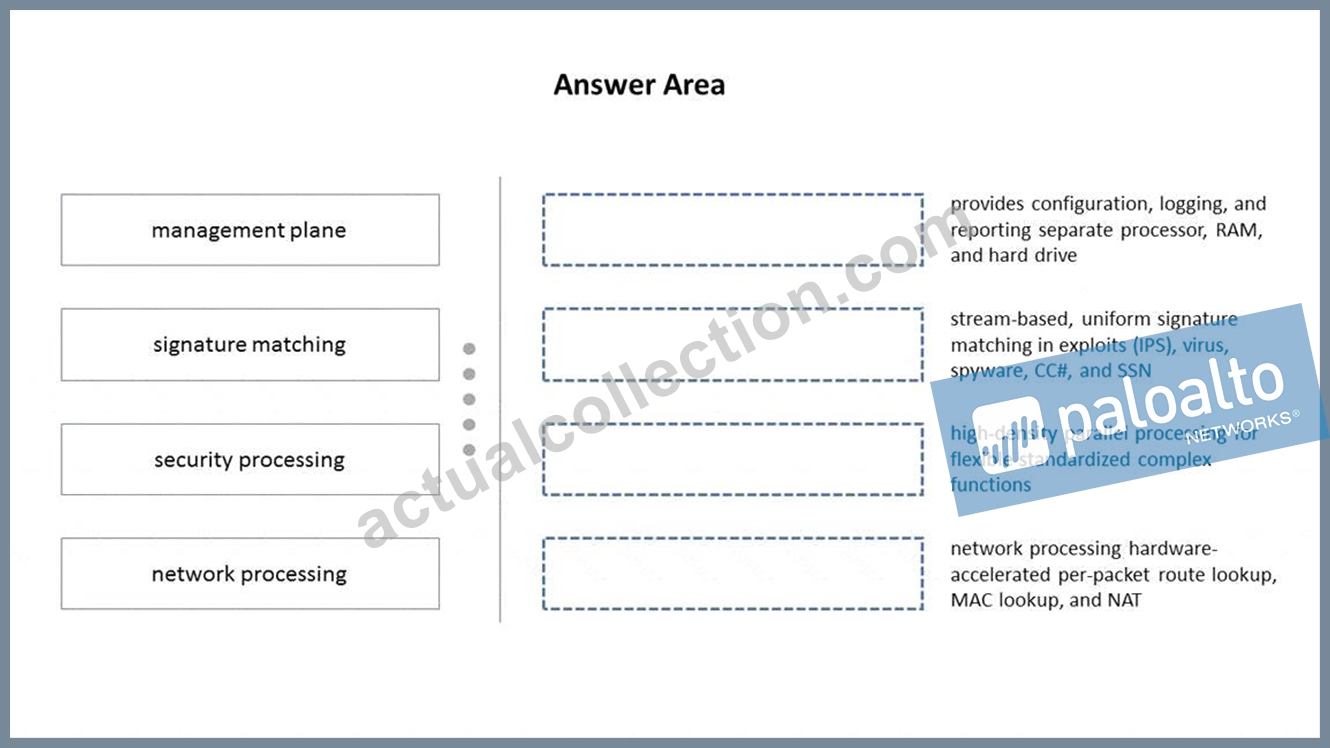
Answer:
Explanation: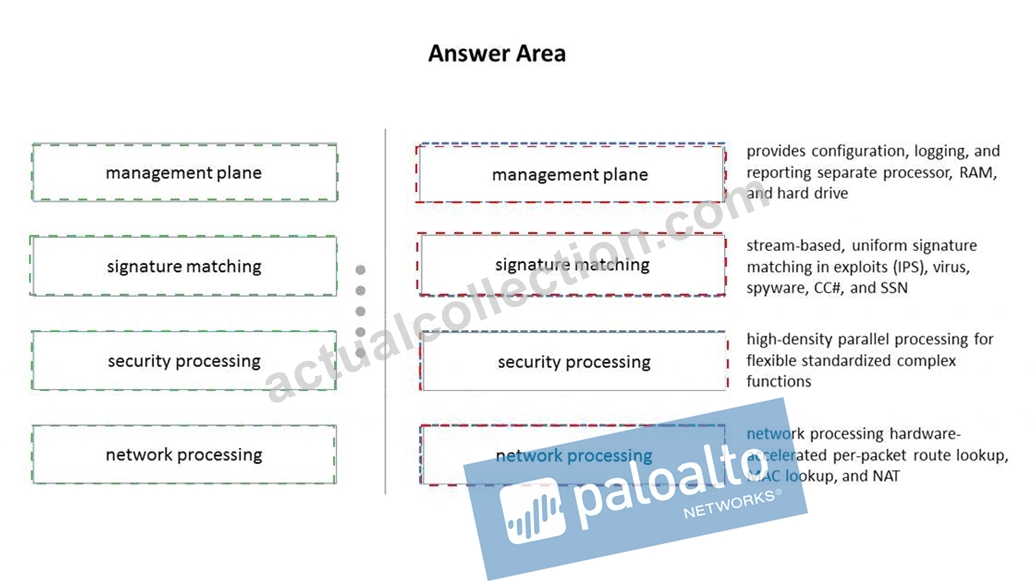
Explanation:
A close-up of a computer screen Description automatically generated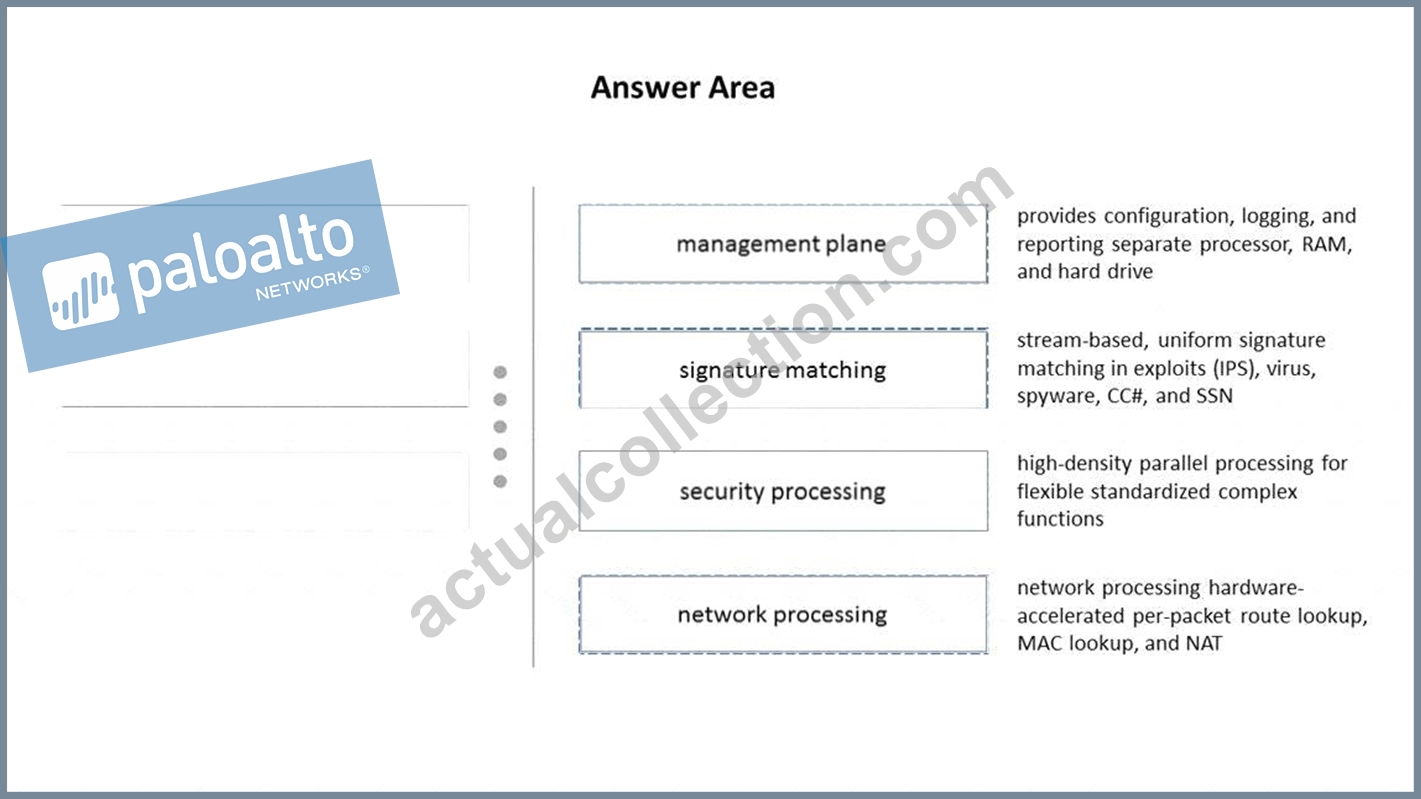
https://www.paloaltonetworks.com/content/dam/pan/en_US/assets/pdf/datasheets/education/pcnse-study-guide.p page 83
NEW QUESTION # 47
Which PAN-OS policy must you configure to force a user to provide additional credentials before he is allowed to access an internal application that contains highly-sensitive business data?
- A. Security policy
- B. Decryption policy
- C. Authentication policy
- D. Application Override policy
Answer: C
NEW QUESTION # 48
A client is deploying a pair of PA-5000 series firewalls using High Availability (HA) in Active/Passive mode.
Which statement is true about this deployment?
- A. The two devices may be different models within the PA-5000 series
- B. The management port may be used for a backup control connection
- C. The HA1 IP address from each peer must be on a different subnet
- D. The two devices must share a routable floating IP address
Answer: B
NEW QUESTION # 49
A client is concerned about resource exhaustion because of denial-of-service attacks against their DNS servers.
Which option will protect the individual servers?
- A. Apply a classified DoS Protection Profile.
- B. Use the DNS App-ID with application-default.
- C. Enable packet buffer protection on the Zone Protection Profile.
- D. Apply an Anti-Spyware Profile with DNS sinkholing.
Answer: A
Explanation:
"Packet Buffer Protection" is indeed an way to protect against resource exhaustion but it is not configured under "DOS Protection Profile". It is directly enabled under ZONES.
NEW QUESTION # 50
View the GlobalProtect configuration screen capture.
What is the purpose of this configuration?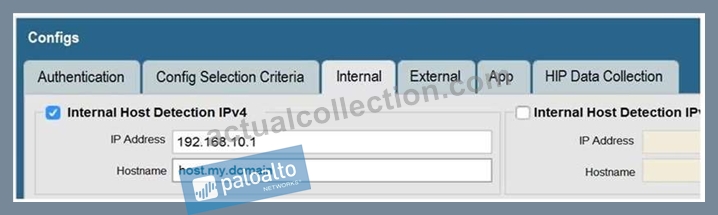
- A. It configures the tunnel address of all internal clients to an IP address range starting at 192.168.10.1.
- B. It forces the firewall to perform a dynamic DNS update, which adds the internal gateway's hostname and IP address to the DNS server.
- C. It forces an internal client to connect to an internal gateway at IP address 192.168.10.1.
- D. It enables a client to perform a reverse DNS lookup on 192.168.10.1 to detect that it is an internal client.
Answer: D
Explanation:
Explanation/Reference: https://www.paloaltonetworks.com/documentation/80/globalprotect/globalprotect-admin-guide/ globalprotect-portals/define-the-globalprotect-client-authentication-configurations/define-the-globalprotect- agent-configurations
NEW QUESTION # 51
Based on the following image,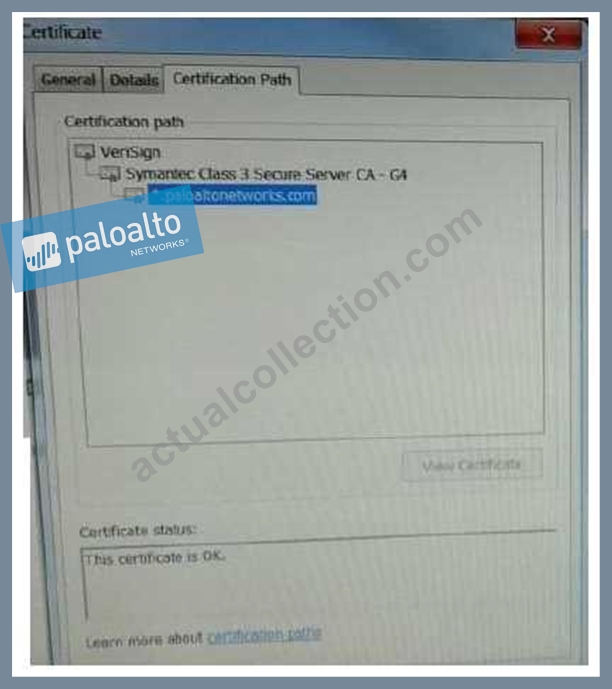
what is the correct path of root, intermediate, and end-user certificate?
- A. VeriSign > Symantec > Palo Alto Networks
- B. VeriSign > Palo Alto Networks > Symantec
- C. Palo Alto Networks > Symantec > VeriSign
- D. Symantec > VeriSign > Palo Alto Networks
Answer: A
NEW QUESTION # 52
An administrator wants to enable zone protection
Before doing so, what must the administrator consider?
- A. Activate a zone protection subscription.
- B. To increase bandwidth no more than one firewall interface should be connected to a zone
- C. The zone protection profile will apply to all interfaces within that zone
- D. Security policy rules do not prevent lateral movement of traffic between zones
Answer: B
NEW QUESTION # 53
An administrator connects four new remote offices to the corporate data center. The administrator decides to use the Large Scale VPN (LSVPN) feature on the Palo Alto Networks next-generation firewall.
What should the administrator configure in order to connect the sites?
- A. SD-WAN
- B. IKE Gateways
- C. GlobalProtect Satellite
- D. Generic Routing Encapsulation (GRE) Tunnels
Answer: C
Explanation:
For remote offices to the corporate data center (Hub and Spoke Topology), we need GlobalProtect Satellite connected to the GP Gateway.
https://docs.paloaltonetworks.com/pan-os/10-1/pan-os-admin/large-scale-vpn-lsvpn
NEW QUESTION # 54
Below are the steps in the workflow for creating a Best Practice Assessment in a firewall and Panorama configuration Place the steps in order.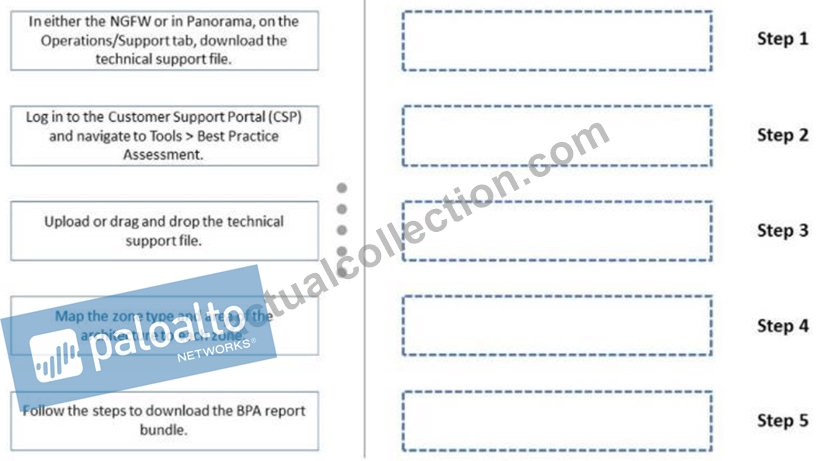
Answer:
Explanation: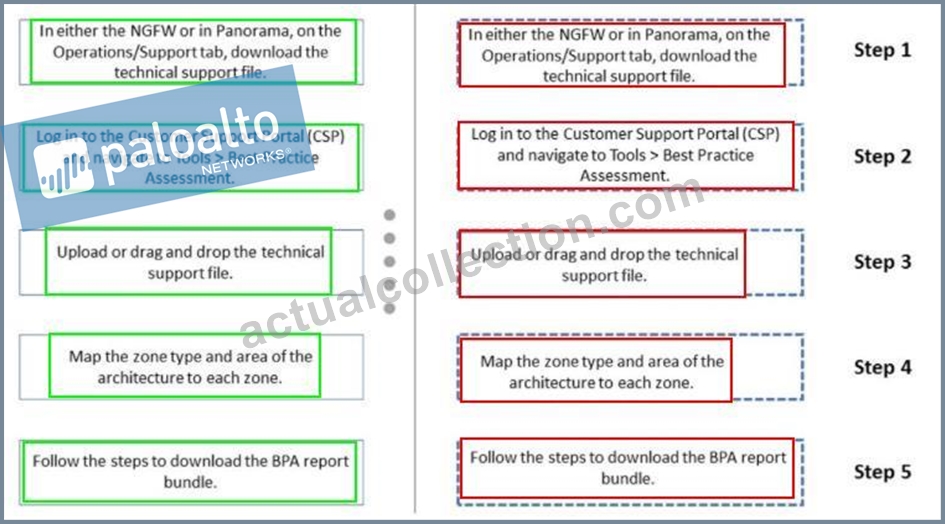
Reference:
https://www.paloaltonetworks.com/resources/videos/how-to-run-a-bpa
NEW QUESTION # 55
Drag and Drop Question
An engineer is troubleshooting traffic routing through the virtual router. The firewall uses multiple routing protocols, and the engineer is trying to determine routing priority Match the default Administrative Distances for each routing protocol.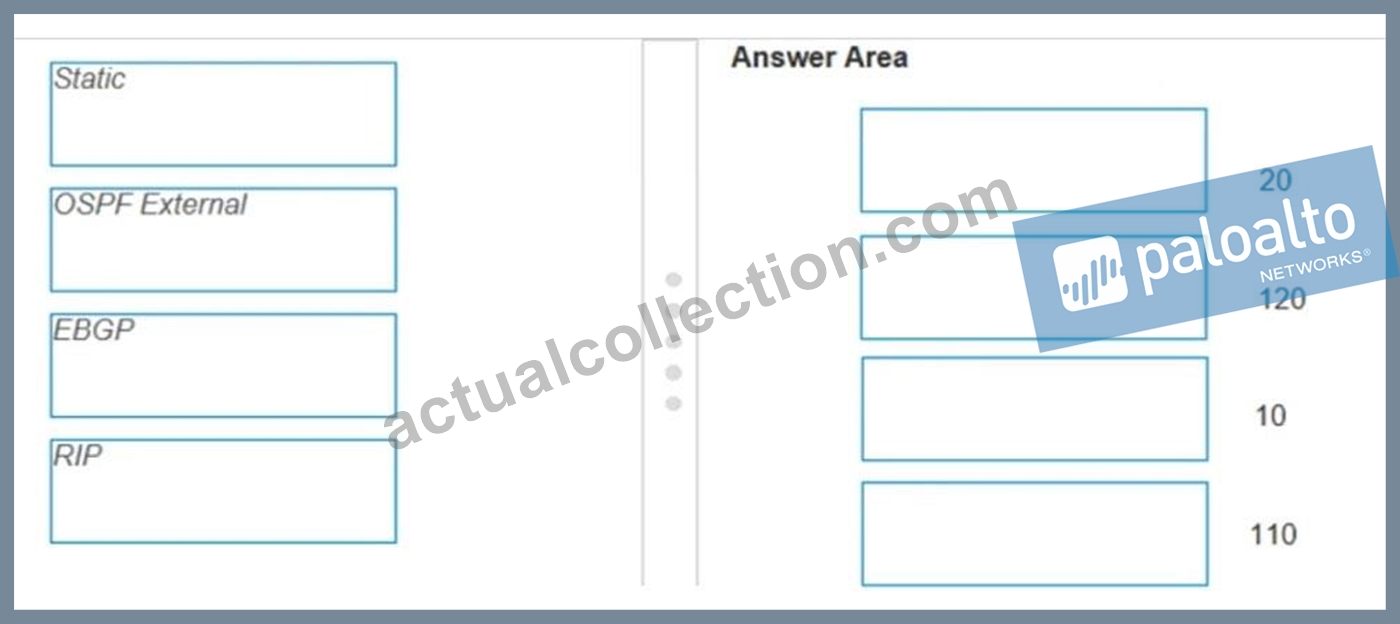
Answer:
Explanation: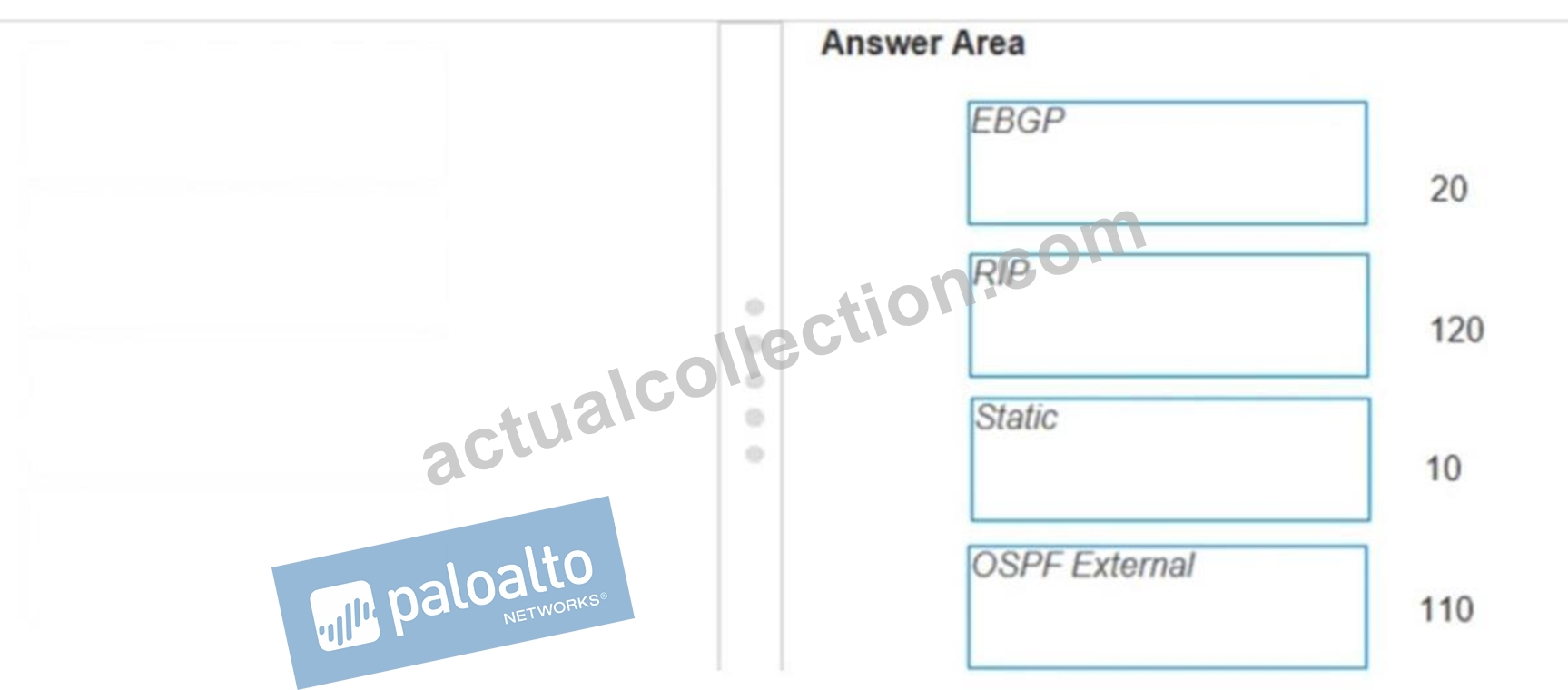
Explanation:
Static - Range is 10-240; default is 10.
OSPF Internal - Range is 10-240; default is 30.
OSPF External - Range is 10-240; default is 110.
IBGP - Range is 10-240; default is 200.
EBGP- Range is 10-240; default is 20.
RIP - Range is 10-240; default is 120.
NEW QUESTION # 56
Refer to Exhibit: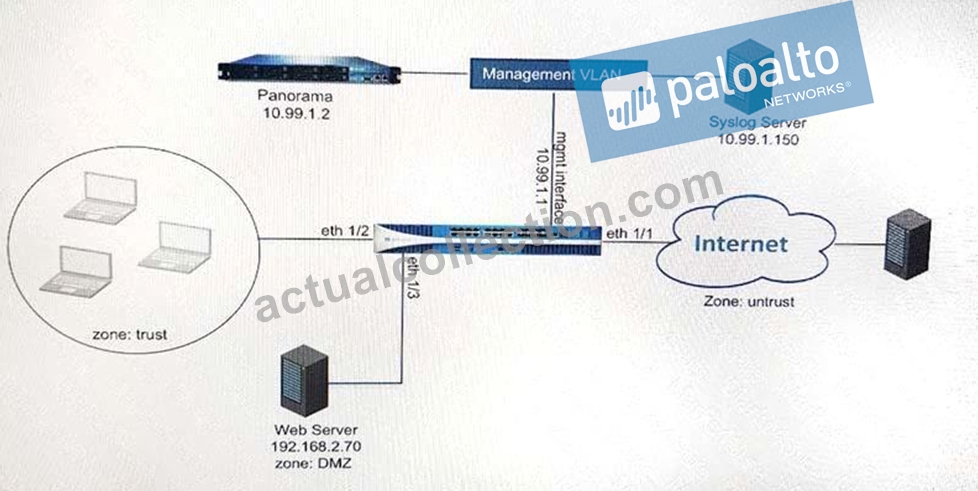
An administrator can not see any Traffic logs from the Palo Alto Networks NGFW in Panorama reports. The configuration problem seems to be on the firewall. Which settings, if configured incorrectly, most likely would stop only Traffic logs from being sent from the NGFW to Panorama?
- A.
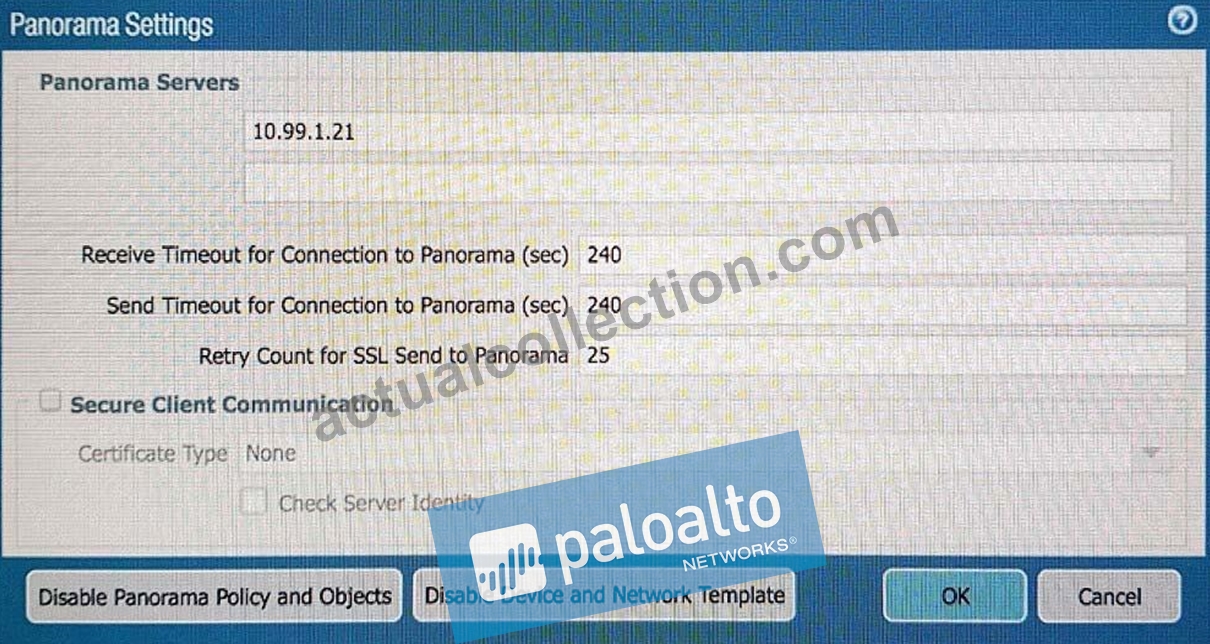
- B.
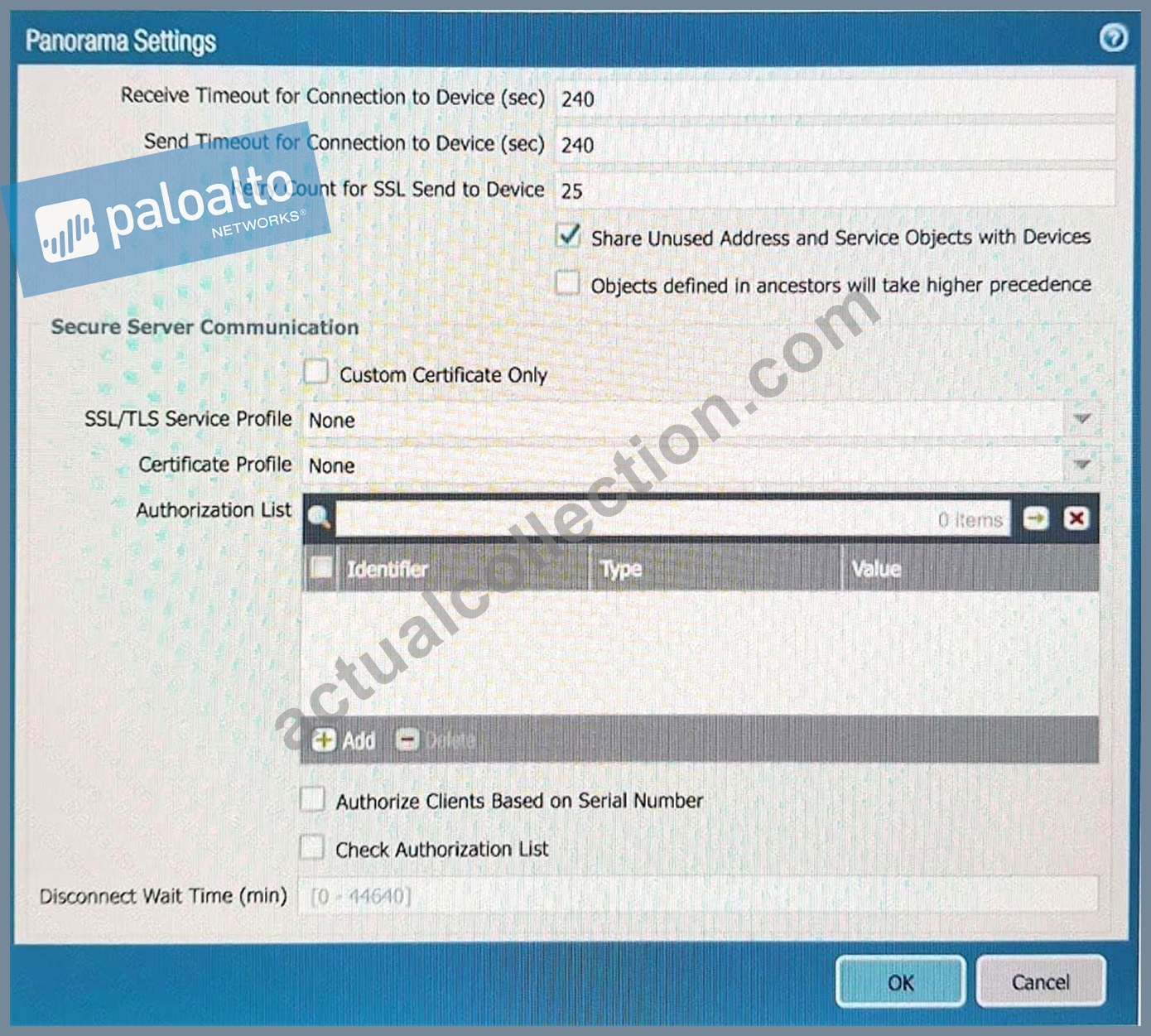
- C.
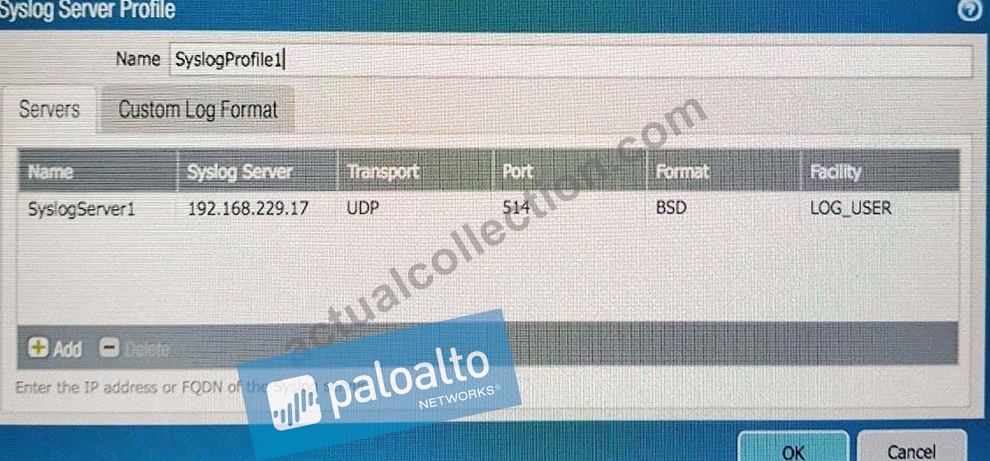
- D.
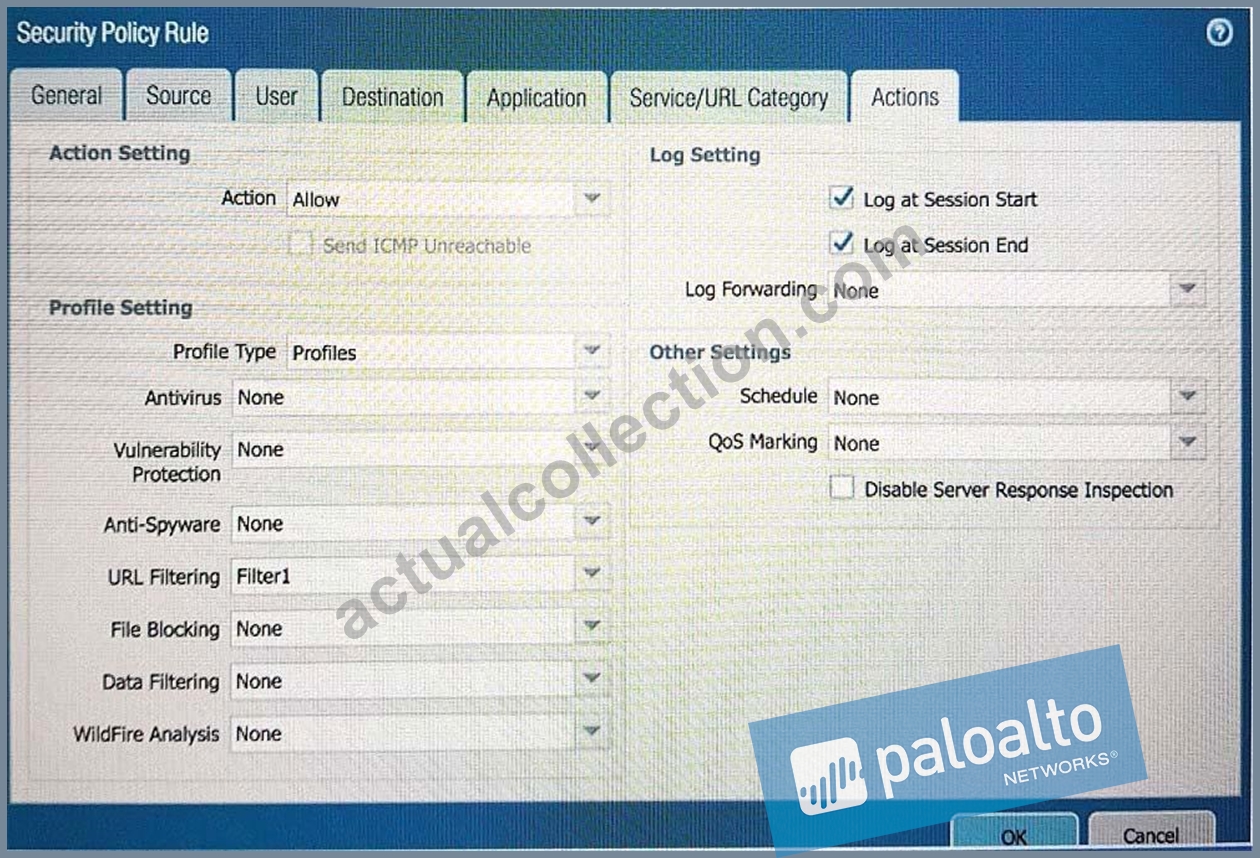
Answer: C
NEW QUESTION # 57
An administrator accidentally closed the commit window/screen before the commit was finished. Which two options could the administrator use to verify the progress or success of that commit task? (Choose two.)
- A. System Logs
- B. Configuration Logs
- C. Traffic Logs
- D. Task Manager
Answer: A,D
Explanation:
1. System Logs: The system logs contain information about various events that occur on the firewall, including the commit process. The administrator can review the system logs to verify whether the commit completed successfully or whether there were any errors or warnings during the commit process.
2. Task Manager: The task manager displays a list of all active tasks on the firewall, including the commit task. The administrator can use the task manager to check the status of the commit task, including whether it is in progress, completed successfully, or failed.
NEW QUESTION # 58
A global corporate office has a large-scale network with only one User-ID agent, which creates a bottleneck near the User-ID agent server. Which solution in PAN-OS software would help in this case?
- A. Redistribution of user mappings
- B. Virtual Wire mode
- C. Content inspection
- D. Application override
Answer: A
Explanation:
A large-scale network can also have numerous firewalls that use the mapping information to enforce policies.
You can reduce the resources that the firewalls and information sources use in the querying process by configuring some firewalls to acquire mapping information through redistribution instead of direct querying.
Redistribution also enables the firewalls to enforce user-based policies when users rely on local sources for authentication (such as regional directory services) but need access to remote services and applications (such as global data center applications).
https://docs.paloaltonetworks.com/pan-os/10-0/pan-os-admin/user-id/deploy-user-id-in-a-large- scale-network.html#id73908ad1-63ee-440b-bb58-859ace1ce34d
NEW QUESTION # 59
......
Free Sales Ending Soon - 100% Valid PCNSE Exam: https://examcollection.actualcollection.com/PCNSE-exam-questions.html