

Aug 09, 2026 Step by Step Guide to Prepare for 300-215 Exam BrainDumps
CyberOps Professional 300-215 Real Exam Questions and Answers FREE Updated on 2026
Cisco 300-215 certification exam is a comprehensive exam that covers a wide range of topics related to conducting forensic analysis and incident response using Cisco technologies. 300-215 exam tests the candidate's knowledge of Cisco security technologies, such as Firepower, Identity Services Engine (ISE), Advanced Malware Protection (AMP), and Stealthwatch. Additionally, the exam also covers topics such as cyber incident response, digital forensics, and network forensics.
Career Prospects
Those individuals who clear the Cisco 300-215 exam along with the core test (350-201 CBRCOR) will earn the Cisco Certified CyberOps Professional certificate. This certification opens up career opportunities in a range of job roles. Some of the positions that the candidates may take up include an Incident Manager, an Information Security Analyst, a Security Architect, a Security Analyst, and a Senior SOC Analyst. The average salary for the certificate holders is $82,000 per annum.
NEW QUESTION # 72
Rotor to the exhibit.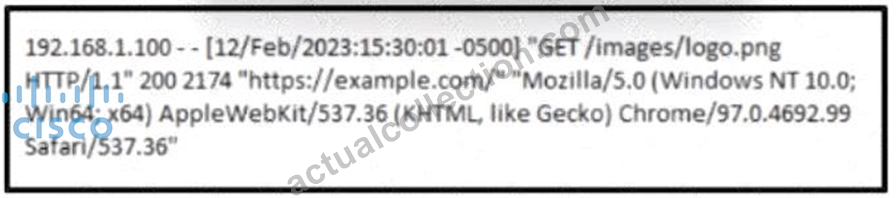
A cybersecurity analyst must analyst the logs from an Apache server for the client. The concern is that an offboarded employee home IP address was potentially used to access the company web server via a still active VPN connection Based on this log entry, what should an analyst conclude?
- A. An employee has accessed a web page on the server
- B. A file was downloaded from the server
- C. An ex employee planted malware on the server
- D. A worker uploaded a file to the server
Answer: A
NEW QUESTION # 73
Refer to the exhibit.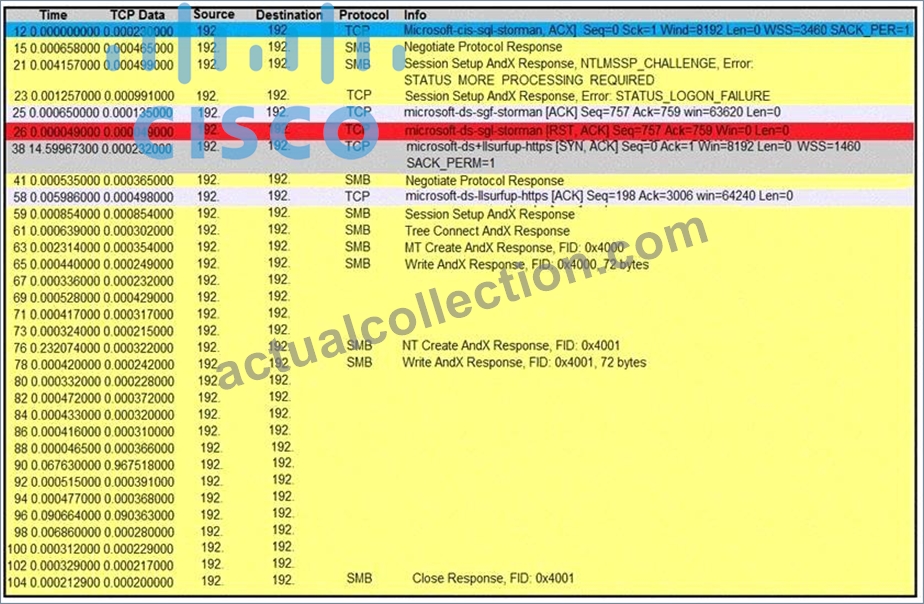
An engineer is analyzing a TCP stream in Wireshark after a suspicious email with a URL. What should be determined about the SMB traffic from this stream?
- A. It is requesting authentication on the user site.
- B. It is exploiting redirect vulnerability
- C. It is sharing access to files and printers.
- D. It is redirecting to a malicious phishing website
Answer: C
Explanation:
The Wireshark output shows SMB protocol transactions, including NT Create AndX Response and Write AndX Response, indicating the transfer of files or objects. SMB (Server Message Block) is a protocol used for file sharing and printer access in Windows networks. The log does not indicate phishing or redirection behavior but rather normal SMB communication such as accessing files or shared resources.
-
NEW QUESTION # 74
A threat actor has successfully attacked an organization and gained access to confidential files on a laptop.
What plan should the organization initiate to contain the attack and prevent it from spreading to other network devices?
- A. root cause
- B. attack surface
- C. incident response
- D. intrusion prevention
Answer: C
Explanation:
Once an incident has occurred, the appropriate course of action is to engage the organization's Incident Response (IR) plan. This is a structured approach to contain, analyze, and eradicate threats before they spread across the network.
The Cisco CyberOps Associate study guide emphasizes:
* "Incident response and handling are essential within an organization... The main objective of implementing an incident handling process is to reduce the impact of a cyber-attack, ensure the damages caused are assessed, and implement recovery procedures".
* In particular, the containment phase of IR is focused on isolating the threat and preventing lateral movement or further compromise.
Options such as "root cause" or "attack surface" are relevant at later stages of analysis and mitigation, not immediate containment. Therefore, the correct answer is C.
NEW QUESTION # 75
Refer to the exhibit.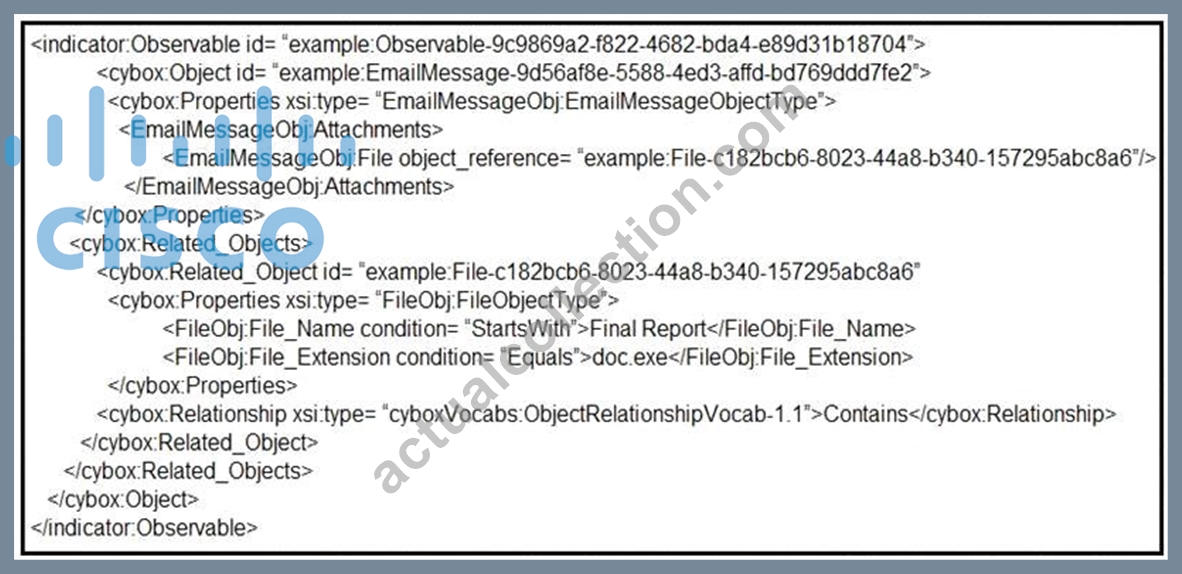
Which determination should be made by a security analyst?
- A. An email was sent with an attachment named "Final Report.doc".
- B. An email was sent with an attachment named "Final Report.doc.exe".
- C. An email was sent with an attachment named "Grades.doc.exe".
- D. An email was sent with an attachment named "Grades.doc".
Answer: B
Explanation:
The XML structure shows that:
* The file name starts with: "Final Report"
* The file extension equals: "doc.exe"
Together, this forms "Final Report.doc.exe" - a known double-extension technique used to disguise executables as benign documents. This is a red flag in email forensics, commonly linked to malware distribution, and explicitly covered in the Cisco CyberOps study material as a typical evasion method for malicious attachments.
NEW QUESTION # 76
Which technique exemplifies an antiforensic technique?
- A. stepheorology
- B. steganalysis
- C. steganography
- D. data replication
Answer: C
NEW QUESTION # 77
During a routine security audit, an organization's security team detects an unusual spike in network traffic originating from one of their internal servers. Upon further investigation, the team discovered that the server was communicating with an external IP address known for hosting malicious content. The security team suspects that the server may have been compromised. As the incident response process begins, which two actions should be taken during the initial assessment phase of this incident? (Choose two.)
- A. Disconnect the compromised server from the network.
- B. Review the organization's network logs for any signs of intrusion.
- C. Notify law enforcement agencies about the incident.
- D. Interview employees who have access to the server.
- E. Conduct a comprehensive forensic analysis of the server hard drive.
Answer: A,B
Explanation:
During the initial phase of incident response, the two key actions are:
* Disconnecting the server (B) to contain the threat and prevent lateral movement or further exfiltration.
* Reviewing network logs (E) to understand the timeline and scope of the attack.
These are emphasized in the containment and detection stages of the incident response lifecycle outlined in NIST 800-61 and covered in the Cisco CyberOps training.
-
NEW QUESTION # 78
Refer to the exhibit.
What is occurring within the exhibit?
- A. Host 209.141.51.196 redirects the client request from /Lk9tdZ to /files/1.bin.
- B. Source 10.1.21.101 is communicating with 209.141.51.196 over an encrypted channel.
- C. Source 10.1.21.101 sends HTTP requests with the size of 302 kb.
- D. Host 209.141.51.196 redirects the client request to port 49723.
Answer: A
Explanation:
The Wireshark capture shows a series of HTTP requests and responses:
* The client (10.1.21.101) sends a GET request for/Lk9tdZ.
* The server (209.141.51.196) responds withHTTP/1.1 302 Found, which is a standard HTTP status code indicating a redirection.
* The subsequent GET request from the client is for/files/1.bin, which indicates it followed the redirect.
This behavior confirms that the server is issuing an HTTP 302 redirect from the initial request path/Lk9tdZto
/files/1.bin. This is often observed in malware command-and-control behavior or file download staging.
* Option A is incorrect: 302 is a status code, not a data size.
* Option C is incorrect: port 49723 is a source/destination ephemeral port, not a redirect target.
* Option D is incorrect: communication is over HTTP, not HTTPS (which would indicate encryption).
Reference:CyberOps Technologies (CBRFIR) 300-215 study guide, Chapter on Network Traffic Analysis and HTTP Status Code Interpretation.
NEW QUESTION # 79
An organization experienced a sophisticated phishing attack that resulted in the compromise of confidential information from thousands of user accounts. The threat actor used a land and expand approach, where initially accessed account was used to spread emails further. The organization's cybersecurity team must conduct an in-depth root cause analysis to uncover the central factor or factors responsible for the success of the phishing attack. The very first victim of the attack was user with email [email protected]. The primary objective is to formulate effective strategies for preventing similar incidents in the future. What should the cybersecurity engineer prioritize in the root cause analysis report to demonstrate the underlying cause of the incident?
- A. examination of the organization's network traffic logs to identify patterns of unusual behavior leading up to the attack
- B. comprehensive analysis of the initial user for presence of an insider who gained monetary value by allowing the attack to happen
- C. evaluation of the organization's incident response procedures and the performance of the incident response team
- D. investigation into the specific vulnerabilities or weaknesses in the organization's email security systems that were exploited by the attackers
Answer: D
Explanation:
In phishing incidents, especially with successful lateral movement (land and expand), the most critical factor is usuallyweaknesses in email security systems-such as lack of advanced phishing detection, weak DMARC/DKIM/SPF policies, or insufficient user behavior monitoring. To prevent recurrence, the root cause analysis must focus on what allowed the phishing email to bypass defenses and how initial credentials were compromised.
This aligns with best practices from the Cisco CyberOps v1.2 Guide underEmail Threat Vectors and Security Control Weaknesses.
Reference:CyberOps Technologies (CBRFIR) 300-215 study guide, Chapter on Threat Analysis and Root Cause Reporting.
Let me know if you'd like the next batch of questions formatted and verified in the same way.
NEW QUESTION # 80
Refer to the exhibit.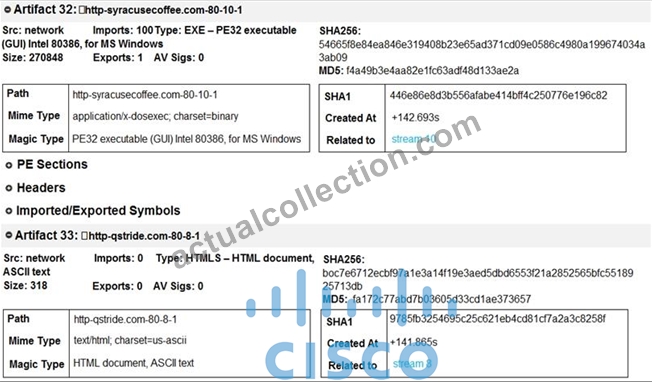
What do these artifacts indicate?
- A. A forged DNS request is forwarding users to malicious websites.
- B. The MD5 of a file is identified as a virus and is being blocked.
- C. A malicious file is redirecting users to different domains.
- D. An executable file is requesting an application download.
Answer: C
Explanation:
From the exhibit, the first artifact (PE32 executable fromsyracusecoffee.com) and the second artifact (HTML fromqstride.com) suggest astaged malware deliverymethod. The executable and the HTML file are linked to different domains, often indicating redirection or multi-stage infection strategies, which is common in phishing or malvertising campaigns.
The Cisco guide explains this tactic as:"One file may appear benign but can initiate downloads or connections to external resources to fetch additional payloads or redirect users". This pattern of domain redirection strongly supportsOption B.
NEW QUESTION # 81
An organization uses a Windows 7 workstation for access tracking in one of their physical data centers on which a guard documents entrance/exit activities of all personnel. A server shut down unexpectedly in this data center, and a security specialist is analyzing the case. Initial checks show that the previous two days of entrance/exit logs are missing, and the guard is confident that the logs were entered on the workstation. Where should the security specialist look next to continue investigating this case?
- A. HKEY_CURRENT_USER\Software\Classes\Winlog
- B. HKEY_LOCAL_MACHINES\SOFTWARE\Microsoft\WindowsNT\CurrentUser
- C. HKEY_LOCAL_MACHINE\SOFTWARE\Microsoft\WindowsNT\CurrentVersion\Winlogon
- D. HKEY_LOCAL_MACHINE\SOFTWARE\Microsoft\WindowsNT\CurrentVersion\ProfileList
Answer: C
NEW QUESTION # 82
A security team received reports of users receiving emails linked to external or unknown URLs that are non- returnable and non-deliverable. The ISP also reported a 500% increase in the amount of ingress and egress email traffic received. After detecting the problem, the security team moves to the recovery phase in their incident response plan. Which two actions should be taken in the recovery phase of this incident? (Choose two.)
- A. collect logs
- B. verify the breadth of the attack
- C. request packet capture
- D. remove vulnerabilities
- E. scan hosts with updated signatures
Answer: D,E
Explanation:
In therecovery phase, the goal is to restore affected systems to normal operations and ensure the threat has been completely eradicated. According to the CyberOps Associate guide:
"This phase may include restoring data from clean backups, replacing compromised systems, and the re- installation of the Operating System (OS) and applications".
Also:
"During recovery, scanning hosts with updated antivirus and removing vulnerabilities ensures systems do not get reinfected".
NEW QUESTION # 83
Refer to the exhibit.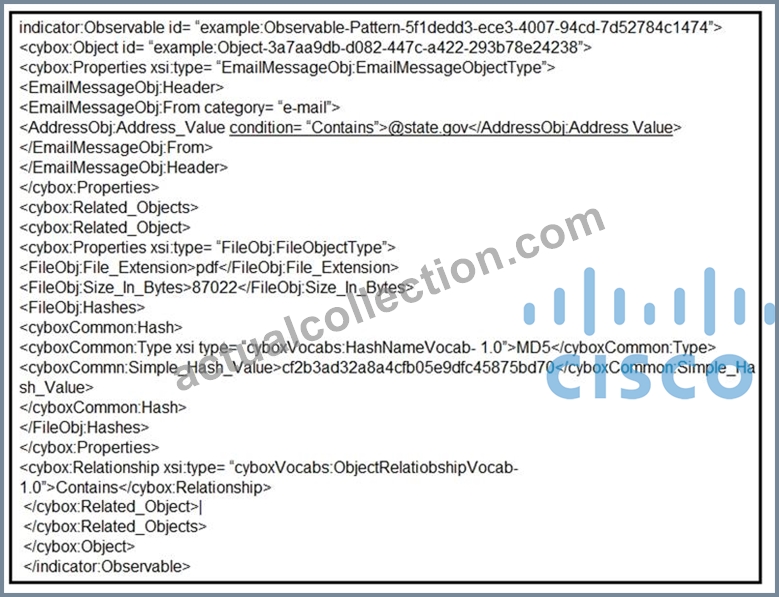
Which two actions should be taken as a result of this information? (Choose two.)
- A. Block emails sent from [email protected] with an attached pdf file with md5 hash
"cf2b3ad32a8a4cfb05e9dfc45875bd70". - B. Block all emails sent from an @state.gov address.
- C. Update the AV to block any file with hash "cf2b3ad32a8a4cfb05e9dfc45875bd70".
- D. Block all emails with subject containing "cf2b3ad32a8a4cfb05e9dfc45875bd70".
- E. Block all emails with pdf attachments.
Answer: A,C
Explanation:
The XML (STIX/CybOX format) details anemail-based threatindicator. Specifically:
* Theemail addresscontains "@state.gov" (not exact match, so blocking all @state.gov would be overbroad).
* Theattachment is a PDFfile with a specifiedMD5 hash: cf2b3ad32a8a4cfb05e9dfc45875bd70.
* Theattachment sizeis 87022 bytes.
From a threat mitigation perspective:
* Ais correct: Updating AV to block or flag files matching the malicious hash is a standard response.
* Dis correct: The email address context and hash together provide a precise rule for blocking-this prevents false positives.
Incorrect options:
* Boverreaches by blocking an entire domain without confirming threat context.
* Cwould stop all PDFs, which is impractical.
* Eis incorrect; there is no indication that the hash appears in the subject line.
NEW QUESTION # 84
Refer to the exhibit.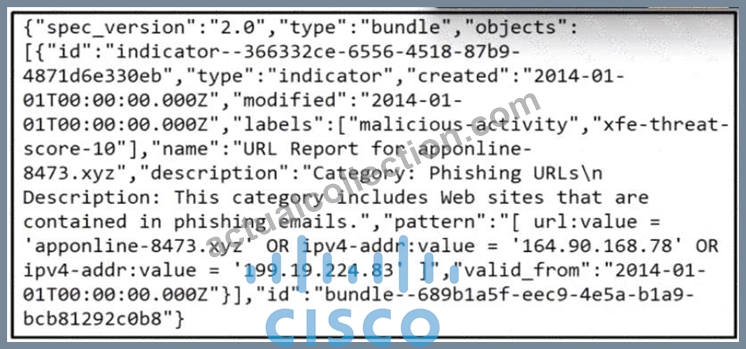
Which two actions should be taken as a result of this information? (Choose two.)
- A. Block any access to and from domain apponline-8473.xyz.
- B. Block all emails sent from malicious domain apponline-8473.xyz.
- C. Block any URLs in received emails.
- D. Blacklist IPs 164.90.168.78 and 199.19.224.83.
- E. Block any malicious activity with xfe-threat-score-10.
Answer: A,D
Explanation:
Comprehensive and Detailed Explanation:
The exhibit contains STIX (Structured Threat Information Expression) formatted threat intelligence indicating:
* A phishing indicator related to the domain: apponline-8473.xyz
* Associated malicious IP addresses: 164.90.168.78 and 199.19.224.83
* Labelled as "malicious-activity" with "xfe-threat-score-10"
Based on this:
* Option B is correct: The IP addresses explicitly listed in the pattern field should be blacklisted to prevent command-and-control or malicious connections.
* Option C is correct: The domain apponline-8473.xyz is also listed and flagged as involved in phishing, so DNS and firewall rules should block access to and from this domain.
Options A and E are too broad or speculative; the data specifies a specific domain, not a generic block on all emails or URLs. Option D refers to a label used for classification and not a directly actionable item.
Therefore, the correct answers are: B and C.
NEW QUESTION # 85
Refer to the exhibit.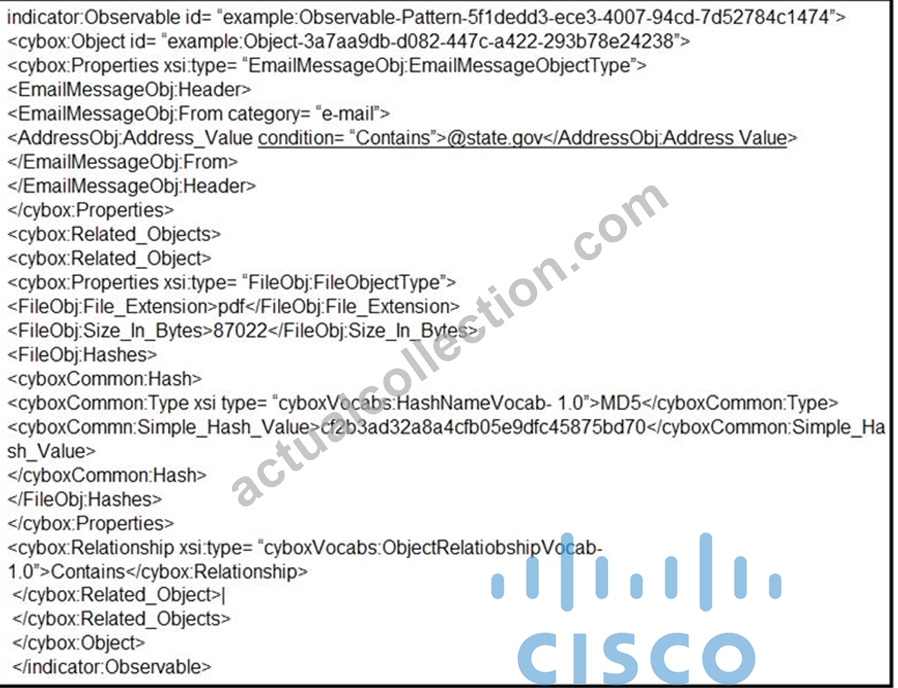
Which two actions should be taken as a result of this information? (Choose two.)
- A. Block all emails sent from an @state.gov address.
- B. Update the AV to block any file with hash "cf2b3ad32a8a4cfb05e9dfc45875bd70".
- C. Block emails sent from [email protected] with an attached pdf file with md5 hash "cf2b3ad32a8a4cfb05e9dfc45875bd70".
- D. Block all emails with subject containing "cf2b3ad32a8a4cfb05e9dfc45875bd70".
- E. Block all emails with pdf attachments.
Answer: A,B
NEW QUESTION # 86
Drag and drop the steps from the left into the order to perform forensics analysis of infrastructure networks on the right.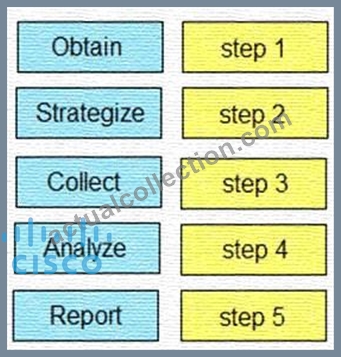
Answer:
Explanation: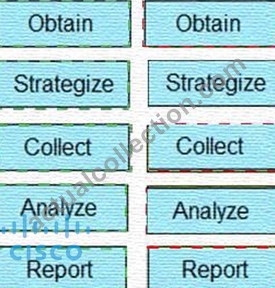
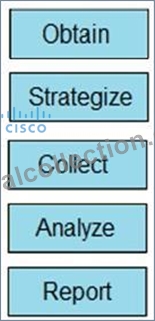
Reference: https://subscription.packtpub.com/book/networking_and_servers/9781789344523/1/ ch01lvl1sec12
/network-forensics-investigation-methodology
NEW QUESTION # 87
Refer to the exhibit.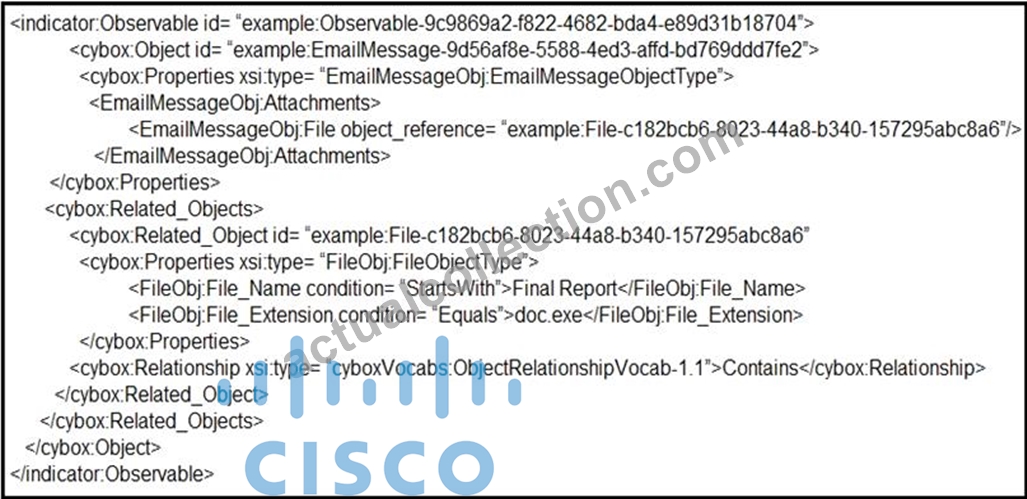
Which determination should be made by a security analyst?
- A. An email was sent with an attachment named "Final Report.doc".
- B. An email was sent with an attachment named "Final Report.doc.exe".
- C. An email was sent with an attachment named "Grades.doc.exe".
- D. An email was sent with an attachment named "Grades.doc".
Answer: B
NEW QUESTION # 88
What is the steganography anti-forensics technique?
- A. hiding a section of a malicious file in unused areas of a file
- B. concealing malicious files in ordinary or unsuspecting places
- C. changing the file header of a malicious file to another file type
- D. sending malicious files over a public network by encapsulation
Answer: B
NEW QUESTION # 89
A new zero-day vulnerability is discovered in the web application. Vulnerability does not require physical access and can be exploited remotely. Attackers are exploiting the new vulnerability by submitting a form with malicious content that grants them access to the server. After exploitation, attackers delete the log files to hide traces. Which two actions should the security engineer take next? (Choose two.)
- A. Install antivirus.
- B. Block connections on port 443.
- C. Update web application to the latest version.
- D. Validate input upon submission.
- E. Enable file integrity monitoring.
Answer: D,E
Explanation:
* Input validation (A) is a critical countermeasure to defend against command injection and related vulnerabilities, as discussed in the Cisco guide. Proper validation ensures that malicious commands or payloads are not accepted or executed by the web application.
* File integrity monitoring (E) helps detect unauthorized changes such as log deletion or binary modification, making it a crucial tool in recognizing and investigating tampering attempts.Blocking port
443 (B) would disable HTTPS and is not a practical solution. Antivirus (C) does not prevent form- based application attacks, and merely updating the application (D) may not be sufficient without addressing the underlying input validation flaw.
-
NEW QUESTION # 90
......
Ultimate Guide to Prepare 300-215 Certification Exam for CyberOps Professional: https://examcollection.actualcollection.com/300-215-exam-questions.html